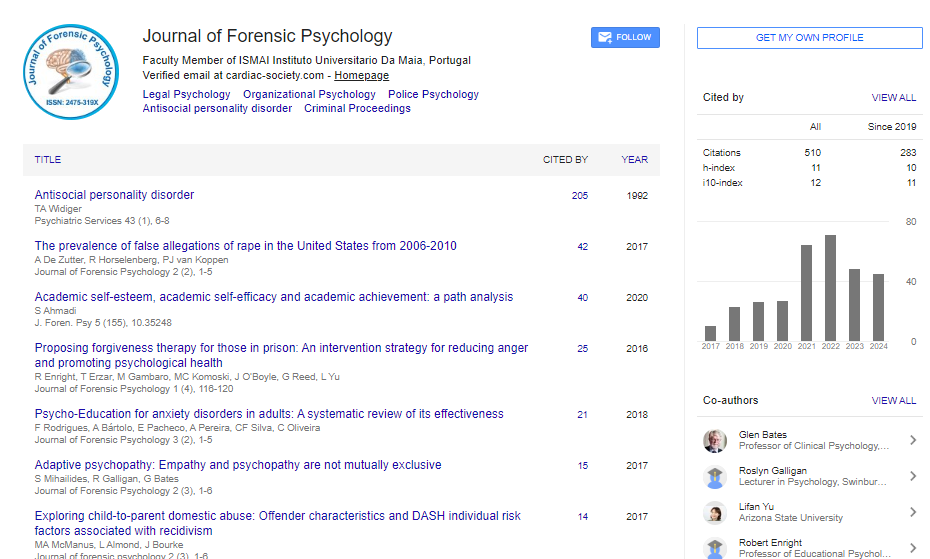
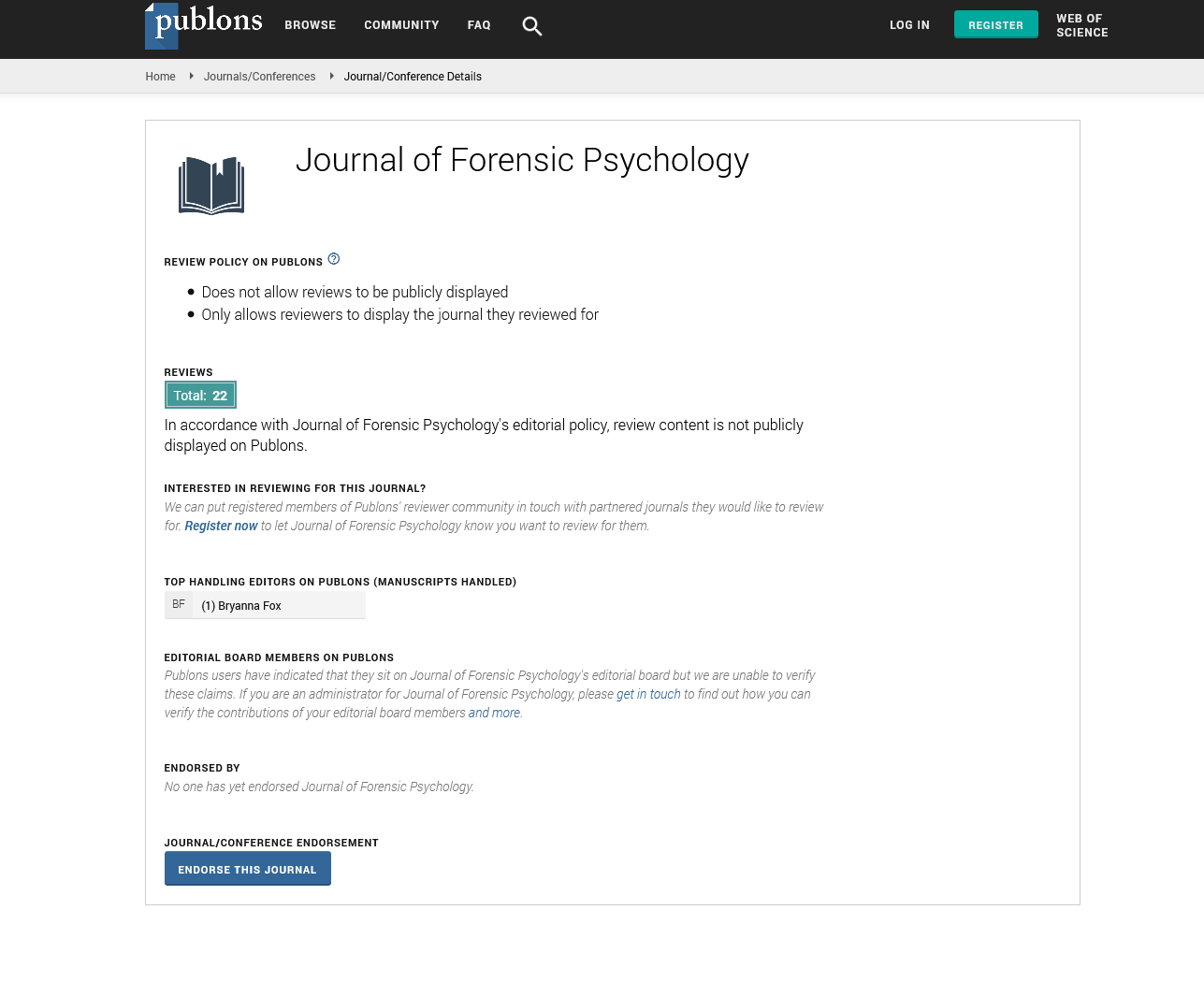

Indexed In
- RefSeek
- Hamdard University
- EBSCO A-Z
- Publons
- Geneva Foundation for Medical Education and Research
- Euro Pub
- Google Scholar
Useful Links
Share This Page
Journal Flyer

Open Access Journals
- Agri and Aquaculture
- Biochemistry
- Bioinformatics & Systems Biology
- Business & Management
- Chemistry
- Clinical Sciences
- Engineering
- Food & Nutrition
- General Science
- Genetics & Molecular Biology
- Immunology & Microbiology
- Medical Sciences
- Neuroscience & Psychology
- Nursing & Health Care
- Pharmaceutical Sciences
Healthcare Providers Perceptions and Experiences Regarding the Effectiveness of WHO's mhGAP-IG SUD-Module in Primary Care: Insights from Focus Group Discussion
12th International Conference on Mental Health and Psychiatry
June 18, 2026 | Webinar
Ishrat Yousaf
Capital University of Science and Technology, Pakistan
Scientific Tracks Abstracts: J Foren Psy
Abstract:
Background: Empowering primary healthcare providers (PHCPs) in the assessment and management of individuals with substance use disorders (SUDs) is crucial to reduce global burden of disease treatment. Task-sharing approaches such as WHO’s mhGAP-IG overcome treatment barriers; including excessive workload, shortage of trained healthcare providers and limited financial resources. In this context, the present study explored perceptions and experiences of healthcare providers regarding the effectiveness, relevance, comprehensiveness and usability of the mhGAP-IG SUD module in their routine clinical practice
Method: A qualitative study was conducted using purposive sampling. Three focus group discussions (FGDs) were conducted using semi-structured interviews, with 23 participants in three cities of Pakistan, including mental health professional (N=9), primary care physicians (N=8) and social workers (N=6). All FGDs were audio-recorded and transcribed verbatim. Data was analysed using thematic analysis.
Results: Three major themes emerged: 1) current practices in SUDs management, 2) integration of mhGAP-IG and future use, 3) Training and implementation. Most participants reported positive perception regarding relevance, comprehensiveness and usability of mhGAP-IG SUD module for improving care for individuals with SUDs. Participants further emphasized that the structured approach of the guide will aid to bring uniformity in clinical practice and contribute in reducing treatment-gap in SUDs care delivery.
Conclusion: The present study highlights the importance of mhGAP-IG-SUD module’s integration into Pakistani primary care settings.
Biography :
Ishrat Yousaf has expertise in Applied and Clinical Psychology, teaching, research, psychological assessment, and evidence-based interventions, including CBT. Her work focuses on children, adolescents, individuals with neurodevelopmental disorders, and high-risk populations. She is a member of the American Psychological Association and presented at national/ international conferences. She has been awarded for several research grants as a PI and Co-PI on competitive merit from HEC Pakistan, and work on collaborative research projects on HIV/AIDS and mental health; developing & contextualizing an e-health intervention for improving care for youth with SUDs; and developed an indigenous intervention lowering depression and anxiety as a Co-PI in funded project. She has published articles in peer-reviewed international journals. She has been awarded for multiple scholarships such as: the developing country scholarship in 74th International Congress of Psychology, Japan. Her research focuses on prevention, assessment, and interventions to support evidence-based strategies for improving mental health and wellbeing.a