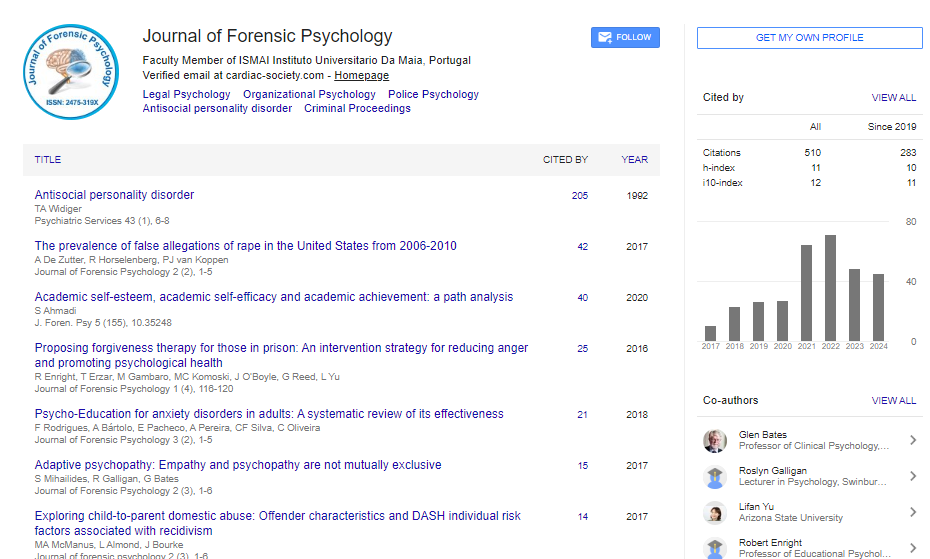


Indexed In
- RefSeek
- Hamdard University
- EBSCO A-Z
- Publons
- Geneva Foundation for Medical Education and Research
- Euro Pub
- Google Scholar
Useful Links
Share This Page
Journal Flyer

Open Access Journals
- Agri and Aquaculture
- Biochemistry
- Bioinformatics & Systems Biology
- Business & Management
- Chemistry
- Clinical Sciences
- Engineering
- Food & Nutrition
- General Science
- Genetics & Molecular Biology
- Immunology & Microbiology
- Medical Sciences
- Neuroscience & Psychology
- Nursing & Health Care
- Pharmaceutical Sciences
Policy Partners: Preferences and Experiences of Women with HIV and Mental Health Conditions Regarding NHI Communication
12th International Conference on Mental Health and Psychiatry
June 18, 2026 | Webinar
Shehani Perera
South African Medical Research Council, South Africa
Scientific Tracks Abstracts: J Foren Psy
Abstract:
Statement of the Problem: Women living with HIV and co-occurring mental health conditions face intersecting vulnerabilities that shape their access to and engagement with healthcare. As South Africa advances National Health Insurance (NHI) implementation, evidence remains scarce on how this marginalised group experiences services and engages with health policy processes. This study examines healthcare experiences and policy engagement preferences to inform inclusive, equity-oriented health system design.
Methodology: We conducted a qualitative study with 13 women living with HIV and co-occurring mental health conditions in the Western Cape, South Africa. Data collection occurred between Feb-March 2026. Participants were recruited from two NGOs: Emthonjeni (n=4) and Triangle Project (n=9). Data were collected through in-depth semi structured interviews exploring care experiences, service integration, and NHI awareness. Transcripts and fieldnotes were analysed using thematic analysis. Findings Three interrelated operational barriers undermined service access: prolonged waiting times, inconsistent medication availability, and unprofessional conduct by healthcare workers. These barriers compounded one another, extended waits frequently preceded dismissive interactions, transforming episodic service failures into chronic care disengagement, particularly for women managing two overlapping conditions. Participants also described pervasive stigma and dismissal within healthcare settings. These experiences were not merely interpersonal but institutional in nature: eroding trust, discouraging care-seeking, and effectively excluding women from the systems designed to support them. NHI awareness was extremely low. However, participants expressed strong motivation to learn about NHI and understand its implications for their care. This gap between low awareness and high engagement motivation represents an actionable opportunity for targeted policy communication. Preferred mechanisms included community-based consultations, simplified materials in accessible formats, and ongoing feedback channels, reflecting a demand for structured, reciprocal dialogue rather than one-way information dissemination.
Conclusion: Findings reveal persistent gaps in HIV and mental health service integration and limited inclusion of affected populations in NHI policy processes. As South Africa implements NHI, embedding structured community engagement mechanisms is essential to achieving equitable, patient-centred care. Incorporating the lived experiences of groups such as those represented by Emthonjeni and Triangle Project into policy design will strengthen health system responsiveness and improve outcomes for women navigating the dual burden of HIV and mental illness.
Biography :
Shehani Perera is a postdoctoral researcher in the Health Systems Research Unit, South African Medical Research Council. She currently works on evaluating the ‘Evidence2Decision’ collaboration which aims to ensure effective, evidence-based decision-making regarding the shift to Universal Health Coverage in South Africa. She is also a Clinical Social Worker in private practice and cares deeply about providing mental healthcare services, particularly for the treatment of depression, anxiety and trauma related conditions. She works with individuals, couples and families and is specialized in Mindfulness-Based Cognitive Therapy.