
Indexed In
- Academic Keys
- ResearchBible
- CiteFactor
- Access to Global Online Research in Agriculture (AGORA)
- RefSeek
- Hamdard University
- EBSCO A-Z
- OCLC- WorldCat
- Publons
- Euro Pub
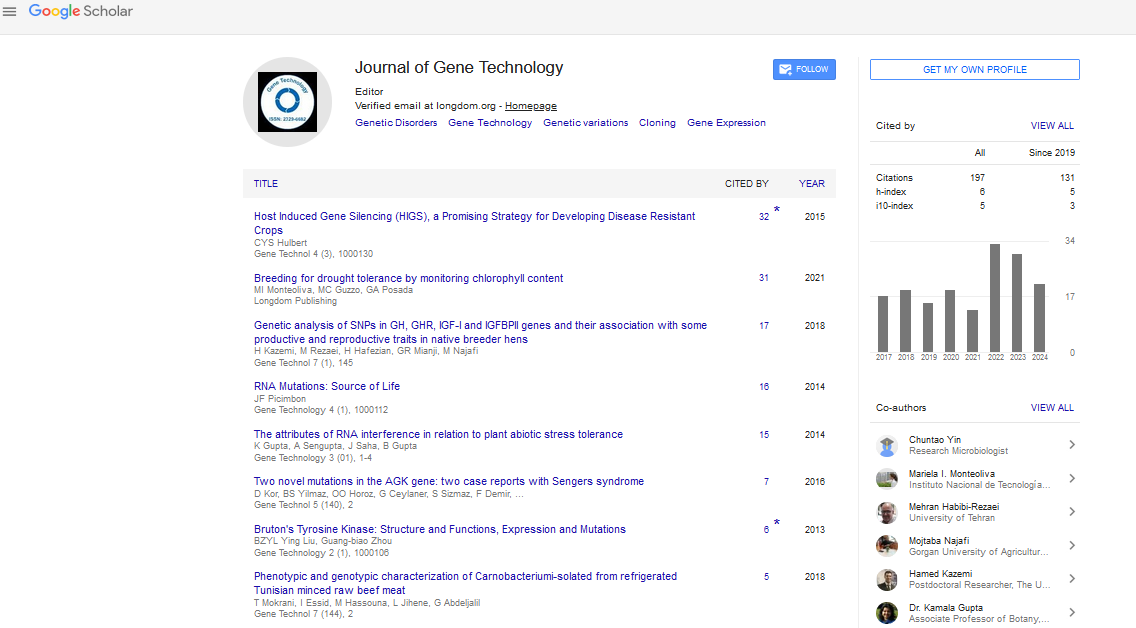
- Google Scholar
Useful Links
Share This Page
Journal Flyer
Open Access Journals
- Agri and Aquaculture
- Biochemistry
- Bioinformatics & Systems Biology
- Business & Management
- Chemistry
- Clinical Sciences
- Engineering
- Food & Nutrition
- General Science
- Genetics & Molecular Biology
- Immunology & Microbiology
- Medical Sciences
- Neuroscience & Psychology
- Nursing & Health Care
- Pharmaceutical Sciences
Opinion Article - (2026) Volume 15, Issue 2
Unlocking the Secrets Hidden in Our Genes Through Advanced Biotechnology
Mauro Zanellato*Received: 25-May-2026, Manuscript No. RDT-26-31808; Editor assigned: 27-May-2026, Pre QC No. RDT-26-31808 (PQ); Reviewed: 10-Jun-2026, QC No. RDT-26-31808; Revised: 17-Jun-2026, Manuscript No. RDT-26-31808 (R); Published: 24-Jun-2026, DOI: 10.35248/2332-2519.26.15.359
Abstract
Description
Advanced biotechnology is now allowing scientists to decode, interpret and even modify this genetic information in ways that were once unimaginable. This rapidly evolving field is transforming medicine, agriculture and biological research by revealing the secrets hidden deep within our genes.
At its core, biotechnology combines biology with technology to manipulate living systems for useful purposes. When applied to genetics, it becomes a powerful tool for understanding how genes influence health and disease. Scientists can now read entire genomes, identify genetic variations and study how small changes in Deoxyribonucleic Acid (DNA). Can have large effects on human biology. This has opened the door to a new era of precision science, where decisions in healthcare are guided by genetic information rather than guesswork.
One of the most exciting developments in this field is the ability to sequence and analyze DNA at high speed. Modern sequencing technologies can read millions of genetic fragments quickly and accurately, allowing researchers to build a complete picture of an individual’s genome. This information helps identify genetic risks for diseases such as cancer, diabetes and heart disorders long before symptoms appear.
Biotechnology has also introduced powerful gene-editing tools that allow scientists to go beyond observation and actively change genetic information. This means that instead of only studying diseases, scientists can now attempt to correct the genetic errors that cause them.
These advances are especially important for treating inherited genetic disorders. Conditions such as sickle cell anemia, cystic fibrosis and Huntington’s disease are caused by mutations in a single gene. With advanced biotechnology, researchers are developing methods to repair these faulty genes, offering hope for long-term or even permanent cures. What was once considered untreatable is now becoming a realistic target for modern medicine?.
Cancer research has also been dramatically transformed by biotechnology. Since cancer is driven by genetic mutations, understanding these changes is key to developing effective treatments. Scientists are using genetic engineering techniques to design therapies that target cancer cells specifically while leaving healthy cells unharmed. In some cases, immune cells are modified to become “genetic hunters” that seek out and destroy tumors inside the body.
Biotechnology is also reshaping the future of disease prevention. Instead of reacting to illness, scientists are now working on predicting and preventing it. Genetic screening can identify individuals who are at high risk of developing certain conditions, allowing early intervention. In the future, gene-based therapies may even prevent diseases before they begin by correcting genetic vulnerabilities at an early stage of life.
Beyond medicine, advanced biotechnology is helping scientists answer fundamental questions about human life. It provides insight into how genes interact, how traits are inherited and how evolution shapes living organisms. This deeper understanding is not only useful for treating disease but also for advancing science itself.
Despite its incredible potential, biotechnology raises important ethical questions. The ability to alter genes brings concerns about safety, fairness and long-term consequences. Debates continue about how far genetic modification should go, especially when it comes to human embryos and future generations. Responsible use of biotechnology is essential to ensure that its benefits are shared safely and ethically.
Conclusion
Unlocking the secrets hidden in our genes through advanced biotechnology is transforming science and medicine at an extraordinary pace. The secrets hidden within our genes are gradually being uncovered and with each discovery, humanity moves closer to a future where many diseases can be predicted, controlled, or even eliminated. By decoding DNA and applying gene-editing tools, researchers are uncovering new ways to treat disease, improve health and understand life itself. While ethical challenges remain, the continued development of biotechnology holds the promise of a healthier, more informed and more advanced future for humanity.
Citation: Zanellato M (2026). Unlocking the Secrets Hidden in Our Genes Through Advanced Biotechnology. Gene Technol.15:359.
Copyright: © 2026 Zanellato M. This is an open-access article distributed under the terms of the Creative Commons Attribution License, which permits unrestricted use, distribution and reproduction in any medium, provided the original author and source are credited