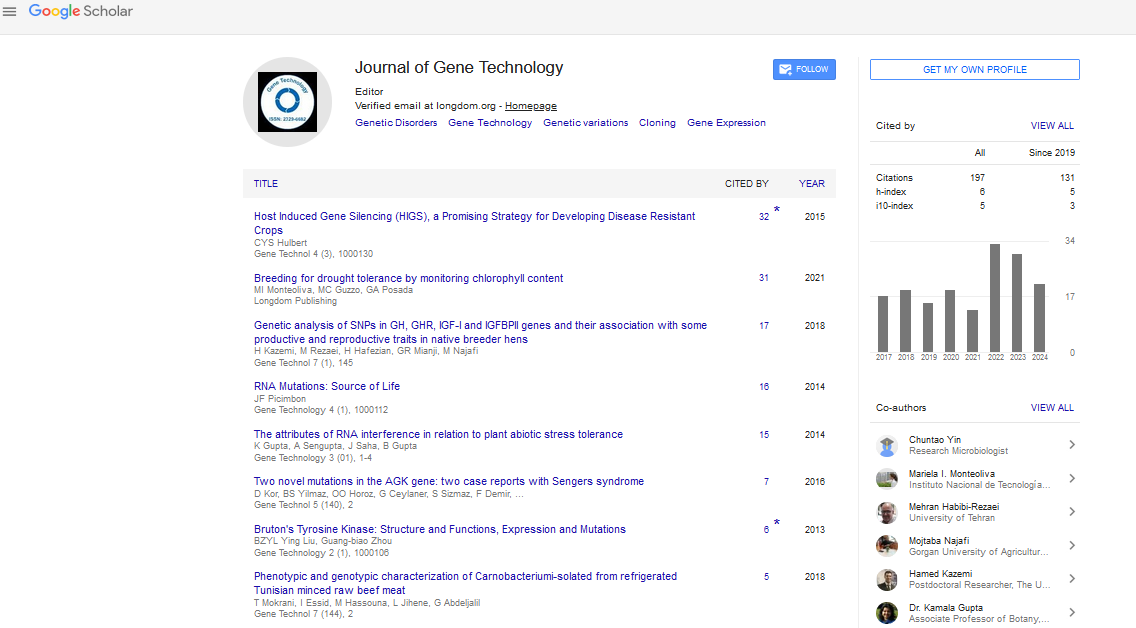


Indexed In
- Academic Keys
- ResearchBible
- CiteFactor
- Access to Global Online Research in Agriculture (AGORA)
- RefSeek
- Hamdard University
- EBSCO A-Z
- OCLC- WorldCat
- Publons
- Euro Pub
- Google Scholar
Useful Links
Share This Page
Journal Flyer

Open Access Journals
- Agri and Aquaculture
- Biochemistry
- Bioinformatics & Systems Biology
- Business & Management
- Chemistry
- Clinical Sciences
- Engineering
- Food & Nutrition
- General Science
- Genetics & Molecular Biology
- Immunology & Microbiology
- Medical Sciences
- Neuroscience & Psychology
- Nursing & Health Care
- Pharmaceutical Sciences
Perspective - (2026) Volume 15, Issue 2
The Promise and Challenges of Genetic Engineering in the Twenty-First Century
Jintao Yang*Received: 25-May-2026, Manuscript No. RDT-26-31810; Editor assigned: 27-May-2026, Pre QC No. RDT-26-31810 (PQ); Reviewed: 10-Jun-2026, QC No. RDT-26-31810; Revised: 17-Jun-2026, Manuscript No. RDT-26-31810 (R); Published: 24-Jun-2026, DOI: 10.35248/2332-2519.26.15.361
Abstract
Description
Genetic engineering has become one of the most influential scientific developments of the twenty-first century, reshaping how humans understand life, disease and biological systems. It involves the direct modification of an organism’s Deoxyribonucleic Acid (DNA) to introduce new traits, remove harmful genetic conditions, or enhance existing biological functions. This powerful capability is transforming medicine, agriculture and biotechnology, while also raising important scientific, ethical and social questions.
At its core, genetic engineering allows scientists to rewrite the biological instructions that define living organisms. DNA acts as a code that controls growth, development and health. When this code contains errors or harmful mutations, it can lead to serious diseases or inherited disorders. Through modern genetic engineering techniques, researchers are now able to identify these problematic regions and make precise corrections, offering new possibilities for treatment and prevention.
In medicine, genetic engineering is opening new pathways for treating previously incurable diseases. Scientists are exploring ways to correct mutations responsible for conditions such as sickle cell anemia, cystic fibrosis and muscular dystrophy. Instead of relying solely on long-term treatments, gene-based therapies aim to address the root genetic causes of these disorders. This shift represents a major change in how healthcare approaches chronic and inherited diseases.
Cancer treatment has also been significantly impacted by genetic engineering. Since cancer is caused by genetic mutations that lead to uncontrolled cell growth, researchers are using engineered immune cells to target and destroy cancerous cells more effectively. This approach improves precision and reduces damage to healthy tissues, making treatments more efficient and less harmful than traditional methods such as chemotherapy.
Another important area is personalized medicine. Genetic engineering allows healthcare providers to tailor treatments based on an individual’s unique genetic profile. This ensures that medications and therapies are better suited to each patient, increasing effectiveness while reducing side effects. As genetic data becomes more widely available, personalized healthcare is expected to become a standard part of medical practice.
Beyond medicine, genetic engineering is also revolutionizing agriculture. Scientists are developing genetically modified crops that are more resistant to pests, diseases and environmental stress. These advancements help improve food security, increase crop yields and reduce the need for chemical pesticides. In regions facing climate change challenges, genetically engineered crops may plays an important role in ensuring stable food supplies.
Despite its many benefits, genetic engineering also presents serious challenges. Ethical concerns are among the most significant, particularly regarding the modification of human embryos and germline cells. Changes made at this level can be inherited by future generations, raising questions about safety, consent and long-term consequences. There is also ongoing debate about whether genetic enhancement should be allowed beyond medical purposes.
Safety is another important concern. While gene-editing technologies are highly precise, there is still a risk of unintended genetic changes. These off-target effects could potentially cause new health problems or disrupt important biological functions. As a result, scientists continue to improve accuracy and develop stricter testing methods to ensure safety in both research and clinical applications.
Accessibility and fairness also remain major issues. Advanced genetic treatments are often expensive and may not be equally available to all populations. This raises concerns about inequality, where only certain groups could benefit from life-changing technologies. Ensuring fair access to genetic engineering innovations is an ongoing challenge for governments and healthcare systems worldwide.
Conclusion
Genetic engineering offers extraordinary opportunities to improve human health, agriculture and scientific knowledge, but it also brings significant ethical, safety and social challenges. Balancing innovation with responsibility will be essential to ensure that its benefits are realized safely and fairly in the twenty-first century. As the twenty-first century progresses, genetic engineering is expected to play an even greater role in shaping the future of science and medicine. Its potential to treat disease, improve agriculture and enhance understanding of life is immense. However, its long-term success will depend on how effectively society manages its risks while maximizing its benefits.
Citation: Yang J (2026). The Promise and Challenges of Genetic Engineering in the Twenty-First Century. Gene Technol. 15:361.
Copyright: © 2026 Yang J. This is an open-access article distributed under the terms of the Creative Commons Attribution License, which permits unrestricted use, distribution and reproduction in any medium, provided the original author and source are credited