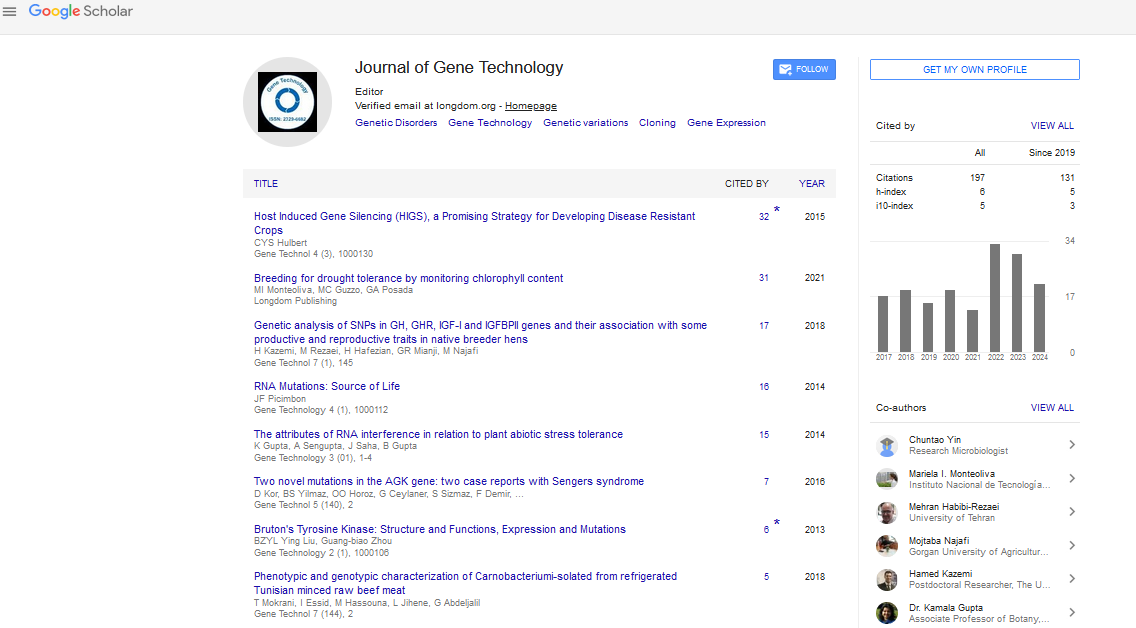

Indexed In
- Academic Keys
- ResearchBible
- CiteFactor
- Access to Global Online Research in Agriculture (AGORA)
- RefSeek
- Hamdard University
- EBSCO A-Z
- OCLC- WorldCat
- Publons
- Euro Pub
- Google Scholar
Useful Links
Share This Page
Journal Flyer

Open Access Journals
- Agri and Aquaculture
- Biochemistry
- Bioinformatics & Systems Biology
- Business & Management
- Chemistry
- Clinical Sciences
- Engineering
- Food & Nutrition
- General Science
- Genetics & Molecular Biology
- Immunology & Microbiology
- Medical Sciences
- Neuroscience & Psychology
- Nursing & Health Care
- Pharmaceutical Sciences
Perspective - (2025) Volume 14, Issue 2
Synthetic Biology for Sustainable Solutions in Health and Industry
Qiyu Luo*Received: 30-May-2025, Manuscript No. RDT-25-30210; Editor assigned: 02-Jun-2025, Pre QC No. RDT-25-30210 (PQ); Reviewed: 16-Jun-2025, QC No. RDT-25-30210; Revised: 23-Jun-2025, Manuscript No. RDT-25-30210 (R); Published: 30-Jun-2025, DOI: 10.35248/2329-6682.25.14.323
Abstract
Description
Synthetic biology is an interdisciplinary field that combines principles of biology, engineering, genetics, and computer science to design and construct new biological parts, devices, and systems or to redesign existing biological systems for useful purposes. Unlike traditional genetic engineering, which focuses on modifying single genes or pathways, synthetic biology aims to create entirely new biological functions and systems, enabling precise control over cellular behavior and metabolic processes.
The foundation of synthetic biology lies in the modular approach to biological design. Researchers treat DNA sequences, proteins, and metabolic pathways as standardized components, often referred to as “biobricks,” which can be assembled to create predictable biological systems. Advances in genome sequencing, DNA synthesis, and computational modelling have accelerated the ability to design and construct synthetic circuits, regulatory networks, and even minimal genomes that perform specific functions within a host organism.
Applications of synthetic biology are broad and transformative. In medicine, synthetic biology enables the development of engineered microbes for drug production, targeted delivery of therapeutics, and novel diagnostic tools. For example, bacteria have been engineered to produce insulin, anticancer compounds, or to detect and respond to disease biomarkers in the human body. Synthetic gene circuits allow controlled expression of therapeutic genes, offering potential for precision medicine and treatment of complex diseases.
In agriculture, synthetic biology contributes to the creation of crops with enhanced traits such as drought tolerance, improved nutrient content, and resistance to pests and pathogens. Engineered microorganisms can also improve soil health, fix nitrogen more efficiently, or produce bio fertilizers, reducing reliance on chemical inputs and promoting sustainable farming practices.
Industrial biotechnology benefits greatly from synthetic biology through the production of biofuels, bioplastics, and specialty chemicals using engineered microorganisms. Metabolic pathways can be optimized to convert renewable resources into high-value products efficiently. For instance, yeast and bacterial strains have been engineered to produce ethanol, biodiesel, and precursors for pharmaceuticals, demonstrating how synthetic biology integrates biology and engineering to solve real-world problems.
Synthetic biology also advances fundamental research by enabling the construction of minimal or synthetic genomes, which helps scientists understand the principles of life and cellular organization. Efforts to create synthetic cells provide insights into gene essentiality, metabolic networks, and the design rules governing cellular behavior. These studies bridge the gap between theoretical biology and practical applications, offering a platform for exploring new biological functions.
Ethical, safety, and regulatory considerations are critical in synthetic biology. The creation of synthetic organisms raises concerns about biosecurity, ecological impacts, and unintended consequences. Regulatory frameworks and ethical guidelines are necessary to ensure responsible research, prevent misuse, and maintain public trust. Advances in biocontainment strategies, such as genetic safeguards and dependency on synthetic nutrients, help mitigate potential risks associated with synthetic organisms.
In conclusion, synthetic biology represents a paradigm shift in biological research and biotechnology. By integrating engineering principles with molecular biology, it allows the design and construction of novel biological systems with applications in medicine, agriculture, and industry. As technologies for DNA synthesis, genome editing, and computational modelling continue to advance, synthetic biology promises to transform science and industry, offering innovative solutions to global challenges.
Citation: Luo Q (2025). Synthetic Biology for Sustainable Solutions in Health and Industry. Gene Technol. 14:323.
Copyright: © 2025 Luo Q. This is an open-access article distributed under the terms of the Creative Commons Attribution License, which permits unrestricted use, distribution, and reproduction in any medium, provided the original author and source are credited.