
Indexed In
- Genamics JournalSeek
- Academic Keys
- JournalTOCs
- China National Knowledge Infrastructure (CNKI)
- Access to Global Online Research in Agriculture (AGORA)
- Centre for Agriculture and Biosciences International (CABI)
- RefSeek
- Directory of Research Journal Indexing (DRJI)
- Hamdard University
- EBSCO A-Z
- OCLC- WorldCat
- Scholarsteer
- SWB online catalog
- Publons
- Euro Pub
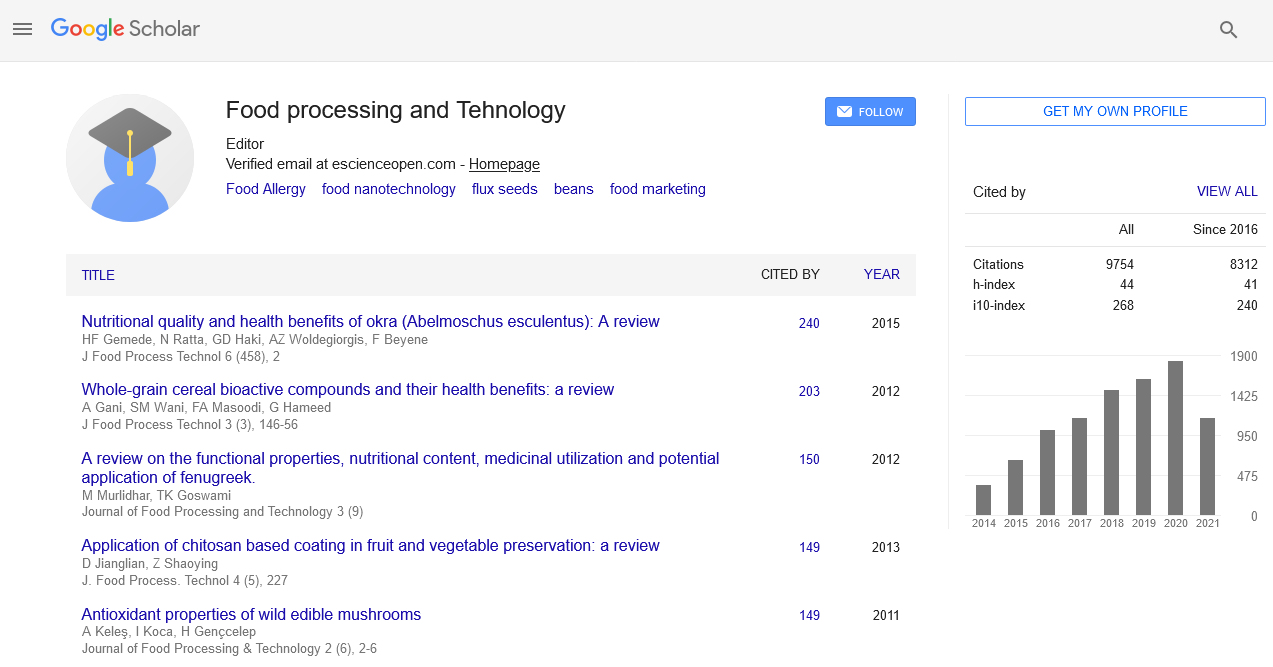
- Google Scholar
Useful Links
Share This Page
Journal Flyer
Open Access Journals
- Agri and Aquaculture
- Biochemistry
- Bioinformatics & Systems Biology
- Business & Management
- Chemistry
- Clinical Sciences
- Engineering
- Food & Nutrition
- General Science
- Genetics & Molecular Biology
- Immunology & Microbiology
- Medical Sciences
- Neuroscience & Psychology
- Nursing & Health Care
- Pharmaceutical Sciences
Commentary - (2025) Volume 16, Issue 5
Sustainable Food Processing: Resource Efficiency, Waste Valorization, and Environmental Management
Lysander Everhart *Received: 15-Sep-2025 , Manuscript No. JFPT-25-32831; Editor assigned: 17-Sep-2025 , Pre QC No. JFPT-25-32831; Reviewed: 01-Oct-2025 , QC No. JFPT-25-32831; Revised: 08-Oct-2025 , Manuscript No. JFPT-25-32831; Published: 15-Oct-2025 , DOI: 10.35248/2157-7110.25.16.1180
Description
Sustainable food processing is increasingly becoming an important approach for improving the efficiency of food production while reducing pressure on natural resources. The food processing sector uses substantial amounts of water, energy, agricultural raw materials, packaging materials, and transportation resources. At the same time, processing generates organic residues, wastewater, emissions, and other forms of waste. Sustainable food processing seeks to address these concerns through improved technologies, efficient resource utilization, waste reduction, renewable energy, and responsible management of food-processing by-products.
One of the main principles of sustainable processing is the efficient use of raw materials. Conventional processing can result in considerable losses of edible and non-edible components during cleaning, peeling, cutting, extraction, and separation. Modern processing methods can improve the recovery of useful compounds from these materials. Fruit peels, seeds, vegetable trimmings, cereal bran, and other residues may contain dietary fiber, proteins, pigments, minerals, antioxidants, and bioactive compounds. Their incorporation into food ingredients, animal feed, nutraceutical products, or biodegradable materials can reduce disposal requirements while creating additional value from agricultural resources.
Energy consumption is another important consideration. Heating, cooling, drying, freezing, evaporation, and refrigeration account for a substantial proportion of energy use in many processing facilities. Technologies such as heat recovery systems, improved insulation, energy-efficient refrigeration, microwave processing, pulsed electric fields, high-pressure processing, and membrane separation can reduce energy requirements under appropriate processing conditions. Integration of renewable energy sources, including solar thermal systems and biomass-derived energy, can further reduce dependence on conventional fuels. The selection of a processing technology should consider both energy demand and its effects on product quality, safety, shelf life, and operating costs.
Water management also contributes substantially to the environmental performance of food processing operations. Water is used for washing raw materials, cleaning equipment, steam generation, cooling, and sanitation. Improved cleaning systems, controlled water flow, reuse of suitable process water, and treatment of wastewater can lower freshwater consumption. Membrane filtration, biological treatment, and other wastewater technologies can recover useful water and organic matter while reducing the pollutant load released into the environment. However, water reuse must be carefully managed to prevent microbiological and chemical hazards from entering food-processing systems.
Packaging forms another part of sustainable food production. Conventional packaging can generate persistent waste and requires significant quantities of raw materials. Sustainable packaging approaches include lightweight materials, recyclable structures, compostable materials, edible films, and packaging designed for extended product protection. The environmental performance of packaging should not be considered separately from food preservation. A package that reduces material use but shortens shelf life may increase food waste, which can have a greater environmental impact than the packaging itself. Therefore, packaging design needs to balance material consumption, product protection, transport efficiency, recyclability, and food quality.
Reducing food loss is closely connected with sustainable processing. Processing technologies that extend shelf life can help prevent deterioration during storage and distribution. Controlled atmosphere packaging, dehydration, fermentation, thermal processing, freezing, and non-thermal preservation methods can provide different routes for maintaining food quality. Better process monitoring and digital control systems can also help processors identify deviations, reduce production losses, and maintain consistent product characteristics. Sensors, automated controls, and data-based process optimization may support more precise use of raw materials, water, and energy.
Sustainable food processing also has an economic and social dimension. Efficient resource use can lower operating expenses, while recovery of valuable compounds can create additional revenue streams. Local processing and utilization of agricultural materials may support rural employment and reduce transportation requirements. Training workers in resource-efficient practices, sanitation, waste segregation, and equipment operation is equally important because technological improvements depend on effective implementation. Sustainability therefore involves not only equipment and processes but also management practices, workforce participation, supply-chain coordination, and responsible decision-making.
In conclusion, sustainable food processing offers a practical pathway for producing safe and high-quality foods while making more responsible use of natural resources. Efficient processing, waste valorization, water conservation, energy management, improved packaging, food-loss reduction, and circular resource systems can work together to reduce environmental impacts. Continued development of processing technologies, combined with life cycle assessment and responsible management practices, can support a food industry that uses resources more efficiently and generates greater value from agricultural materials. The future of food processing will depend on integrating environmental responsibility with food safety, product quality, economic viability, and the needs of consumers and producers.
Citation: Everhart L (2025). Sustainable Food Processing: Resource Efficiency, Waste Valorization, and Environmental Management. Food Process Technol.16:1180.
Copyright: ©2025 Everhart L. This is an open-access article distributed under the terms of the Creative Commons Attribution License, which permits unrestricted use, distribution, and reproduction in any medium, provided the original author and source are credited.