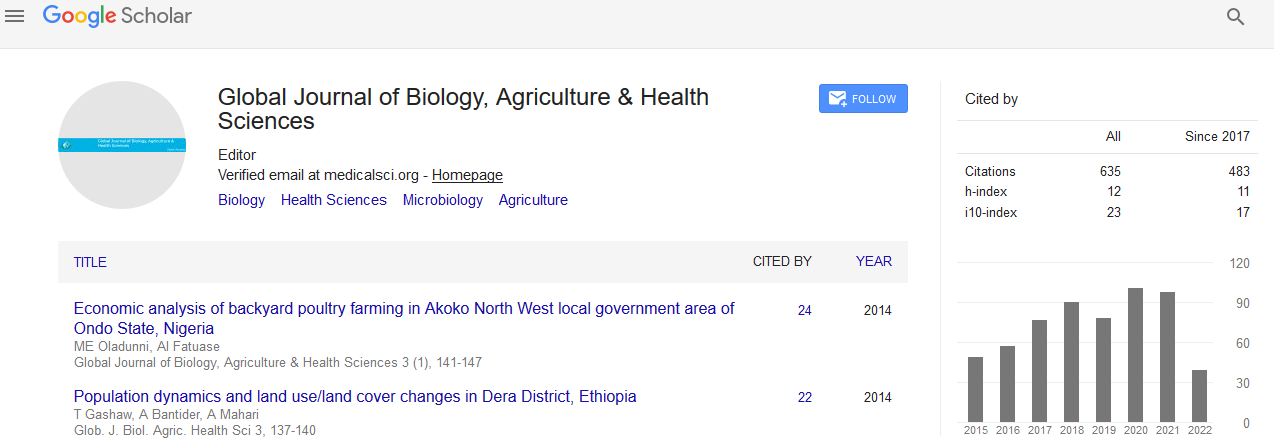

Indexed In
- Euro Pub
- Google Scholar
Useful Links
Share This Page
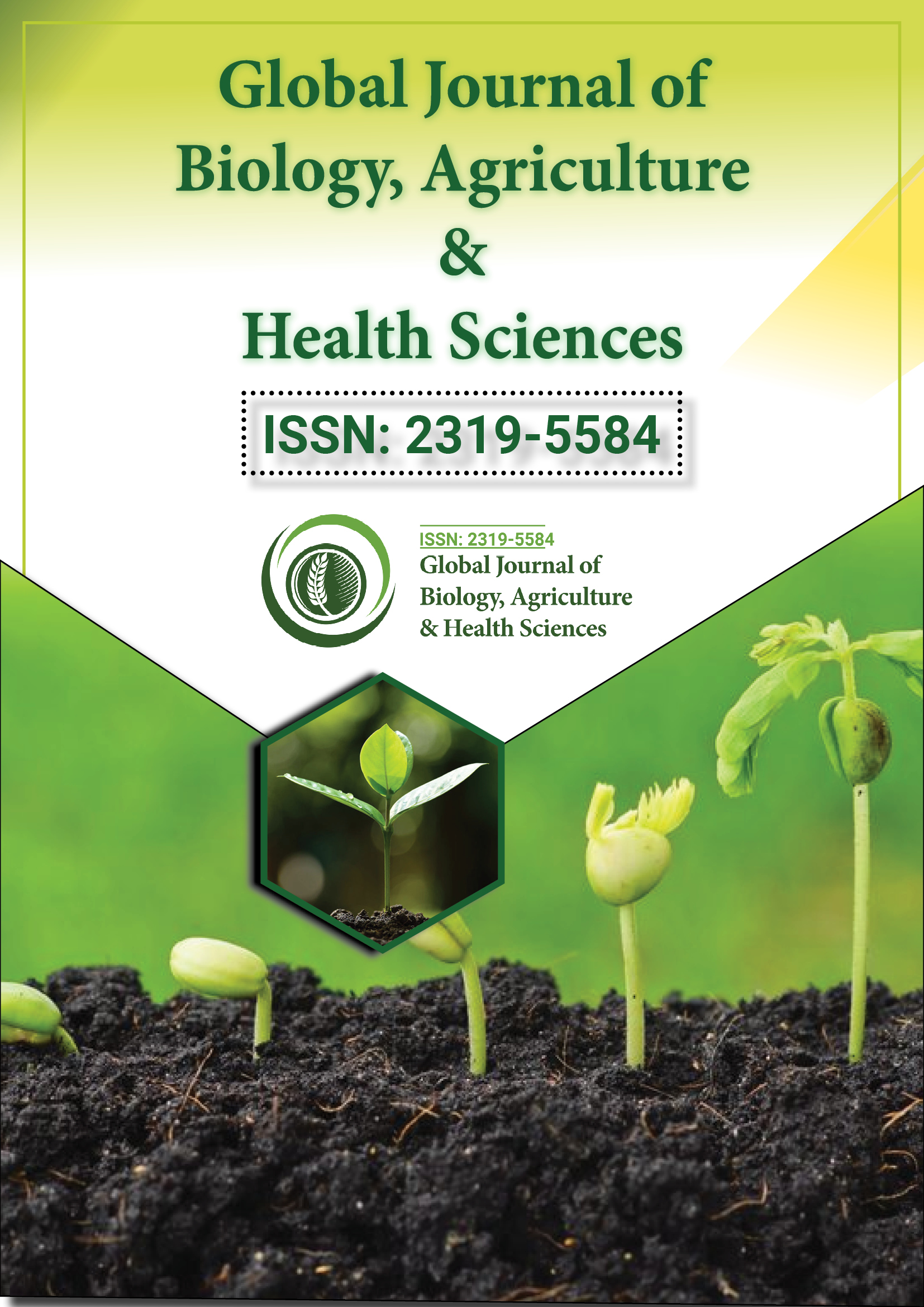
Journal Flyer
Open Access Journals
- Agri and Aquaculture
- Biochemistry
- Bioinformatics & Systems Biology
- Business & Management
- Chemistry
- Clinical Sciences
- Engineering
- Food & Nutrition
- General Science
- Genetics & Molecular Biology
- Immunology & Microbiology
- Medical Sciences
- Neuroscience & Psychology
- Nursing & Health Care
- Pharmaceutical Sciences
Perspective Article - (2025) Volume 14, Issue 4
Seed Science and Technology in Improving Crop Establishment and Agricultural Productivity
Jonathan Wallace*Received: 10-Nov-2025, Manuscript No. GJBAHS-26-31091; Editor assigned: 12-Nov-2025, Pre QC No. GJBAHS-26-31091 (PQ); Reviewed: 26-Nov-2025, QC No. GJBAHS-26-31091; Revised: 03-Dec-2025, Manuscript No. GJBAHS-26-31091 (R); Published: 10-Dec-2025, DOI: 10.35248/2319-5584.25.14.279
Description
Seed science and technology represent an essential area within agricultural research that focuses on the study of seed development, quality, storage, and utilization for crop production. Seeds are the primary starting point of most agricultural systems, and their quality plays a decisive role in determining crop establishment, plant vigor, and final yield. Research in seed science aims to understand the biological, physiological, and technological aspects that influence seed performance from the moment of formation within the parent plant until germination and early plant growth.
Seeds serve as reproductive structures that contain the embryonic plant along with stored nutrients required for early development. During the seed formation stage, the parent plant allocates carbohydrates, proteins, and lipids into the developing seed tissues. These stored nutrients support the seedling until it is capable of producing energy through photosynthesis. The genetic information contained in seeds determines the inherited characteristics of the resulting plants, including growth rate, yield potential, resistance to diseases, and adaptation to environmental conditions.
Seed quality is a fundamental concept in seed science and is generally evaluated through several characteristics such as purity, viability, vigor, and moisture content. Genetic purity refers to the degree to which seeds correspond to the intended crop variety without contamination from other varieties or species. Viability indicates whether the seed is capable of germination under suitable environmental conditions. Seed vigor represents the ability of seeds to produce strong and healthy seedlings under a wide range of field conditions. Moisture content is another critical factor because excessive moisture during storage can lead to microbial growth, reduced germination capacity, and deterioration of seed tissues.
The germination process is one of the most important stages in the life cycle of a plant. Germination begins when a seed absorbs water from its surroundings, activating metabolic processes that lead to the growth of the embryonic plant. During this stage, enzymes become active and begin converting stored nutrients into energy that supports the growth of the root and shoot. Environmental conditions such as temperature, oxygen availability, and moisture strongly influence the rate and success of germination. Seed scientists conduct controlled experiments to determine optimal conditions for germination in different crop species.
Seed storage is a crucial aspect of seed technology, particularly for maintaining seed viability over extended periods. Proper storage conditions help prevent deterioration caused by moisture, temperature fluctuations, and microbial contamination. Seeds are often stored in cool and dry environments where metabolic activity remains minimal. Seed banks and germplasm conservation facilities maintain large collections of seeds from various plant species, preserving genetic diversity that may be valuable for future crop improvement programs.
Seed processing and conditioning represent additional steps in the preparation of seeds for agricultural use. After harvesting, seeds may contain impurities such as plant debris, broken seeds, or seeds from other species. Cleaning processes remove these unwanted materials and improve seed uniformity. Grading procedures separate seeds according to size and weight, allowing the selection of seeds that are more likely to produce strong seedlings. These processes help improve planting efficiency and contribute to uniform crop emergence in the field.
Quality control plays an important role in the seed industry to ensure that seeds distributed to farmers meet established standards. Seed testing laboratories conduct various analyses to determine germination rates, moisture content, purity levels, and the presence of seed-borne diseases. These tests help guarantee that farmers receive seeds capable of producing reliable crop stands. Certification systems are often implemented to maintain traceability and quality assurance throughout seed production and distribution.
Conclusion
Seed science also contributes to the conservation of plant genetic resources. Many wild and traditional crop varieties contain valuable genetic traits that may be useful for future breeding programs. Preserving seeds from diverse plant populations ensures that these genetic materials remain available for scientific study and agricultural development. Seed banks around the world store millions of seed samples under carefully controlled conditions to safeguard biodiversity. Quality control plays an important role in the seed industry to ensure that seeds distributed to farmers meet established standards. Seed testing laboratories conduct various analyses to determine germination rates, moisture content, purity levels, and the presence of seedborne diseases.
Citation: Wallace J (2025). Seed Science and Technology in Improving Crop Establishment and Agricultural Productivity. Glob J Agric Health Sci. 14:279
Copyright: © 2025 Wallace J. This is an open-access article distributed under the terms of the Creative Commons Attribution License, which permits unrestricted use, distribution and reproduction in any medium, provided the original author and source are credited.