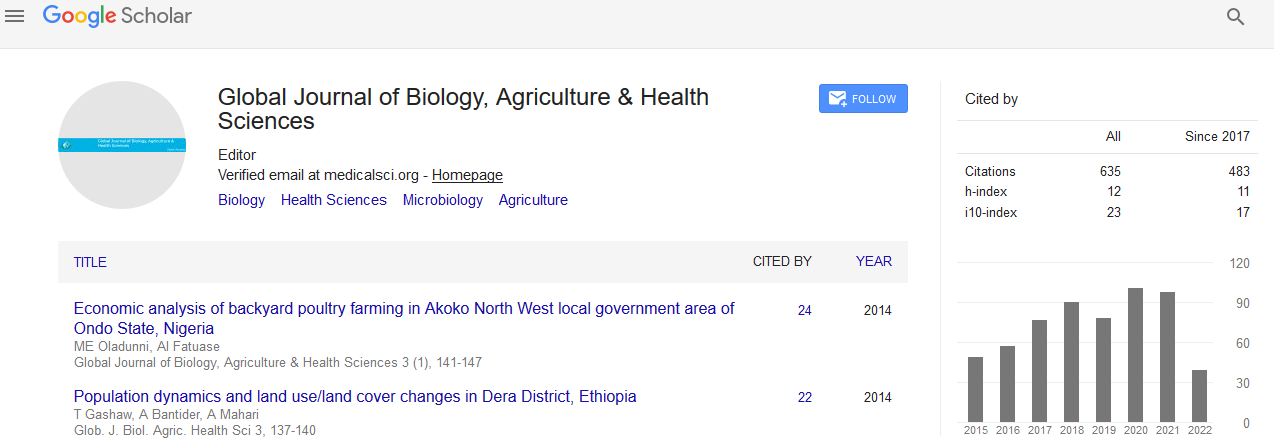

Indexed In
- Euro Pub
- Google Scholar
Useful Links
Share This Page
Journal Flyer
Open Access Journals
- Agri and Aquaculture
- Biochemistry
- Bioinformatics & Systems Biology
- Business & Management
- Chemistry
- Clinical Sciences
- Engineering
- Food & Nutrition
- General Science
- Genetics & Molecular Biology
- Immunology & Microbiology
- Medical Sciences
- Neuroscience & Psychology
- Nursing & Health Care
- Pharmaceutical Sciences
Commentary - (2026) Volume 15, Issue 2
Seed Dormancy: Environmental Factors, Hormonal Regulation, and Techniques for Breaking Dormancy
Makoto Torada*Received: 23-Oct-2024, Manuscript No. GJBAHS-24-27248; Editor assigned: 25-Oct-2024, Pre QC No. GJBAHS-24-27248 (PQ); Reviewed: 08-Nov-2024, QC No. GJBAHS-24-27248; Revised: 13-Oct-2025, Manuscript No. GJBAHS-24-27248 (R); Published: 20-Oct-2025, DOI: 10.35248/2319-5584.25.14.280
Description
Seeds are the main parts of the plant life cycle because they are the basis for the formation of the new generation of plants. Seeds are not only a staple food for human consumption, but also for animals and contribute significantly to calorie intake. The main reason for this situation is the need for a period of rest before growth. These conditions can vary from days to months and years. These conditions are a combination of light, water, heat, air, seed coat and hormonal structures. Seed dormancy is a condition in which a seed cannot germinate even under ideal conditions (Merriam-Webster). Since dormancy can be broken with optimal growing conditions (different and specific for each species), the seeds will grow as they grow. Dormant species have grown to be dormant because they are good for life. Plants use dormancy so that the seed can withstand adverse conditions, not to grow all at once, and not to die from bad weather (Seed dormancy). While it may increase the plant's survival in the wild, it can prevent the seeds from growing as evenly as possible, making them suitable for wild flower seed farms.
Importance of seed dormancy
• Aim to save seeds for use by animals and humans.
• It helps to spread the seeds in bad areas.
• Dormancy caused by inhibition in the seed coat is very beneficial for desert plants.
• Allow the seeds to remain in suspended animation under cold, high summer, or even under drought conditions without injury.
• Dormancy helps the seeds survive in the soil for many years, providing a source of new growth, even when all the mature plants in the area have been killed by disasters.
Techniques for breaking a dormant seed
Several methods for breaking a dormant seed are mentioned below:
Breaking a dormant seed: The state of sleep ends at when the embryo receives a suitable environment such as humidity and temperature. The seed coat, which can be found in many species, deteriorates due to the breakdown of its filter function by environmental factors such as microorganisms, heat and the wear and tear of the digestive system of birds and animals. eating these seeds. Other natural methods:
• Completion of ripening period.
• Cleaning of obstructions in the seed coat.
• Clearing blockages by providing cold, heat and light.
• Cleans excess and excess salt from seeds.
• The production of growth hormones can eliminate the effect of inhibitors.
Some artificial methods to break seed dormancy are listed below:
• Hot water treatment to remove waxes, surfactants, etc. or threshing machines.
• Exposure to heat, cold or light, depending on the type of seed dormancy.
• Applying hydraulic pressure for 5 to 20 minutes to loosen hard seed layers.
• The seed shell is treated with concentrated sulfuric acid to remove all traces of mineral acid.
There are two types of scarification: External and terminal (Scarification). External dormancy results from external conditions of the seed embryo. An example of external dormancy is when the seed coat is too long for moisture to enter, preventing growth. Endogenous dormancy results from chemical changes in the seed embryo. One of the reasons why a plant cannot grow is because it is dormant, the fact that the embryo has not yet fully formed and there are no signs of seasonality (Endogenous dormancy). Germination can also be inhibited due to endogenous chemical inhibition.
Seed dormancy can be defined as the failure of a viable seed to germinate under optimal conditions. Preparation for seed dormancy involves several plant hormones (ABA, GA and ethylene), environmental factors and signalling molecules (NO and ROS). ABA abundance and signalling are involved in the seed dormancy process during seed development, as stressors also occur to regulate dormancy depth.
Therefore, seed germination and dormancy are regulated by growth hormone/ROS metabolism interactions, and antioxidant-related mechanisms appear to directly regulate ROS accumulation in the both process.
Citation: Torada M (2025) Seed Dormancy: Environmental Factors, Hormonal Regulation, and Techniques for Breaking Dormancy. Glob J Agric Health Sci. 14:280.
Copyright: © 2025 Torada M. This is an open-access article distributed under the terms of the Creative Commons Attribution License, which permits unrestricted use, distribution and reproduction in any medium, provided the original author and source are credited.