
Indexed In
- Open J Gate
- Genamics JournalSeek
- China National Knowledge Infrastructure (CNKI)
- Ulrich's Periodicals Directory
- RefSeek
- Hamdard University
- EBSCO A-Z
- OCLC- WorldCat
- Publons
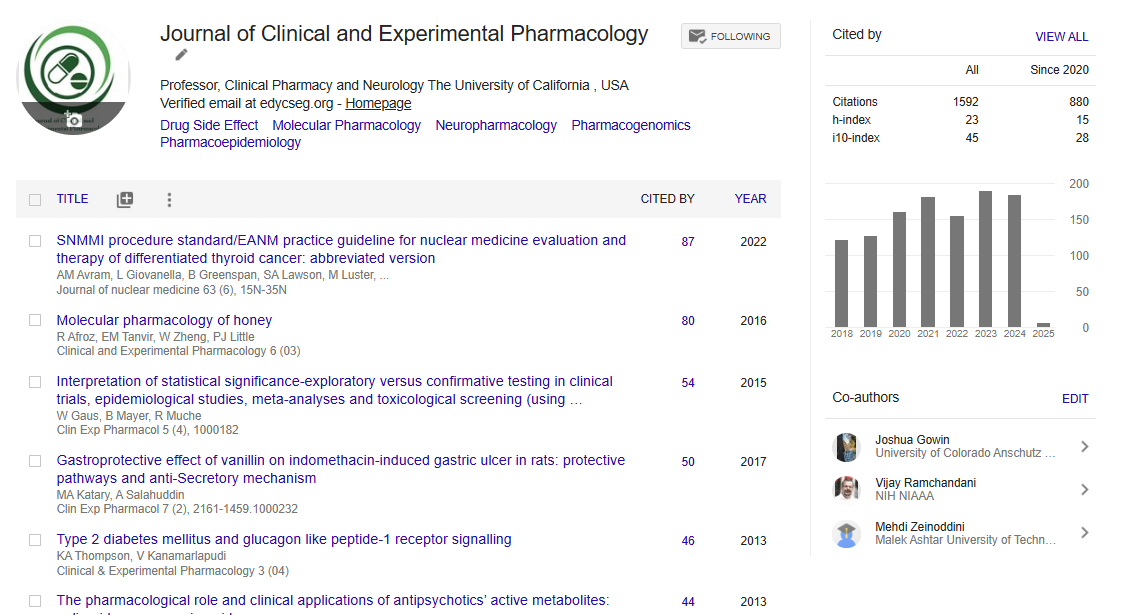
- Google Scholar
Useful Links
Share This Page
Journal Flyer
Open Access Journals
- Agri and Aquaculture
- Biochemistry
- Bioinformatics & Systems Biology
- Business & Management
- Chemistry
- Clinical Sciences
- Engineering
- Food & Nutrition
- General Science
- Genetics & Molecular Biology
- Immunology & Microbiology
- Medical Sciences
- Neuroscience & Psychology
- Nursing & Health Care
- Pharmaceutical Sciences
Commentry - (2025) Volume 15, Issue 5
Rational Drug Design in Modern Pharmacology: Strategies and Applications
Arjun Verma*Received: 02-Sep-2025, Manuscript No. CPECR-25-30501; Editor assigned: 05-Sep-2025, Pre QC No. CPECR-25-30501 (PQ); Reviewed: 19-Sep-2025, QC No. CPECR-25-30501; Revised: 26-Sep-2025, Manuscript No. CPECR-25-30501 (R); Published: 03-Oct-2025, DOI: 10.35248/2161-1459.25.15.502
Description
Drug design is a central pillar of pharmacology, aimed at discovering and developing molecules capable of modulating specific biological pathways to treat disease. Traditional approaches relied heavily on screening natural compounds or synthetic libraries, often resulting in lengthy timelines and unpredictable outcomes. Rational Drug Design (RDD), by contrast, leverages knowledge of the structure and function of biological targets, allowing a more targeted and efficient approach. The convergence of computational methods, structural biology and medicinal chemistry has enabled the identification of potent and selective drug candidates. Rational drug design is now widely used in oncology, infectious diseases, neuropharmacology and metabolic disorders.
Principles of rational drug design
The first step in RDD is identifying a biologically relevant target, such as an enzyme, receptor, or ion channel. Validation ensures that modulating this target produces the desired therapeutic effect without unacceptable side effects. Techniques include gene knockout studies, RNA interference and protein expression analysis.
X-ray crystallography, NMR spectroscopy and cryo-electron microscopy provide detailed structural insights. Drugs are then designed to fit the active or allosteric sites, optimizing binding affinity and specificity.
When structural data of a target is unavailable, active molecules to develop new analogs. Methods include Quantitative Structure-Activity Relationship (QSAR) models, pharmacophore modeling and molecular docking simulations.
Advanced computational tools enable virtual screening of large compound libraries, prediction of binding affinities and optimization of physicochemical properties. Machine learning and AI models are increasingly applied to predict drug-target interactions and potential toxicities.
Methodologies in drug design
Molecular docking simulates the binding of small molecules to target proteins, predicting the orientation, affinity and interactions. Virtual screening accelerates the identification of lead compounds from thousands of candidates.
A pharmacophore represents the spatial arrangement of features essential for molecular recognition by the target. This approach is used to design compounds with optimal activity and minimal off-target effects.
De novo methods generate novel compounds computationally based on target structure, aiming for high specificity and druglikeness while avoiding known toxicophores.
Applications of rational drug design
Targeted therapies such as kinase inhibitors and monoclonal antibodies have emerged from structure-guided design, offering higher efficacy and lower toxicity than traditional chemotherapy.
Rational design has produced drugs for neurodegenerative disorders like Alzheimer’s and Parkinson’s, focusing on enzyme inhibition, receptor modulation and protein aggregation prevention.
Computational drug design accelerates the discovery of antivirals, antibacterials and antifungals, particularly against resistant pathogens.
Rationally designed small molecules targeting enzymes in glucose and lipid metabolism have advanced diabetes and obesity treatment.
Challenges in drug design
Target complexity: Many biological targets have dynamic conformations, complicating drug binding predictions.
Absorption, Distribution, Metabolism, Excretion and Toxicity (ADMET) optimization: Drug candidates must have favorable absorption, distribution, metabolism, excretion and toxicity profiles.
Computational limitations: While AI and molecular simulations are powerful, they cannot fully capture complex biological systems.
Cost and time: Despite efficiency improvements, bringing a rationally designed drug to market remains expensive and time-consuming.
Future perspectives
Rational drug design is evolving with advances in AI, quantum chemistry and high-throughput structural biology. Personalized pharmacology, integrating patient-specific genomic and proteomic data, promises tailored therapies. Multi-target drug design and combination therapies are also gaining attention, particularly for complex diseases like cancer and neurodegeneration.
Conclusion
Rational drug design represents a paradigm shift in pharmacology, enabling the development of highly specific, effective and safer therapeutic agents. By integrating computational modeling, structural biology and medicinal chemistry, researchers can reduce trial-and-error approaches and accelerate drug discovery. Despite challenges related to target complexity and ADMET optimization, ongoing technological innovations are poised to make rational drug design central to precision medicine. Rational drug design has transformed pharmacology by enabling the creation of highly specific and effective therapeutic agents. By integrating structural biology, computational modeling and medicinal chemistry, researchers can design drugs with optimized efficacy, safety and pharmacokinetics.
Citation: Verma A (2025). Rational Drug Design in Modern Pharmacology: Strategies and Applications. J Clin Exp Pharmacol. 15:502.
Copyright: © 2025 Verma A. This is an open-access article distributed under the terms of the Creative Commons Attribution License, which permits unrestricted use, distribution and reproduction in any medium, provided the original author and source are credited.