
Indexed In
- CiteFactor
- RefSeek
- Directory of Research Journal Indexing (DRJI)
- Hamdard University
- EBSCO A-Z
- Scholarsteer
- Publons
- Euro Pub
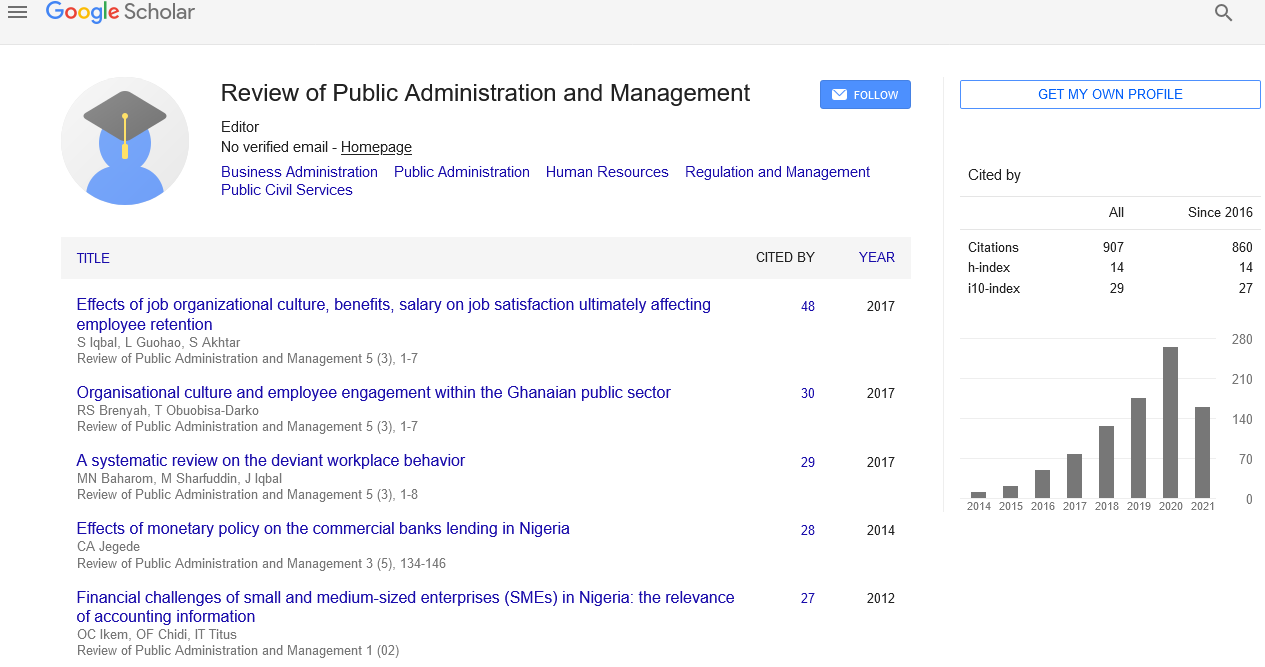
- Google Scholar
Useful Links
Share This Page
Journal Flyer

Open Access Journals
- Agri and Aquaculture
- Biochemistry
- Bioinformatics & Systems Biology
- Business & Management
- Chemistry
- Clinical Sciences
- Engineering
- Food & Nutrition
- General Science
- Genetics & Molecular Biology
- Immunology & Microbiology
- Medical Sciences
- Neuroscience & Psychology
- Nursing & Health Care
- Pharmaceutical Sciences
Commentary - (2025) Volume 13, Issue 3
Public Administration and the Economic Potential of Mineral Deposits
John Tobias *Received: 26-Dec-2024 , Manuscript No. RPAM-24-27969; Editor assigned: 30-Dec-2024 , Pre QC No. RPAM-24-27969 (PQ); Reviewed: 13-Jan-2025 , QC No. RPAM-24-27969; Revised: 11-Sep-2025 , Manuscript No. RPAM-24-27969 (R); Published: 18-Sep-2025 , DOI: 10.35248/2315-7844.25.13.501
Description
The economic potential of mineral deposits is vast, but realizing this potential requires effective management and strategic planning. Public administration plays a central role in ensuring that mineral resources are used efficiently and responsibly, benefiting society while addressing environmental and social concerns. Governments are tasked with regulating the extraction, trade and use of minerals to maximize their economic value and ensure sustainable practices. Minerals are essential for various industries, such as construction and technology. Mining activities contribute to job creation, infrastructure development and foreign exchange earnings. In resource-rich countries, these deposits can significantly boost the economy if managed properly. The role of public administration is critical in balancing the benefits of mineral wealth with the need for responsible governance.
Governments must establish clear policies and regulations to ensure that mineral resources are extracted and utilized efficiently and equitably. These regulations include environmental protection measures to minimize land degradation, water contamination and pollution. Moreover, governments need to enforce labor laws that protect workers' rights and safety, as mining can present hazardous working conditions. Another critical aspect of public administration is ensuring that the revenues generated from mining benefit the broader population. Mineral wealth can be a major source of government income, used to fund public services such as healthcare, education and infrastructure. However, without effective management, these revenues may be misallocated or misused, leading to corruption or inequality. Governments must ensure that mineral wealth is distributed fairly and contributes to the overall well-being of society. In some countries, mineral resource management has led to the creation of sovereign wealth funds, which invest mining revenues in long-term development projects. These funds provide a way to preserve the benefits of mineral wealth for future generations, creating more stable economic conditions and reducing reliance on finite resources. By investing in infrastructure, education and social services, these funds can also help mitigate the negative effects of economic fluctuations caused by the volatility of global mineral prices.
Public administration also plays a role in ensuring that local communities benefit from mineral extraction. In many resource rich countries, mineral wealth has often been concentrated in the hands of a few, leaving local populations without access to the economic benefits of mining. Governments can address this by implementing policies that provide local employment, community development projects and infrastructure improvements such as schools, healthcare and roads. These measures ensure that mineral extraction contributes to the overall development of local communities and reduces social tensions. Environmental concerns also need to be addressed by public administration. Mining can have significant environmental impacts, including land degradation, pollution and biodiversity loss. Governments must develop and enforce laws that require mining companies to adopt sustainable practices, restore mined land and protect ecosystems. Encouraging greener technologies, such as water- and energy efficient mining processes, can also help mitigate these impacts. Ensuring that mining is done in an environmentally responsible manner is essential for long-term sustainability.
The economic benefits of mineral deposits extend beyond extraction. The processing, refining and transportation of minerals also contribute to the economy. Governments must ensure that the infrastructure for these activities is in place, including transportation networks, energy supplies and ports. Public-private partnerships can be effective in developing this infrastructure, as governments provide the regulatory framework and incentives, while private companies contribute capital and expertise. Education and training are also essential for the mining sector's success. As demand for skilled workers in the industry grows, governments must invest in education and vocational training programs. Universities and technical colleges can collaborate with the mining sector to provide specialized training in areas such as geology, engineering and environmental management.
Public administration also plays a role in attracting foreign investment to the mining sector. A stable and predictable regulatory environment can increase investor confidence, leading to capital inflows necessary for developing new mines or expanding existing ones. Governments must ensure that foreign investors contribute to the local economy by creating jobs, supporting local businesses and complying with environmental and social regulations. The economic potential of mineral deposits can be realized through effective public administration. Governments must develop policies to regulate mining, ensure fair revenue distribution, protect the environment and provide opportunities for local communities. By investing in infrastructure, education and governments can further enhance the economic benefits of mineral resources and ensure that mining contributes to sustainable development. With the right governance, mineral resources can play a vital role in driving long-term economic growth and prosperity.
Citation: Tobias J (2025) Public Administration and the Economic Potential of Mineral Deposits. Review Pub Administration Manag. 13:501.
Copyright: © 2025 Tobias J. This is an open-access article distributed under the terms of the Creative Commons Attribution License, which permits unrestricted use, distribution, and reproduction in any medium, provided the original author and source are credited.