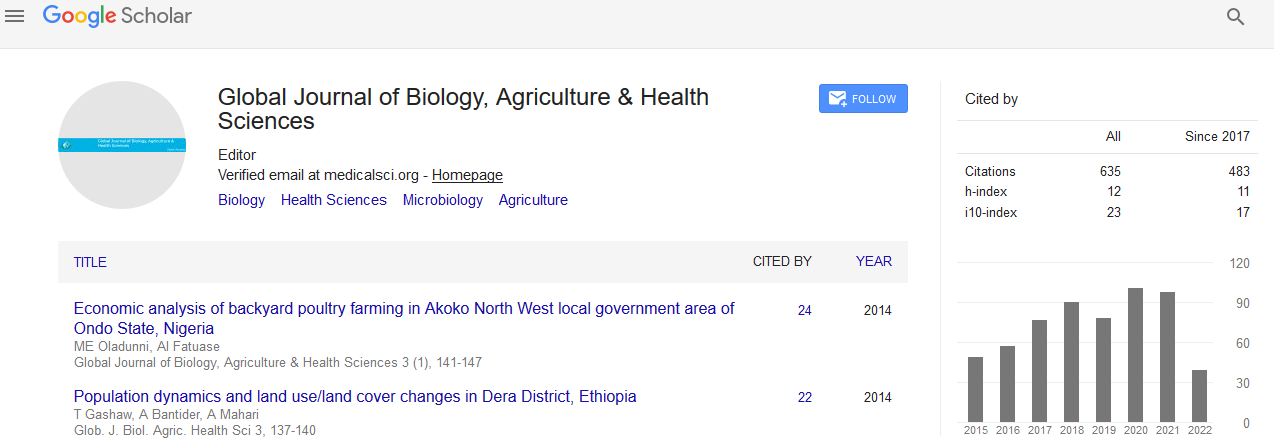

Indexed In
- Euro Pub
- Google Scholar
Useful Links
Share This Page
Journal Flyer
Open Access Journals
- Agri and Aquaculture
- Biochemistry
- Bioinformatics & Systems Biology
- Business & Management
- Chemistry
- Clinical Sciences
- Engineering
- Food & Nutrition
- General Science
- Genetics & Molecular Biology
- Immunology & Microbiology
- Medical Sciences
- Neuroscience & Psychology
- Nursing & Health Care
- Pharmaceutical Sciences
Perspective - (2026) Volume 15, Issue 1
Physiological Regulation and Yield Optimization in Crop Science Studies
Henrik Johansson*Received: 10-Feb-2026, Manuscript No. GJBAHS-26-31451; Editor assigned: 12-Feb-2026, Pre QC No. GJBAHS-26-31451; Reviewed: 26-Feb-2026, QC No. GJBAHS-26-31451; Revised: 05-Mar-2026, Manuscript No. GJBAHS-26-31451; Published: 12-Mar-2026, DOI: 10.35248/2319-5584.26.15.287
Abstract
Description
Crop science studies focus on understanding the biological, chemical, and environmental factors that influence plant growth and agricultural productivity. Researchers in this field examine how crops develop from seed germination through maturation and how external conditions such as temperature, soil composition, and water availability affect their performance. The objective of these studies is to improve agricultural output while maintaining stability in plant growth systems under varying environmental conditions.
Plant growth analysis is a central component of crop science research. Scientists observe developmental stages including germination, vegetative growth, flowering, and seed production. Measurements of plant height, leaf area, biomass accumulation, and root development are commonly recorded. These parameters help determine how efficiently a plant converts resources into growth. Experimental trials are conducted in controlled environments as well as open field conditions to compare performance under different ecological settings.
Soil-plant interaction studies are another important area within crop science. Researchers examine how soil texture, nutrient content, and microbial activity influence plant development. Essential nutrients such as nitrogen, phosphorus, and potassium are analyzed to understand their role in crop productivity. Soil amendments and fertilization practices are tested to evaluate their effects on plant health. Long-term field experiments provide insights into how continuous cultivation affects soil properties and nutrient availability.
Water use efficiency is a key focus in crop science studies, particularly in regions with limited water resources. Scientists investigate irrigation methods and their impact on plant growth and yield. Techniques such as drip irrigation, sprinkler systems, and regulated deficit irrigation are evaluated for their effectiveness. Plant responses to water stress are studied by measuring physiological indicators such as stomatal activity, leaf water content, and transpiration rates. These findings support the development of efficient water management strategies in agriculture.
Genetic improvement of crops is widely studied to enhance desirable traits such as yield, disease resistance, and environmental adaptability. Researchers analyze genetic variation among plant populations using breeding experiments and molecular techniques. Hybridization and selection methods are applied to develop improved crop varieties. Field trials are conducted over multiple growing seasons to assess stability and performance under different environmental conditions.
Pest and disease resistance studies form another major part of crop science research. Crops are frequently affected by insects, fungal infections, bacterial pathogens, and viral agents. Scientists study the life cycles of pests and the conditions that promote their spread. Resistant crop varieties are identified and tested to reduce losses caused by biological stress factors. Integrated management approaches combining biological, cultural, and chemical methods are evaluated for their effectiveness in maintaining crop health.
Photosynthesis and plant metabolism are also important areas of investigation. Researchers study how plants convert sunlight into chemical energy and how this energy is used for growth and reproduction. Factors such as light intensity, carbon dioxide concentration, and temperature are analyzed for their influence on photosynthetic efficiency. Metabolic pathways involved in carbohydrate production and energy storage are examined to understand their contribution to overall plant productivity.
Crop science studies focus on understanding the biological, chemical, and environmental factors that influence plant growth and agricultural productivity. Researchers in this field examine how crops develop from seed germination through maturation and how external conditions such as temperature, soil composition, and water availability affect their performance. The objective of these studies is to improve agricultural output while maintaining stability in plant growth systems under varying environmental conditions.
Plant growth analysis is a central component of crop science research. Scientists observe developmental stages including germination, vegetative growth, flowering, and seed production. Measurements of plant height, leaf area, biomass accumulation, and root development are commonly recorded. These parameters help determine how efficiently a plant converts resources into growth. Experimental trials are conducted in controlled environments as well as open field conditions to compare performance under different ecological settings.
Soil-plant interaction studies are another important area within crop science. Researchers examine how soil texture, nutrient content, and microbial activity influence plant development. Essential nutrients such as nitrogen, phosphorus, and potassium are analyzed to understand their role in crop productivity. Soil amendments and fertilization practices are tested to evaluate their effects on plant health. Long-term field experiments provide insights into how continuous cultivation affects soil properties and nutrient availability.
Water use efficiency is a key focus in crop science studies, particularly in regions with limited water resources. Scientists investigate irrigation methods and their impact on plant growth and yield. Techniques such as drip irrigation, sprinkler systems, and regulated deficit irrigation are evaluated for their effectiveness. Plant responses to water stress are studied by measuring physiological indicators such as stomatal activity, leaf water content, and transpiration rates. These findings support the development of efficient water management strategies in agriculture.
Genetic improvement of crops is widely studied to enhance desirable traits such as yield, disease resistance, and environmental adaptability. Researchers analyze genetic variation among plant populations using breeding experiments and molecular techniques. Hybridization and selection methods are applied to develop improved crop varieties. Field trials are conducted over multiple growing seasons to assess stability and performance under different environmental conditions.
Pest and disease resistance studies form another major part of crop science research. Crops are frequently affected by insects, fungal infections, bacterial pathogens, and viral agents. Scientists study the life cycles of pests and the conditions that promote their spread. Resistant crop varieties are identified and tested to reduce losses caused by biological stress factors. Integrated management approaches combining biological, cultural, and chemical methods are evaluated for their effectiveness in maintaining crop health.
Photosynthesis and plant metabolism are also important areas of investigation. Researchers study how plants convert sunlight into chemical energy and how this energy is used for growth and reproduction. Factors such as light intensity, carbon dioxide concentration, and temperature are analyzed for their influence on photosynthetic efficiency. Metabolic pathways involved in carbohydrate production and energy storage are examined to understand their contribution to overall plant productivity.
Conclusion
Crop science studies continue to evolve through integration of biological research, environmental analysis, and technological tools. Sustainable agriculture practices are also explored within crop science research. Scientists evaluate farming methods that maintain soil fertility, reduce environmental impact, and ensure long-term productivity. Crop rotation, intercropping, and organic farming systems are studied to assess their effectiveness in maintaining agricultural balance. These approaches are compared with conventional farming systems to determine their advantages and limitations. Continuous experimentation and field evaluation contribute to improved understanding of plant systems and their responses to changing conditions.
Citation: Johansson H (2026). Physiological Regulation and Yield Optimization in Crop Science Studies. Glob J Agric Health Sci. 15:287.
Copyright: © 2026 Johansson H. This is an open-access article distributed under the terms of the Creative Commons Attribution License, which permits unrestricted use, distribution and reproduction in any medium, provided the original author and source are credited.