
Indexed In
- CiteFactor
- RefSeek
- Directory of Research Journal Indexing (DRJI)
- Hamdard University
- EBSCO A-Z
- Scholarsteer
- Publons
- Euro Pub
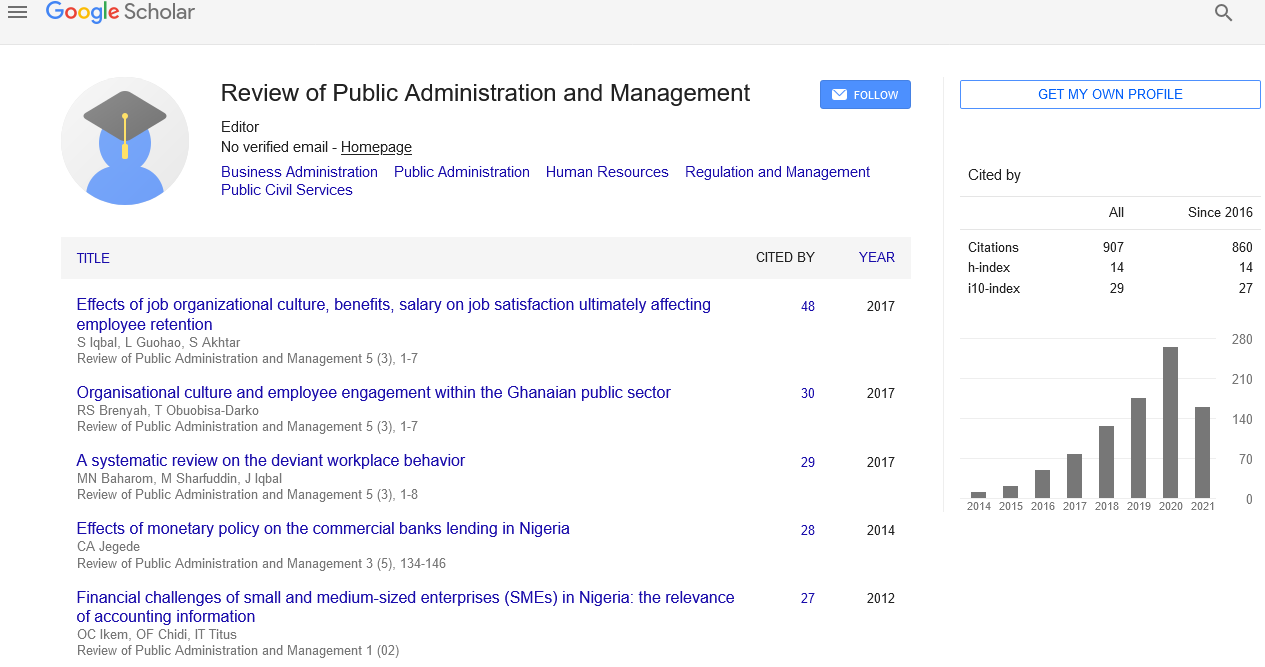
- Google Scholar
Useful Links
Share This Page
Journal Flyer

Open Access Journals
- Agri and Aquaculture
- Biochemistry
- Bioinformatics & Systems Biology
- Business & Management
- Chemistry
- Clinical Sciences
- Engineering
- Food & Nutrition
- General Science
- Genetics & Molecular Biology
- Immunology & Microbiology
- Medical Sciences
- Neuroscience & Psychology
- Nursing & Health Care
- Pharmaceutical Sciences
Commentary - (2026) Volume 13, Issue 3
Leadership and Dysfunction: How Management Influences Public Sector Behaviors
Jarrod Zaman *Received: 26-Dec-2024 , Manuscript No. RPAM-24-27972; Editor assigned: 30-Dec-2024 , Pre QC No. RPAM-24-27972 (PQ); Reviewed: 13-Jan-2025 , QC No. RPAM-24-27972; Revised: 11-Sep-2025 , Manuscript No. RPAM-24-27972 (R); Published: 18-Sep-2025 , DOI: 10.35248/2315-7844.25.13.504
Description
Leadership in public sector organizations significantly shapes behaviour and organizational performance. The approach that management takes directly affects employee morale, decisionmaking and the efficiency of service delivery. While effective leadership can improve productivity and innovation, ineffective management can lead to dysfunction, affecting both internal operations and the quality of services provided to the public. Understanding how management influences public sector behaviours is essential for improving organizational effectiveness and overall public service outcomes. Public sector leadership differs from that in the private sector due to the unique challenges of working within government structures. These include operating under tight regulations, budget constraints, and the need to satisfy various stakeholders, including the public, government officials and interest groups. These factors require a leadership approach that is both flexible and responsive. However, when management fails to address these challenges effectively, dysfunction can occur. A common form of dysfunction is poor communication. Leaders who are disconnected from their employees may fail to understand the challenges on the ground, which can lead to misalignment between leadership decisions and employee needs. This lack of communication can create disengagement, resulting in low morale, high turnover and decreased productivity. Employees who feel that their concerns are not being heard or addressed are less likely to be motivated to perform at their best. In addition, when decision-making processes lack transparency, employees often feel alienated and unclear about their roles and organizational goals. This uncertainty can cause confusion and reduce effectiveness within the organization. When leaders do not involve employees in important decisions, it can lead to frustration and disengagement, which can ultimately affect the quality of service provided to the public.
Another way dysfunctional leadership manifests is through overly hierarchical or rigid management structures. When decision-making is concentrated at the top, it limits the input of lower-level staff who might have valuable insights. This lack of autonomy discourages employees from contributing new ideas or solutions, creating a stagnant environment. Employees who do not feel empowered to take risks or initiate change often do the bare minimum, which limits the potential for innovation and improvement in the organization. Furthermore, ineffective leadership can cause fragmentation within the organization. When leaders fail to address interpersonal conflicts or do not encourage collaboration, silos can form, reducing cooperation between departments or teams. This lack of unity decreases overall efficiency, making it harder to achieve organizational goals. A lack of team cohesion can lead to a work culture that is more focused on internal politics than on achieving the mission of the organization. Managing diversity within the workforce is also a challenge for public sector leaders. Public organizations often employ people from various backgrounds, each bringing different perspectives and skills to the table. Effective leadership requires an understanding of these differences and the ability to unite people with diverse perspectives toward common goals. Failure to create an inclusive environment where all employees feel valued can lead to disengagement and missed opportunities for improvement. In contrast, effective leadership in public sector organizations can inspire engagement and collaboration. Leaders who provide clear direction, trust their employees and create a sense of ownership can help foster a culture of commitment and teamwork. In an organization where employees feel valued and included, morale improves and individuals are more likely to contribute their best work. This can lead to higher levels of job satisfaction and better outcomes for the public.
Leadership also plays a critical role in managing change within the public sector. Government institutions are subject to constant changes in policies, regulations and technologies. Leaders who are open to new ideas and willing to invest in modern practices can guide their teams through these transitions smoothly. Employees who are supported during times of change are more likely to embrace new processes and contribute to the organization's long-term success. On the other hand, leaders who resist change or fail to provide adequate support for innovation can cause frustration, leading to disengagement and decreased efficiency. Balancing multiple priorities is another challenge for public sector leaders. They must manage the needs of various stakeholders, including the public and government, while ensuring their employees' needs are met and that budget constraints are respected. This requires emotional intelligence and the ability to navigate complex political landscapes. Leaders who can strike this balance are better able to steer their organizations toward success and deliver valuable public services.
Conclusion
In conclusion, leadership in public sector organizations is essential in shaping employee behavior and performance. Dysfunctional management, marked by poor communication, lack of transparency, rigid hierarchies and failure to address diversity and interpersonal conflicts, can create an ineffective and disengaged workforce. On the other hand, strong leadership that is inclusive, transparent and adaptive can motivate employees, improve morale and productive work environment. By recognizing the impact of leadership on organizational dynamics, public sector leaders can create conditions that promote success, innovation and better service to the public.
Citation: Zaman J (2025) Leadership and Dysfunction: How Management Influences Public Sector Behaviors. Review Pub Administration Manag. 13:504.
Copyright: © 2025 Zaman J. This is an open-access article distributed under the terms of the Creative Commons Attribution License, which permits unrestricted use, distribution, and reproduction in any medium, provided the original author and source are credited.