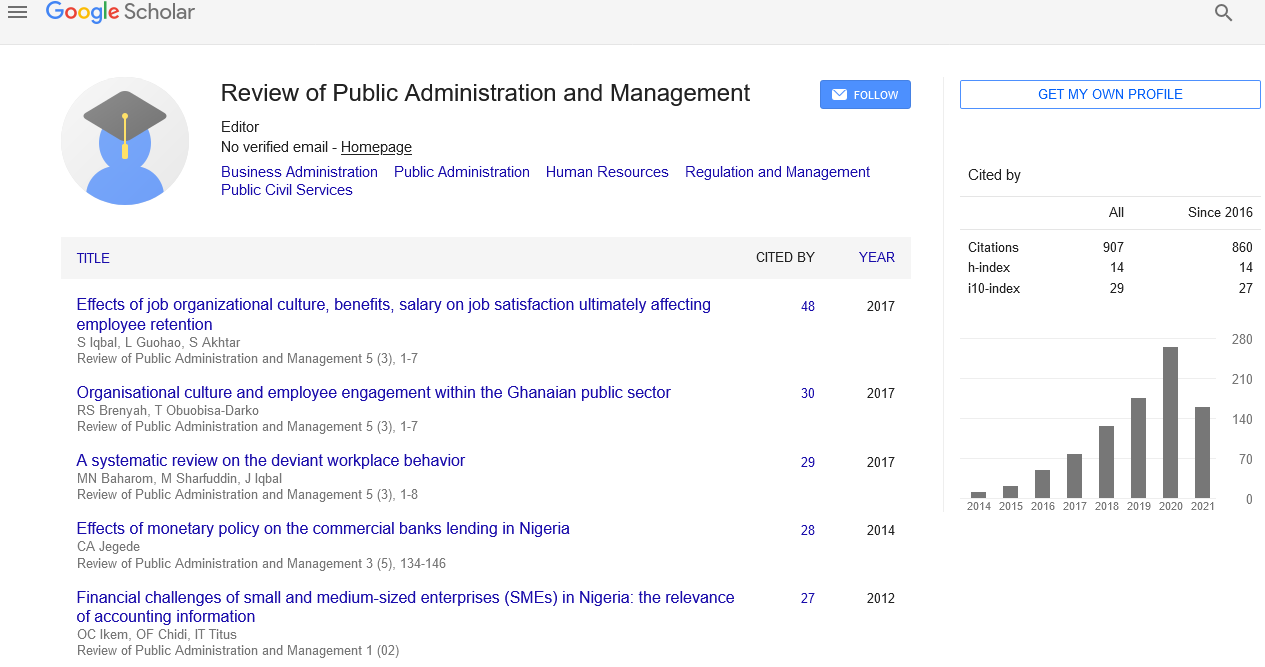


Indexed In
- CiteFactor
- RefSeek
- Directory of Research Journal Indexing (DRJI)
- Hamdard University
- EBSCO A-Z
- Scholarsteer
- Publons
- Euro Pub
- Google Scholar
Useful Links
Share This Page
Journal Flyer

Open Access Journals
- Agri and Aquaculture
- Biochemistry
- Bioinformatics & Systems Biology
- Business & Management
- Chemistry
- Clinical Sciences
- Engineering
- Food & Nutrition
- General Science
- Genetics & Molecular Biology
- Immunology & Microbiology
- Medical Sciences
- Neuroscience & Psychology
- Nursing & Health Care
- Pharmaceutical Sciences
Commentary - (2025) Volume 13, Issue 3
Intersection of Technology and Strategy: Digital Transformation for Business Model Innovation
Jing Mia *Received: 26-Dec-2024 , Manuscript No. RPAM-24-27965; Editor assigned: 30-Dec-2024 , Pre QC No. RPAM-24-27965 (PQ); Reviewed: 13-Jan-2025 , QC No. RPAM-24-27965; Revised: 11-Sep-2025 , Manuscript No. RPAM-24-27965 (R); Published: 18-Sep-2025 , DOI: 10.35248/2315-7844.25.13.497
Description
The interaction between technology and strategy is transforming the way businesses operate, creating new opportunities for innovation and adaptation. Digital transformation is central to this process, reshaping traditional business models and introducing dynamic methods of value creation. Organizations that effectively integrate advanced technology into their strategic frameworks are well-positioned to succeed in an increasingly competitive environment. The integration of digital tools into strategic planning is more than an operational enhancement; it represents a fundamental shift in how businesses envision growth and efficiency. Emerging technologies like artificial intelligence, machine learning and blockchain provide companies with capabilities that were previously unattainable. These innovations enable businesses to process vast amounts of data, optimize decision-making and deliver personalized experiences to customers. The alignment of these technological advancements with strategic objectives creates a powerful synergy that drives progress.
Digital transformation is not confined to technological upgrades but involves a rethinking of core business processes. Organizations must assess their existing operations and identify areas where technology can enhance efficiency or reduce costs. For instance, automation of routine tasks allows employees to focus on more complex and creative aspects of their roles, boosting overall productivity. Similarly, cloud computing and advanced analytics offer new ways to manage resources, forecast trends and adapt to changing market conditions. Customer engagement is another area profoundly influenced by digital transformation. Modern consumers demand seamless and personalized interactions with brands and companies that fail to meet these expectations risk losing relevance. Through the use of data analytics and customer relationship management systems, businesses can gain deep insights into consumer behavior and preferences. These insights inform marketing strategies, product development and service delivery, ensuring that offerings resonate with target audiences.
One of the most significant outcomes of integrating technology and strategy is the emergence of entirely new business models. Companies are no longer limited to traditional structures and revenue streams; instead, they can experiment with innovative approaches such as subscription-based services, platform models and collaborative ventures. These approaches often rely on digital ecosystems that connect multiple stakeholders, enabling them to share resources and co-create value. This interconnectedness expands the potential for growth and diversification. Organizations must navigate issues such as resistance to change, skill gaps and cybersecurity risks. Addressing these obstacles requires a commitment to continuous learning and adaptation. By creating a culture that values innovation and encourages experimentation, businesses can overcome these hurdles and unlock the full potential of digital transformation.
Effective leaders understand the importance of aligning technology investments with long-term strategic goals. They prioritize the development of digital competencies across the organization and ensure that teams have the resources and training needed to succeed. Transparent communication and collaboration are essential for building trust and securing buy-in from employees and stakeholders. By focusing on creative problem-solving and exploration, businesses can identify opportunities that others may overlook. For instance, the rise of the sharing economy and the proliferation of digital marketplaces are examples of how technology has inspired new ways of delivering value. Organizations that stay ahead of technological trends and anticipate shifts in consumer behavior are better equipped to remain competitive. The impact of digital transformation extends beyond individual businesses, influencing entire industries and economies. As companies adopt advanced technologies, they contribute to the creation of smarter supply chains, more efficient production methods and enhanced customer experiences. The ripple effects of technologydriven innovation are far-reaching, shaping the future of work, commerce and society as a whole.
Collaboration is another important aspect of digital transformation. Partnerships between businesses, technology providers and other stakeholders can accelerate the adoption of new tools and practices. By sharing knowledge and resources, participants can reduce costs, mitigate risks and achieve greater impact. This cooperative approach creates an environment of mutual benefit and shared success. Despite its many advantages, digital transformation requires careful planning and execution. Organizations must balance the need for innovation with the imperative to protect data privacy and ensure ethical practices. Establishing clear guidelines and accountability measures is essential for maintaining trust and integrity. Companies that prioritize responsible technology use can build stronger relationships with customers, employees and partners. Digital transformation is a powerful driver of business model innovation. By integrating advanced technologies into their strategic frameworks, organizations can unlock new possibilities for growth, efficiency and customer engagement. The process requires vision, commitment and a willingness to adapt, but the rewards are substantial. As businesses navigate this dynamic landscape, those that leverage the interplay between technology and strategy will be well-equipped to thrive in an ever-changing world.
Citation: Mia J (2025) Intersection of Technology and Strategy: Digital Transformation for Business Model Innovation. Review Pub Administration Manag. 13:497.
Copyright: © 2025 Mia J. This is an open-access article distributed under the terms of the Creative Commons Attribution License, which permits unrestricted use, distribution, and reproduction in any medium, provided the original author and source are credited.