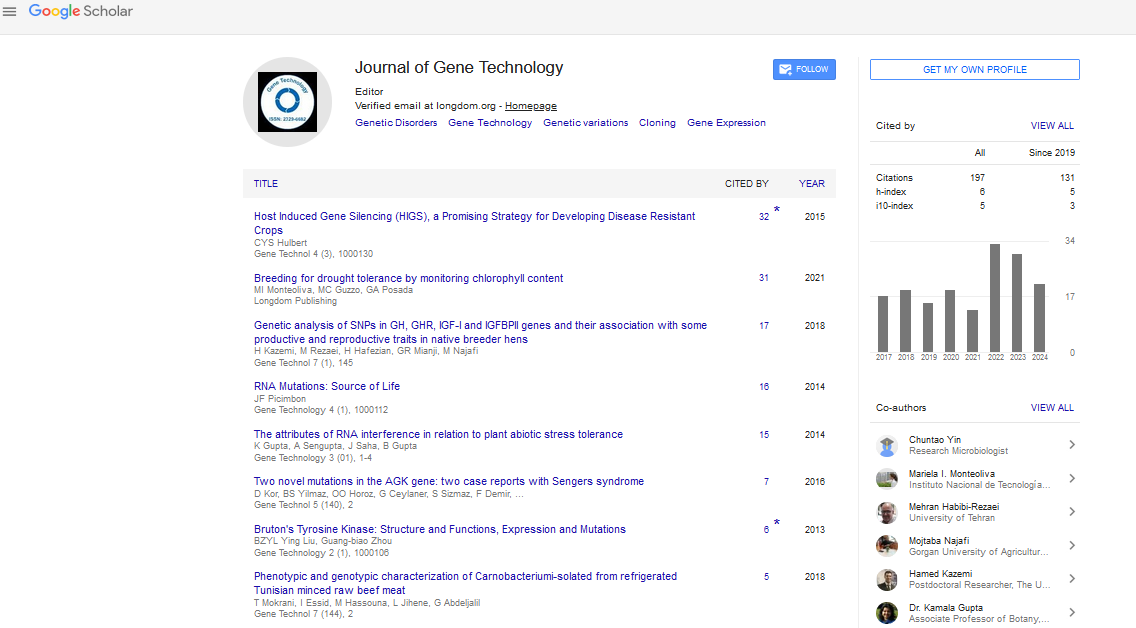


Indexed In
- Academic Keys
- ResearchBible
- CiteFactor
- Access to Global Online Research in Agriculture (AGORA)
- RefSeek
- Hamdard University
- EBSCO A-Z
- OCLC- WorldCat
- Publons
- Euro Pub
- Google Scholar
Useful Links
Share This Page
Journal Flyer

Open Access Journals
- Agri and Aquaculture
- Biochemistry
- Bioinformatics & Systems Biology
- Business & Management
- Chemistry
- Clinical Sciences
- Engineering
- Food & Nutrition
- General Science
- Genetics & Molecular Biology
- Immunology & Microbiology
- Medical Sciences
- Neuroscience & Psychology
- Nursing & Health Care
- Pharmaceutical Sciences
Opinion Article - (2025) Volume 14, Issue 3
Gene Drives Shaping the Future of Biotechnology
Ronald Hong*Received: 29-Aug-2025, Manuscript No. RDT-25-30628; Editor assigned: 01-Sep-2025, Pre QC No. RDT-25-30628 (PQ); Reviewed: 15-Sep-2025, QC No. RDT-25-30628; Revised: 22-Sep-2025, Manuscript No. RDT-25-30628 (R); Published: 29-Sep-2025, DOI: 10.35248/2329-6682.25.14.334
Abstract
Description
Gene drives have become one of the most groundbreaking and debated advancements in gene technology, offering the unprecedented ability to spread specific genetic traits rapidly through entire populations. Unlike normal Mendelian inheritance, where each gene has a 50 percent chance of being passed to offspring, a gene drive biases this process so that nearly all offspring inherit the engineered genetic element. This powerful capability has positioned gene drives as a transformative tool for addressing global challenges in public health, agriculture, and environmental conservation.
The fundamental mechanism behind gene drives relies on genetic elements that can replicate themselves during reproduction. Modern gene drive systems are most commonly built using CRISPR-Cas technology, which allows scientists to target precise sites in the genome. When an organism carrying a gene drive mates with a wild-type organism, the gene drive copies itself onto the homologous chromosome in the developing embryo. As a result, instead of producing a 50 percent inheritance rate, the modified trait can be inherited by up to 99 percent of offspring. Over many generations, this leads to rapid spread throughout the population.
One of the most widely studied applications of gene drives is in vector control, particularly for mosquitoes that transmit deadly diseases such as malaria, dengue, Zika, and chikungunya. For decades, conventional control strategies use of insecticides, bed nets, and breeding site removal have struggled to keep pace with mosquito adaptation and resistance. Gene drives offer a novel strategy by targeting the mosquitoes themselves. Researchers have developed gene drives that reduce female fertility, thereby suppressing mosquito populations, and gene drives that prevent mosquitoes from carrying the Plasmodium parasite responsible for malaria. If successfully deployed, these approaches could significantly reduce transmission rates and improve global health outcomes.
Despite their vast potential, gene drives raise significant ethical, ecological, and regulatory concerns. Because gene drives are designed to spread broadly and persist across generations, their release into the wild carries risks that must be thoroughly evaluated. Ecologists caution that altering or suppressing species could disrupt food webs, lead to unintended ecological consequences, or cause evolutionary responses that undermine the effectiveness of the gene drive. Ethical concerns include issues of consent, especially when interventions could affect communities or ecosystems across national borders. There is also fear that gene drive technology could be misused or released prematurely without adequate oversight.
To address these concerns, scientists are developing safer gene drive designs, including threshold-dependent systems that spread only when introduced above a certain population level and reversal drives that could theoretically counteract unintended releases. Strict biosafety protocols, comprehensive ecological risk assessments, and transparent public engagement are essential before field releases are considered. International regulatory frameworks are also being discussed to ensure responsible global governance of gene drive research and application.
Research in gene drives continues to advance, with laboratory studies demonstrating increasingly precise and efficient inheritance patterns in model organisms such as mosquitoes, fruit flies, and yeast. Although real-world implementation remains cautious and highly regulated, gene drives have sparked a worldwide discussion about the future of genetic technologies and their role in solving complex biological challenges.
In Conclusion, Gene drives represent a powerful and emerging frontier in gene technology, offering innovative solutions for disease control, agricultural protection, and ecosystem management. While the potential benefits are significant, responsible development, cautious evaluation, and strong ethical frameworks are essential to ensure safe and beneficial use. As the scientific community continues to refine this technology, gene drives will remain a central topic in the ongoing evolution of gene technology and its impact on society.
Citation: Hong R (2025). Gene Drives Shaping the Future of Biotechnology. Gene Technol. 14:334.
Copyright: © 2025 Hong R. This is an open-access article distributed under the terms of the Creative Commons Attribution License, which permits unrestricted use, distribution, and reproduction in any medium, provided the original author and source are credited.