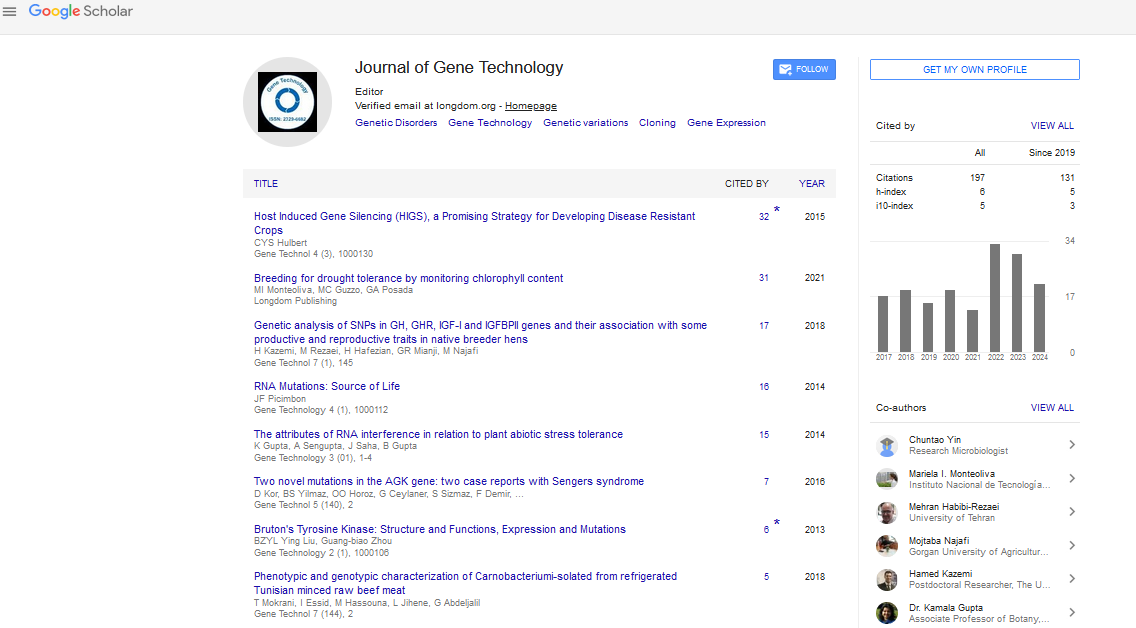


Indexed In
- Academic Keys
- ResearchBible
- CiteFactor
- Access to Global Online Research in Agriculture (AGORA)
- RefSeek
- Hamdard University
- EBSCO A-Z
- OCLC- WorldCat
- Publons
- Euro Pub
- Google Scholar
Useful Links
Share This Page
Journal Flyer

Open Access Journals
- Agri and Aquaculture
- Biochemistry
- Bioinformatics & Systems Biology
- Business & Management
- Chemistry
- Clinical Sciences
- Engineering
- Food & Nutrition
- General Science
- Genetics & Molecular Biology
- Immunology & Microbiology
- Medical Sciences
- Neuroscience & Psychology
- Nursing & Health Care
- Pharmaceutical Sciences
Commentary - (2025) Volume 14, Issue 4
Exploring the Applications and Ethical Considerations of Gene Engineering
Luis Hernandez*Received: 28-Nov-2025, Manuscript No. RDT-25-30942; Editor assigned: 01-Dec-2025, Pre QC No. RDT-25-30942 (PQ); Reviewed: 15-Dec-2025, QC No. RDT-25-30942; Revised: 22-Dec-2025, Manuscript No. RDT-25-30942 (R); Published: 29-Dec-2025, DOI: 10.35248/2329-6682.25.14.338
Description
Gene engineering is a transformative field in modern science that focuses on altering the genetic material of organisms to achieve desired traits or correct genetic disorders. This branch of biotechnology has evolved rapidly over the past few decades, allowing scientists to manipulate nucleus with unprecedented precision. Gene engineering involves the insertion, deletion, or modification of genes within an organism’s genome, enabling applications in medicine, agriculture, environmental science and industrial processes. The ability to edit genes has opened new possibilities for treating diseases, improving crop yields and addressing global challenges such as food security and climate change. By understanding and controlling the genetic code, researchers can unlock solutions that were previously thought impossible.
One of the most significant impacts of gene engineering is in the field of medicine. By correcting genetic defects, scientists can prevent or treat inherited disorders such as cystic fibrosis, sickle cell anemia and muscular dystrophy. Gene engineering has also accelerated cancer research by enabling the development of targeted therapies that attack tumor cells without harming healthy tissue. Additionally, genetically modified organisms play a role in producing pharmaceuticals more efficiently and safely. The application of gene engineering in medicine represents a shift from traditional treatments to personalized approaches, where therapies are tailored to an individual’s genetic profile. This precision medicine approach holds the promise of improving outcomes and reducing side effects for patients worldwide.
In agriculture, gene engineering has enabled the creation of crops that are more resistant to pests, diseases and environmental stress. Genetically modified crops such as drought-tolerant maize, pest-resistant cotton and vitamin enriched rice demonstrate the potential to improve food security and nutrition. These innovations reduce the need for chemical pesticides, lower production costs and increase crop yields. Gene engineering also allows for the development of livestock with improved traits such as faster growth rates, disease resistance and enhanced nutritional value. These advancements not only support farmers and the agricultural industry but also contribute to sustainable practices that can meet the demands of a growing global population.
Despite its benefits, gene engineering raises ethical, social and environmental concerns. Modifying the genetic code of humans, animals and plants requires careful consideration of potential risks and long-term effects. In humans, concerns include the unintended consequences of gene editing, genetic inequality and the possibility of altering traits beyond medical necessity. In agriculture, questions arise about the ecological impact of genetically modified organisms and the potential for crossbreeding with wild species. Ethical debates also focus on the extent to which humans should interfere with natural processes and the responsibility of scientists and policymakers to regulate gene engineering responsibly. Public dialogue and international cooperation are essential to ensure that the technology is applied in a way that benefits society while minimizing harm.
The future of gene engineering holds immense promise as scientific tools and knowledge continue to advance. Combining gene engineering with other emerging fields such as synthetic biology, nanotechnology and artificial intelligence could lead to new approaches in medicine, environmental conservation and industry. For example, researchers are exploring gene drives to control disease-carrying insects, engineering microbes to clean up environmental pollutants and designing bioengineered tissues for regenerative medicine. These innovations demonstrate the potential for gene engineering to address some of the most pressing challenges facing humanity. However, responsible research, careful risk assessment and ethical guidelines will be critical to ensure that these technologies are used safely and equitably.
In conclusion, gene engineering is a powerful tool that has transformed the landscape of modern biotechnology. While the technology presents extraordinary opportunities, it also requires careful ethical and scientific oversight to prevent unintended consequences and ensure equitable access. Gene engineering illustrates the potential of human ingenuity in understanding and harnessing the genetic code to improve life on Earth. As research progresses and applications expand, gene engineering will continue to play a central role in shaping the future of medicine, agriculture and biotechnology, demonstrating both the promise and responsibility that come with altering the building blocks of life.
Citation: Hernandez L (2025). Exploring the Applications and Ethical Considerations of Gene Engineering. Gene Technol. 14:338.
Copyright: © 2025 Hernandez L. This is an open-access article distributed under the terms of the Creative Commons Attribution License, which permits unrestricted use, distribution, and reproduction in any medium, provided the original author and source are credited.