
Indexed In
- Open J Gate
- Genamics JournalSeek
- China National Knowledge Infrastructure (CNKI)
- Ulrich's Periodicals Directory
- RefSeek
- Hamdard University
- EBSCO A-Z
- OCLC- WorldCat
- Publons
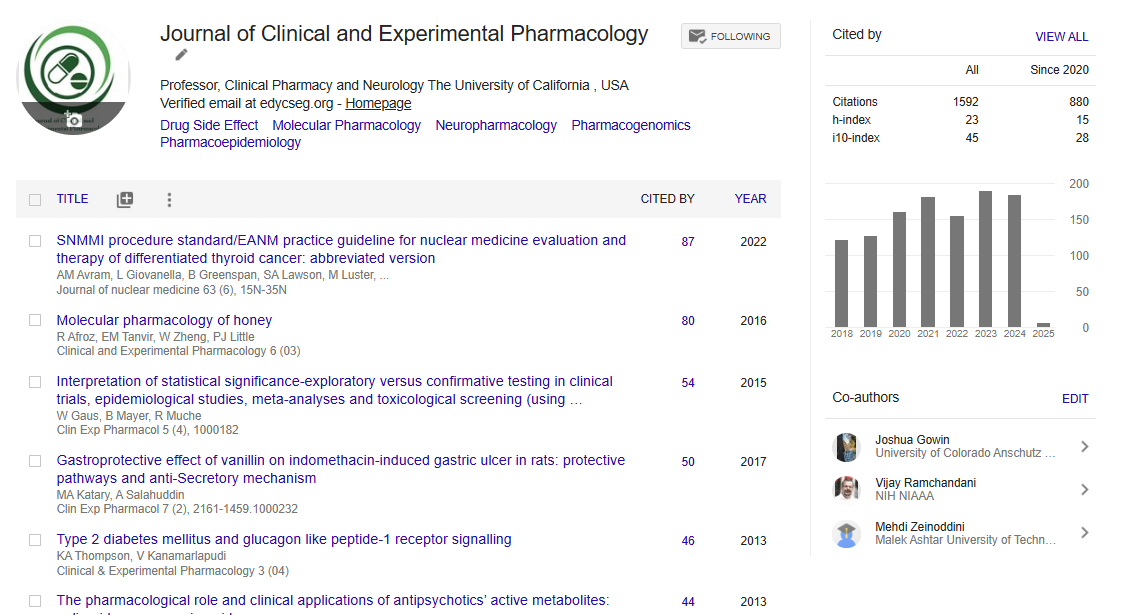
- Google Scholar
Useful Links
Share This Page
Journal Flyer
Open Access Journals
- Agri and Aquaculture
- Biochemistry
- Bioinformatics & Systems Biology
- Business & Management
- Chemistry
- Clinical Sciences
- Engineering
- Food & Nutrition
- General Science
- Genetics & Molecular Biology
- Immunology & Microbiology
- Medical Sciences
- Neuroscience & Psychology
- Nursing & Health Care
- Pharmaceutical Sciences
Opinion Article - (2025) Volume 15, Issue 6
Ethnopharmacology: Bridging Traditional Knowledge and Modern Medicine
Zhenpeng Li*Received: 19-Nov-2025, Manuscript No. CPECR-26-30818; Editor assigned: 21-Nov-2025, Pre QC No. CPECR-26-30818 (PQ); Reviewed: 05-Dec-2025, QC No. CPECR-26-30818; Revised: 12-Dec-2025, Manuscript No. CPECR-26-30818 (R); Published: 19-Dec-2025, DOI: 10.35248/2161-1459.25.15.512
Description
Ethnopharmacology is an interdisciplinary field that studies the traditional use of medicinal substances by different cultures and ethnic groups. It focuses on understanding how plants, animals, minerals and natural preparations have been used in indigenous and traditional medical systems for the prevention and treatment of diseases. By combining knowledge from pharmacology, anthropology, botany and chemistry, ethnopharmacology serves as a bridge between ancient healing practices and modern scientific medicine.
Since ancient times, human societies have relied on nature for healthcare. Traditional medical systems such as Ayurveda, Traditional Chinese Medicine (TCM), Unani and various indigenous healing practices are based on centuries of observation and experience. Ethnopharmacology seeks to document this traditional knowledge systematically and evaluate it using scientific methods. This is particularly important because much of this knowledge is passed down orally and is at risk of being lost due to modernization and cultural changes.
A major focus of ethnopharmacology is the study of medicinal plants. Many modern drugs have their origins in traditional plant-based remedies. For example, traditional uses of certain plants for pain relief, fever, or infections have guided scientists toward the discovery of important therapeutic compounds. Ethnopharmacological research begins with field studies, where researchers interact with traditional healers and local communities to record information about medicinal substances, methods of preparation, dosage and indications.
Once traditional claims are documented, laboratory studies are conducted to evaluate their safety and efficacy. These studies include phytochemical analysis to identify active constituents, pharmacological testing to assess biological activity and toxicological studies to ensure safety. Through this process, ethnopharmacology helps validate traditional medicines and provides a scientific basis for their use. In some cases, this research leads to the development of new drugs or standardized herbal formulations.
Ethnopharmacology also plays an important role in drug discovery. Natural products remain a valuable source of new therapeutic agents, especially for complex diseases such as cancer, infectious diseases and neurological disorders. Traditional knowledge often provides clues about which plants or substances may have medicinal value, reducing the time and cost involved in random screening. As a result, ethnopharmacology is considered a cost-effective and culturally informed approach to discovering novel drugs.
In addition to drug discovery, ethnopharmacology contributes to public health. In many developing regions, traditional medicine is the primary source of healthcare due to limited access to modern medical facilities. Understanding and improving traditional remedies can enhance healthcare delivery in such areas. Ethnopharmacological studies can help identify effective treatments, promote safe practices and prevent the use of harmful or toxic substances.
Ethical considerations are central to ethnopharmacology. Respect for indigenous knowledge and cultural heritage is essential. Researchers must ensure that traditional communities are acknowledged and that benefits arising from the use of their knowledge are shared fairly. Issues such as intellectual property rights and biopiracy have drawn attention to the need for ethical guidelines and international agreements to protect traditional knowledge systems.
Despite its importance, ethnopharmacology faces several challenges. Traditional remedies often vary in preparation methods, dosage and composition, making standardization difficult. Environmental factors, seasonal variation and differences in plant species can affect the quality and potency of natural products. Furthermore, translating traditional concepts of health and disease into modern scientific terms can be complex. Addressing these challenges requires collaboration among scientists, healthcare professionals and traditional practitioners.
In recent years, interest in ethnopharmacology has increased due to the global demand for natural and herbal medicines. Advances in analytical techniques, biotechnology and pharmacological testing have strengthened the scientific evaluation of traditional remedies. This integration of traditional knowledge with modern science has the potential to lead to safer, more effective and culturally acceptable therapies.
In conclusion, ethnopharmacology is a vital field that connects traditional medical wisdom with modern pharmacological research. By preserving indigenous knowledge, supporting drug discovery and promoting culturally relevant healthcare, ethnopharmacology contributes significantly to global health. As scientific methods continue to evolve, ethnopharmacology will remain an important source of inspiration for future medicines and a key tool in understanding the therapeutic potential of nature.
Citation: Li Z (2025). Ethnopharmacology: Bridging Traditional Knowledge and Modern Medicine. J Clin Exp Pharmacol. 15:512.
Copyright: © 2025 Li Z. This is an open-access article distributed under the terms of the Creative Commons Attribution License, which permits unrestricted use, distribution and reproduction in any medium, provided the original author and source are credited.