
Indexed In
- CiteFactor
- RefSeek
- Directory of Research Journal Indexing (DRJI)
- Hamdard University
- EBSCO A-Z
- Scholarsteer
- Publons
- Euro Pub
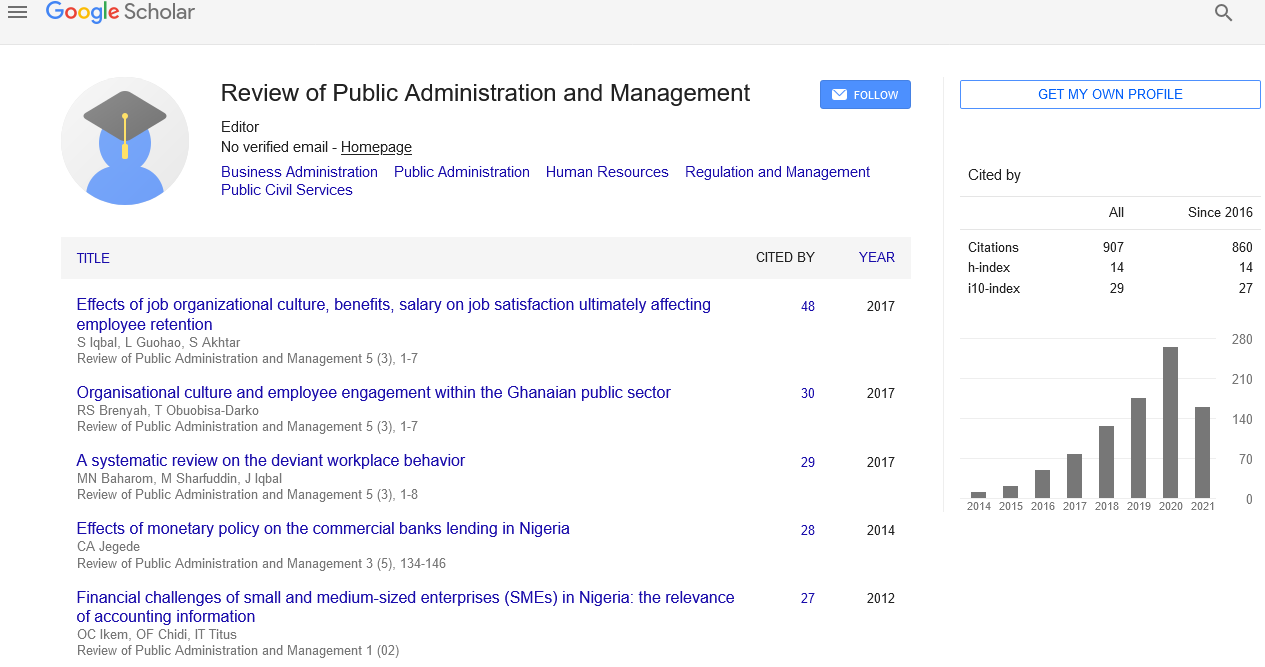
- Google Scholar
Useful Links
Share This Page
Journal Flyer
Open Access Journals
- Agri and Aquaculture
- Biochemistry
- Bioinformatics & Systems Biology
- Business & Management
- Chemistry
- Clinical Sciences
- Engineering
- Food & Nutrition
- General Science
- Genetics & Molecular Biology
- Immunology & Microbiology
- Medical Sciences
- Neuroscience & Psychology
- Nursing & Health Care
- Pharmaceutical Sciences
Commentary - (2025) Volume 13, Issue 3
Efficient Resource Management: The Intersection of Consumption and Government Administration
Karen Jansen *Received: 26-Dec-2024 , Manuscript No. RPAM-24-27970; Editor assigned: 30-Dec-2024 , Pre QC No. RPAM-24-27970 (PQ); Reviewed: 13-Jan-2025 , QC No. RPAM-24-27970; Revised: 11-Sep-2025 , Manuscript No. RPAM-24-27970 (R); Published: 18-Sep-2025 , DOI: 10.35248/2315-7844.25.13.502
Description
Efficient resource management is essential for the smooth functioning of government administration, ensuring that public resources are used effectively to meet societal needs. Governments must balance resource consumption with the efficient delivery of services, making decisions that optimize the use of funds, human capital and infrastructure. The management of these resources is a complex task, requiring coordination among various sectors, careful planning and data-driven decisionmaking. Governments are responsible for managing a wide array of resources, including finances, personnel, infrastructure and natural assets. These resources are allocated across different sectors, each with its own priorities, such as healthcare, education, transportation and security. The challenge lies in distributing resources in a way that meets the demands of each sector without draining others, while considering economic constraints and long-term planning. To manage resources effectively, governments must track and monitor usage patterns. Data analysis plays a vital role in understanding consumption trends, identifying inefficiencies and making informed decisions. This allows governments to allocate resources where they are most needed and ensure transparency in resource distribution. For example, with data-driven insights, governments can pinpoint areas of waste and make adjustments, resulting in more efficient service delivery and optimized spending.
Human capital is another essential resource that requires careful management. Public administration must ensure that government employees are skilled, efficient and capable of performing their roles. This involves training staff and developing their skills to meet the demands of modern governance. As populations change and demographics shift, governments must also adapt their workforce planning to address evolving needs in different sectors. Investing in human capital not only improves service delivery but also contributes to the overall effectiveness of government operations. Infrastructure management is also a significant challenge. Governments must balance the construction of new infrastructure with the maintenance of existing assets, such as roads, utilities and public buildings. Proper infrastructure planning ensures that public services are accessible and reliable, while also considering sustainability. This requires thoughtful planning to optimize resource use and minimize waste, especially with increasing concerns about environmental impact.
Managing natural resources, such as water, energy and land, adds another layer of complexity. Governments must regulate the consumption of these finite resources to ensure their long-term availability. Policies promoting sustainability, renewable energy and efficient use of resources are key to achieving this. Governments must strike a balance between meeting immediate demands and preserving resources for future generations, addressing both economic and environmental concerns. Collaboration with the private sector is also critical for efficient resource management. Public-private partnerships enable governments to access expertise, technology and financial resources that may not be available within the public sector. These partnerships can help improve service delivery and infrastructure development, as private companies may be able to offer more efficient solutions. Additionally, working with nongovernmental organizations and community groups ensures that government policies align with the needs of various populations. Efficient management of public funds is another crucial aspect of resource administration. Governments must carefully manage spending to avoid waste and ensure that resources are allocated to priority areas. Budgetary constraints require difficult decisions about which services to prioritize, but transparent budgeting processes and regular monitoring allow governments to adjust spending as needed to respond to changing circumstances. Sustainability is an increasingly important consideration in resource management. Governments are expected to adopt environmentally responsible practices, including reducing waste, promoting green technologies and minimizing carbon emissions. Governments that focus on sustainable resource management can reduce costs, increase efficiency and ensure that future generations inherit a more stable and sustainable society.
Conclusion
In conclusion, efficient resource management is fundamental to the effective operation of government administration. By carefully managing finances, human capital, infrastructure and natural resources, governments can provide better services to citizens, promote economic growth and ensure sustainability. The use of data, collaboration with the private sector and transparent decision-making are essential components of successful resource management. Ultimately, governments that balance resource consumption with responsible administration can achieve greater prosperity and stability for their citizens.
Citation: Jansen K (2025) Efficient Resource Management: The Intersection of Consumption and Government Administration. Review Pub Administration Manag. 13:502.
Copyright: © 2025 Jansen K. This is an open-access article distributed under the terms of the Creative Commons Attribution License, which permits unrestricted use, distribution, and reproduction in any medium, provided the original author and source are credited.