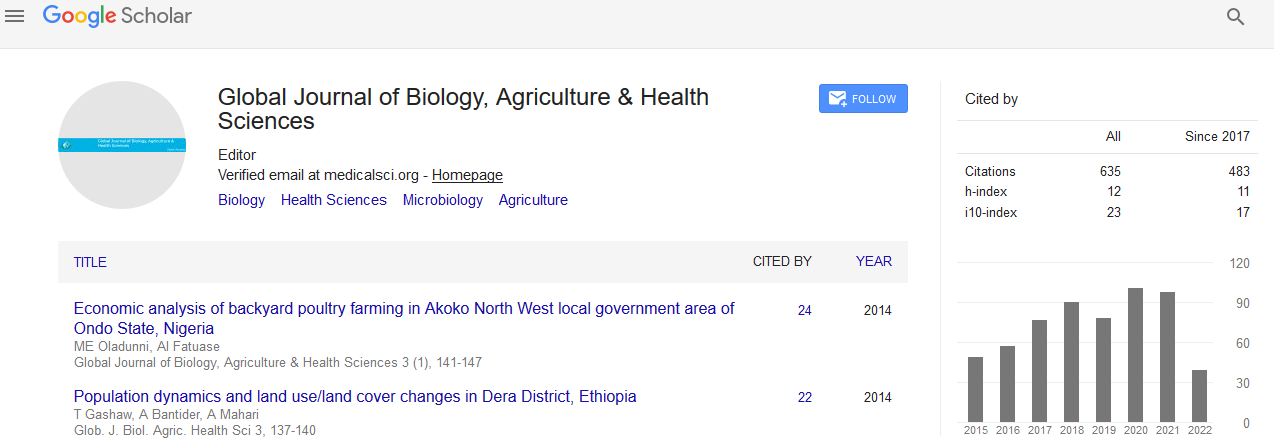

Indexed In
- Euro Pub
- Google Scholar
Useful Links
Share This Page
Journal Flyer
Open Access Journals
- Agri and Aquaculture
- Biochemistry
- Bioinformatics & Systems Biology
- Business & Management
- Chemistry
- Clinical Sciences
- Engineering
- Food & Nutrition
- General Science
- Genetics & Molecular Biology
- Immunology & Microbiology
- Medical Sciences
- Neuroscience & Psychology
- Nursing & Health Care
- Pharmaceutical Sciences
Perspective - (2026) Volume 15, Issue 1
Ecosystem Functioning and Organismal Interactions in Environmental Biology Research
Laura Peterson*Received: 10-Feb-2026, Manuscript No. GJBAHS-26-31450; Editor assigned: 12-Feb-2026, Pre QC No. GJBAHS-26-31450; Reviewed: 26-Feb-2026, QC No. GJBAHS-26-31450; Revised: 05-Mar-2026, Manuscript No. GJBAHS-26-31450; Published: 12-Mar-2026, DOI: 10.35248/2319-5584.26.15.286
Abstract
Description
Environmental biology focuses on the study of interactions between living organisms and their surroundings, including air, water, soil, and climate systems. Research in this field examines how biological communities respond to natural changes and human activities. Scientists investigate relationships among species, energy flow within ecosystems, and the movement of nutrients through ecological cycles. These studies help explain how environmental conditions influence the survival, growth, and distribution of organisms across different habitats.
One important area of environmental biology research is ecosystem analysis. Ecosystems are studied as integrated systems where plants, animals, microorganisms, and physical components interact continuously. Researchers measure energy transfer from primary producers such as plants to higher-level consumers like herbivores and carnivores. Observations are made in both natural environments and controlled experimental setups to understand how ecosystems maintain stability under varying conditions. Changes in temperature, rainfall, and soil quality are often examined to assess their impact on ecosystem functioning.
Population dynamics is another major focus of environmental biology. Scientists study how populations of different species increase or decrease over time. Factors such as reproduction rate, mortality, migration, and resource availability are analyzed to understand population trends. Field surveys and long-term monitoring programs provide data on species abundance and distribution. These findings are used to interpret how environmental pressures influence population stability and community structure.
Biodiversity studies play a central role in environmental biology. Researchers examine the variety of life forms within ecosystems, including genetic, species, and ecosystem diversity. High biodiversity is often associated with greater ecological stability, while reduced diversity may indicate environmental stress. Field sampling, remote sensing, and genetic analysis are used to document species presence and evaluate changes in biodiversity over time. These studies also help identify regions that require conservation attention.
Soil and water ecology are essential components of environmental biological research. Scientists analyze soil composition, microbial activity, and nutrient content to understand how terrestrial ecosystems function. In aquatic systems, water quality parameters such as pH, dissolved oxygen, salinity, and pollutant levels are measured. These factors influence the survival of aquatic organisms and the overall health of freshwater and marine ecosystems. Laboratory experiments are often combined with field observations to study these environmental variables.
Climate-related studies are increasingly important in environmental biology. Researchers investigate how changes in temperature patterns, precipitation levels, and atmospheric conditions affect biological systems. Long-term climate data is compared with ecological observations to identify shifts in species distribution and ecosystem behavior. These studies help explain how organisms adapt to changing environmental conditions and how ecosystems respond to long-term climatic variation.
Pollution impact assessment is another key research area. Scientists study the effects of chemical, industrial, and agricultural pollutants on living organisms and ecosystems. Air pollution is analyzed in relation to respiratory effects on animals and plants, while water pollution studies focus on contamination of aquatic habitats. Soil pollution research examines the accumulation of harmful substances and their impact on plant growth and microbial communities. These investigations support the development of environmental protection strategies. Human impact on ecosystems is also a significant area of study. Land use changes, urban development, deforestation, and agricultural expansion are examined to understand their effects on natural habitats.
Conclusion
Environmental biology research continues to expand through continuous observation and analysis of natural systems. Technological tools are widely used in environmental biology research. Geographic information systems, satellite imaging, and ecological modeling software assist in data collection and analysis. These tools allow researchers to map ecosystems, track environmental changes, and predict future ecological trends. Field instruments are also used to measure environmental parameters accurately in real time. The integration of field studies, laboratory experiments, and technological applications supports a deeper understanding of ecological processes and the factors influencing them.
Citation: Peterson L (2026). Ecosystem Functioning and Organismal Interactions in Environmental Biology Research. Glob J Agric Health Sci. 15:286.
Copyright: © 2026 Peterson L. This is an open-access article distributed under the terms of the Creative Commons Attribution License, which permits unrestricted use, distribution and reproduction in any medium, provided the original author and source are credited.