
Indexed In
- Open J Gate
- Academic Keys
- JournalTOCs
- ResearchBible
- RefSeek
- Hamdard University
- EBSCO A-Z
- OCLC- WorldCat
- Publons
- Geneva Foundation for Medical Education and Research
- Euro Pub
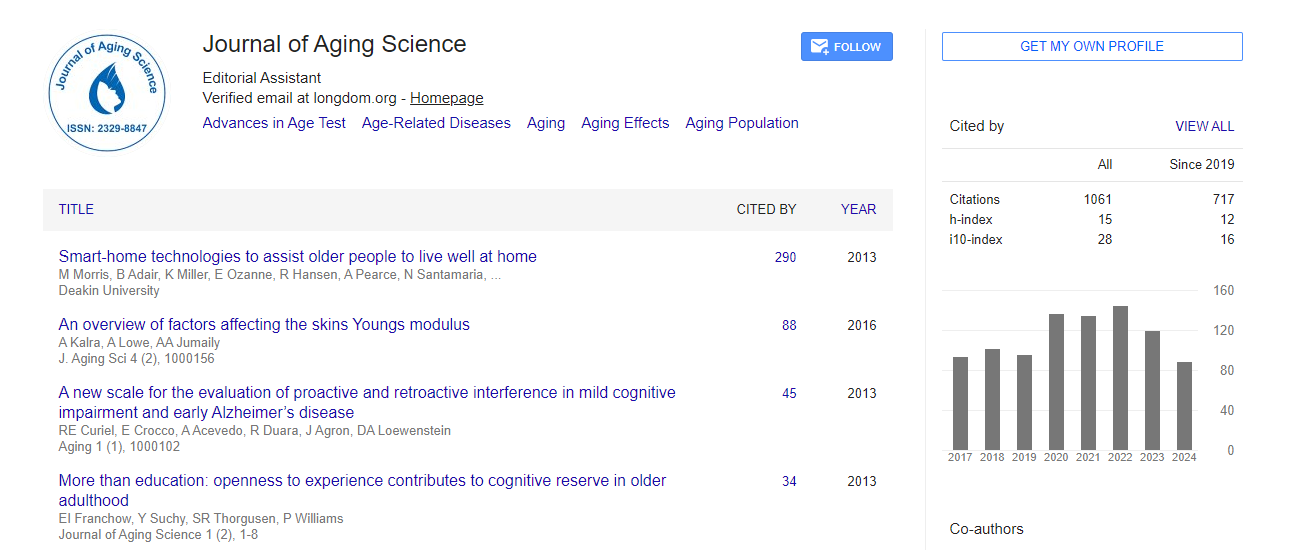
- Google Scholar
Useful Links
Share This Page
Journal Flyer
Open Access Journals
- Agri and Aquaculture
- Biochemistry
- Bioinformatics & Systems Biology
- Business & Management
- Chemistry
- Clinical Sciences
- Engineering
- Food & Nutrition
- General Science
- Genetics & Molecular Biology
- Immunology & Microbiology
- Medical Sciences
- Neuroscience & Psychology
- Nursing & Health Care
- Pharmaceutical Sciences
Commentary - (2025) Volume 13, Issue 4
Decoding Longevity: Emerging Molecular Pathways Driving the Future of Aging Research
Liana Veras*Received: 30-Sep-2025, Manuscript No. JASC-25-30491; Editor assigned: 02-Oct-2025, Pre QC No. JASC-25-30491 (PQ); Reviewed: 16-Oct-2025, QC No. JASC-25-30491; Revised: 23-Oct-2025, Manuscript No. JASC-25-30491 (R); Published: 31-Oct-2025, DOI: 10.35248/2329-8847.25.13.427
Description
This article reviews the fast-growing field of molecular aging research, focusing on pathways such as autophagy, mitochondrial resilience, proteostasis, epigenetic patterns and cellular stress resistance. It explores how these pathways not only explain why we age but also offer new opportunities for longevity interventions. For centuries, aging was viewed as an unavoidable decline dictated by time. Today, the field of aging research has overturned this assumption, demonstrating that aging is a complex yet modifiable biological process governed by cellular and molecular pathways. From DNA repair mechanisms to metabolic regulation, scientific breakthroughs are revealing the intricacies of why cells deteriorate and how we might slow or even reverse certain components of aging.
The expansion of geroscience has created new optimism for enhancing both lifespan and healthspan.This article explores the molecular pathways most critical to aging: epigenetic drift, mitochondrial impairment, proteostasis decline, nutrient-sensing pathways and cellular senescence. By understanding these mechanisms, researchers are creating therapies capable of modulating biological aging.
Epigenetic alterations: The molecular clock within
Epigenetics involves changes that affect gene expression without modifying DNA sequence. One of the most significant discoveries in modern geroscience is that epigenetic patterns shift systematically with age. DNA methylation levels, histone modifications and chromatin remodeling collectively define biological age often more accurately than chronological age.
Epigenetic clocks such as the Horvath and Hannum clocks measure these methylation signatures. They correlate strongly with disease risk, mortality and lifestyle exposures. Ongoing research shows that epigenetic aging is modifiable: short-term lifestyle interventions, including stress reduction and improved sleep, have demonstrated small but measurable decreases in epigenetic age.
Mitochondrial dysfunction and cellular energy decline
Mitochondria the cell’s energy producers play a central role in aging. As mitochondria deteriorate, they generate higher levels of Reactive Oxygen Species (ROS), impairing proteins, lipids and DNA.
Key mitochondrial hallmarks of aging include:
• Reduced ATP production
• Accumulation of mtDNA mutations
• Decreased mitophagy (removal of damaged mitochondria)
• Impaired oxidative phosphorylation
Research into NAD⁺ boosters, mitochondrial-targeted antioxidants and mitophagy enhancers offers new therapeutic possibilities. Compounds such as urolithin A have shown promise in improving muscle function by promoting mitochondrial renewal.
Proteostasis: Maintaining protein quality with age
Proteostasis the maintenance of functional proteins is essential for cellular health. Aging disrupts proteostasis by weakening the cell’s ability to fold, repair and degrade proteins properly. This breakdown plays a major role in neurodegenerative diseases such as Alzheimer’s and Parkinson’s.
Key components contributing to proteostasis decline include:
• Impaired autophagy
• Reduced chaperone protein activity
• Accumulation of misfolded proteins
Interventions that enhance autophagy, such as mTOR inhibitors and certain plant-derived compounds, have shown strong potential in extending lifespan in model organisms.
Nutrient-sensing pathways and longevity
Four major nutrient-sensing pathways play an essential role in aging:
• mTOR
• AMPK
• Insulin/IGF-1
• Sirtuins
These pathways determine whether a cell focuses on growth or maintenance. When nutrient abundance is high, growth pathways dominate but this accelerates aging. Caloric restriction, intermittent fasting and metabolic mimetics shift the balance toward repair and stress resilience.
Rapamycin, a well-known mTOR inhibitor, is one of the most promising pharmacological candidates for slowing aging. Meanwhile, metformin, resveratrol and NAD⁺ precursors regulate similar pathways and are being investigated in longevity trials.
Cellular senescence: A double-edged sword
Cellular senescence occurs when cells stop dividing in response to stress or damage. While senescence prevents cancerous growth, accumulated senescent cells release inflammatory molecules that impair tissue health.
Senolytics drugs that selectively destroy senescent cells have reversed multiple aging markers in mice and improved physical function in older adults in early trials. These breakthroughs suggest that clearing senescent cells may one day become a mainstream anti-aging strategy.
Conclusion
Modern aging research has progressed from observing agerelated decline to understanding and actively altering molecular pathways. Epigenetic drift, mitochondrial weakness, proteostasis disruption, nutrient-sensing imbalances and senescence are no longer mysteries they are therapeutic targets. While many interventions are still experimental, the rapid pace of discovery suggests a future where aging is increasingly manageable. Instead of merely treating diseases of old age, science is finally addressing aging itself, paving the way for longer, healthier lives.
Citation: Veras L(2025). Decoding Longevity: Emerging Molecular Pathways Driving the Future of Aging Research. J Aging Sci. 13:427.
Copyright: © 2025 Veras L. This is an open-access article distributed under the terms of the Creative Commons Attribution License, which permits unrestricted use, distribution and reproduction in any medium, provided the original author and source are credited.