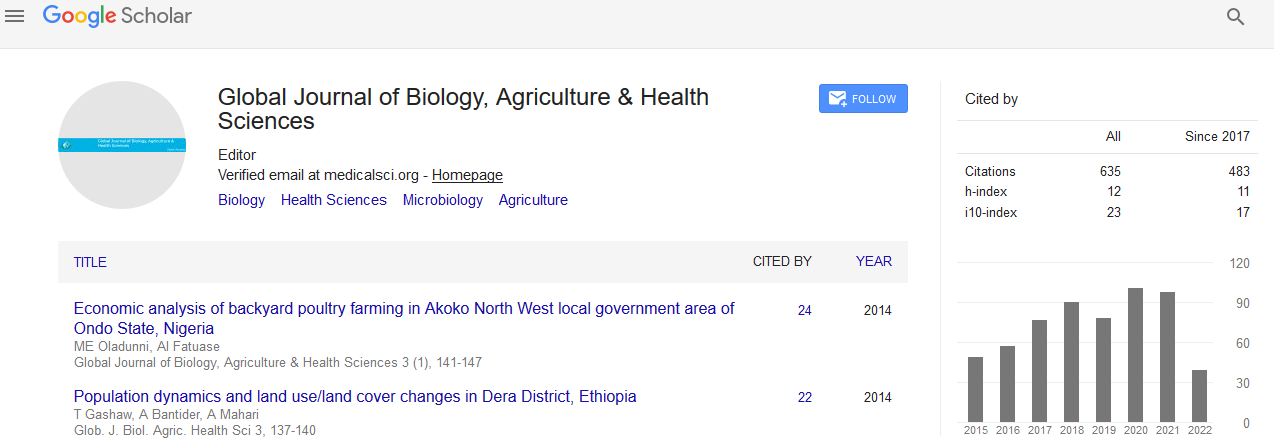

Indexed In
- Euro Pub
- Google Scholar
Useful Links
Share This Page
Journal Flyer
Open Access Journals
- Agri and Aquaculture
- Biochemistry
- Bioinformatics & Systems Biology
- Business & Management
- Chemistry
- Clinical Sciences
- Engineering
- Food & Nutrition
- General Science
- Genetics & Molecular Biology
- Immunology & Microbiology
- Medical Sciences
- Neuroscience & Psychology
- Nursing & Health Care
- Pharmaceutical Sciences
Commentary - (2025) Volume 14, Issue 3
Agronomy: Principles, Practices, and Role in Sustainable Agriculture
Ethan Caldwell*Received: 19-Aug-2025, Manuscript No. GJHABS-25-30752; Editor assigned: 21-Aug-2025, Pre QC No. GJHABS-25-30752; Reviewed: 04-Sep-2025, QC No. GJHABS-25-30752; Revised: 11-Sep-2025, Manuscript No. GJHABS-25-30752; Published: 18-Sep-2025, DOI: 10.35248/2319-5584.25.14.262
Description
Agronomy is the scientific discipline that focuses on the study of crops, soils, and the management practices necessary for efficient agricultural production. It integrates principles from biology, chemistry, physics, and ecology to improve crop yields, maintain soil fertility, and optimize resource use. Agronomy is critical for addressing food security, environmental sustainability, and the efficient use of natural resources in agriculture. The field covers a broad spectrum of topics, including crop selection, soil management, irrigation, pest and nutrient management, and sustainable farming practices.
Soil management is a central aspect of agronomy. Healthy soil provides essential nutrients, supports root growth, and regulates water availability for crops. Agronomists study soil composition, structure, pH, and fertility to determine optimal management practices. Techniques such as crop rotation, cover cropping, organic amendments, and conservation tillage maintain soil health, prevent erosion, and improve nutrient cycling. Understanding the interactions between soil, water, and crops allows for precise interventions that enhance productivity while protecting the environment.
Crop selection and improvement are also important areas in agronomy. Different crops have specific requirements for soil type, nutrient levels, and climatic conditions. Agronomists evaluate crop varieties for yield potential, disease resistance, drought tolerance, and nutrient efficiency. Plant breeding, genetic selection, and modern biotechnology help develop high-performing cultivars adapted to local environments. Selecting the right crop and variety for a given region ensures efficient use of resources and maximizes agricultural output.
Irrigation and water management are critical in ensuring consistent crop growth, especially in regions with variable rainfall. Agronomists assess crop water requirements, soil moisture levels, and climatic conditions to design effective irrigation schedules. Methods such as drip, sprinkler, and surface irrigation are applied depending on crop type and field conditions. Efficient water management reduces waste, maintains soil health, and supports sustainable agricultural practices.
Nutrient and pest management are essential to optimize crop growth and yield. Agronomists analyze soil nutrient levels and recommend appropriate fertilization strategies to meet crop demands. Proper nutrient management prevents deficiencies and excesses that can harm plant health and the environment. Pest and disease management involves monitoring, biological controls, cultural practices, and, when necessary, selective chemical interventions. Integrated approaches ensure sustainable crop protection while minimizing negative environmental impacts.
Sustainable agriculture is a growing focus within agronomy. Practices such as conservation agriculture, precision farming, organic farming, and agroforestry optimize resource use while reducing environmental impacts. Precision farming utilizes technologies such as GPS mapping, soil sensors, and remote sensing to monitor crop health and apply inputs efficiently. These practices improve productivity, reduce costs, and contribute to long-term agricultural sustainability.
Conclusion
Agronomy is a multidisciplinary science that integrates crop, soil, water, and resource management to optimize agricultural productivity and sustainability. By understanding and applying principles of soil health, crop selection, water and nutrient management, and pest control, agronomists support efficient and environmentally responsible farming. Research, technological innovation, and knowledge transfer are central to advancing agronomic practices, ensuring food security, and maintaining ecological balance. Agronomy also addresses the challenges of climate change. Rising temperatures, changing rainfall patterns, and increased frequency of extreme weather events affect crop performance.
Citation: Caldwell E (2025). Agronomy: Principles, Practices, and Role in Sustainable Agriculture. Glob J Agric Health Sci. 14:262.
Copyright: © 2025 Caldwell E. This is an open-access article distributed under the terms of the Creative Commons Attribution License, which permits unrestricted use, distribution and reproduction in any medium, provided the original author and source are credited.