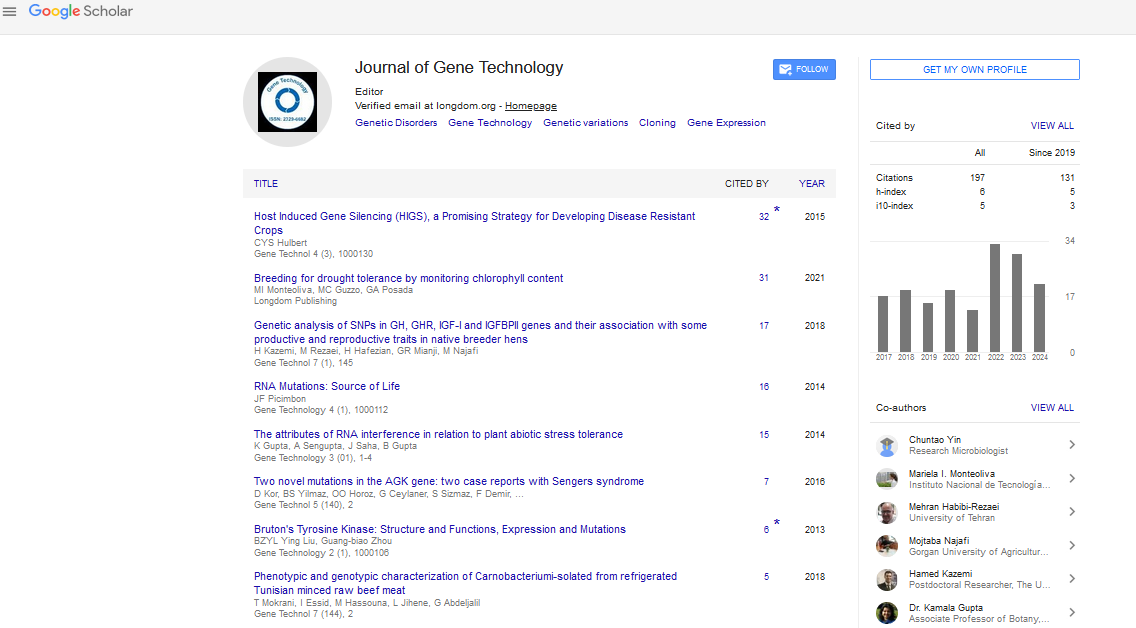

Indexed In
- Academic Keys
- ResearchBible
- CiteFactor
- Access to Global Online Research in Agriculture (AGORA)
- RefSeek
- Hamdard University
- EBSCO A-Z
- OCLC- WorldCat
- Publons
- Euro Pub
- Google Scholar
Useful Links
Share This Page
Journal Flyer

Open Access Journals
- Agri and Aquaculture
- Biochemistry
- Bioinformatics & Systems Biology
- Business & Management
- Chemistry
- Clinical Sciences
- Engineering
- Food & Nutrition
- General Science
- Genetics & Molecular Biology
- Immunology & Microbiology
- Medical Sciences
- Neuroscience & Psychology
- Nursing & Health Care
- Pharmaceutical Sciences
Perspective - (2025) Volume 14, Issue 4
Advances in Marker Assisted Breeding for Disease Resistant and Nutritious Varieties
Aisha Rahman*Received: 28-Nov-2025, Manuscript No. RDT-25-30946; Editor assigned: 01-Dec-2025, Pre QC No. RDT-25-30946 (PQ); Reviewed: 15-Dec-2025, QC No. RDT-25-30946; Revised: 22-Dec-2025, Manuscript No. RDT-25-30946 (R); Published: 29-Dec-2025, DOI: 10.35248/2329-6682.25.14.342
Description
Marker Assisted Breeding (MAB) is a powerful in modern agriculture that uses molecular markers to accelerate and improve the process of developing superior crop varieties. Traditional breeding methods rely on selecting plants based on observable traits, which can be influenced by environmental factors and may require several generations to achieve desired results. Marker Assisted Breeding (MAB) on other hand allows breeders to select plants based on their genetic material at an early stage, identifying the presence of specific genes or quantitative trait loci associated with important characteristics such as disease resistance, drought tolerance, yield potential, or nutritional quality. This method has transformed plant breeding by making it more precise, efficient and time-saving.
The basis of Marker Assisted Breeding (MAB) lies in the identific ation use of molecular markers which are specific sequences in the genetic material linked to traits of interest. These markers serve as indicators, allowing scientists to track the inheritance of genes during the breeding process. Techniques such as simple sequence repeats, single nucleotide polymorphisms and restriction fragment length polymorphisms are commonly used to detect these markers. Once markers associated with desirable traits are identified, breeders can cross plants and select offspring carrying the targeted genes without waiting for the plants to fully mature or express the traits. This reduces the breeding cycle and enhances the accuracy of selecting superior varieties.
Marker Assisted Breeding (MAB) has had a significant impact on improving crop productivity and resilience. For example, in rice, markers linked to blast disease resistance or submergence tolerance have enabled the development of high-yielding varieties that can withstand adverse conditions. In wheat, markers associated with rust resistance have facilitated the creation of varieties resistant to multiple diseases, reducing dependence on chemical pesticides. The technique is also used to improve nutritional quality, such as increasing protein content in maize or enhancing vitamin levels in cassava. These applications demonstrate how Marker Assisted Breeding (MAB) contributes to food security, sustainable agriculture and the production of crops that meet the nutritional needs of growing populations.
In addition to improving crop traits allows for the conservation and utilization of genetic diversity. By identifying and tracking valuable genes in wild relatives or landraces, breeders can incorporate beneficial traits into cultivated varieties. This not only broadens the genetic base of crops but also helps safeguard them against future challenges such as climate change, emerging pests and diseases. The integration of genetic information in breeding programs enhances the predictability of outcomes and minimizes the loss of valuable traits, making breeding more strategic and targeted.
The efficiency of Marker Assisted Breeding (MAB) has also contri buted to reducing costs and resources in plant breeding programs. Traditional breeding requires the cultivation and evaluation of large populations over multiple seasons, which is timeconsuming and labour-intensive. By using molecular markers, breeders can focus on a smaller subset of plants with the desired genetic composition, conserving land, labour and other resources. Furthermore, combining Marker Assisted Breeding (MAB) with other modern biotechnological tools, such as genetic mapping and genomic selection, enables the rapid development of high-performing varieties tailored to specific environments and production systems.
Despite its advantages, Marker Assisted Breeding (MAB) faces challenges. The identification of reliable markers linked to complex traits can be difficult, especially for traits controlled by multiple genes or influenced by environmental interactions. In addition, the initial setup of molecular marker technologies requires investment in laboratory infrastructure, skilled personnel and data management systems. Ethical considerations regarding access to genetic resources and intellectual property rights also play a role in the adoption and dissemination of Marker Assisted Technologies (MAT). Addressing these challenge requires collaboration between research institutions, governments and farmers to ensure equitable and sustainable use of the technology.
In conclusion, Marker Assisted Breeding (MAB) represents a major advancement in agricultural science, enabling precise and efficient selection of superior crop varieties. By using molecular markers to track desirable genes, breeders can develop crops with improved yield, quality and resilience in less time compared to traditional methods. The technique also supports the conservation of genetic diversity and reduces the resources required for breeding programs. While challenges remain, ongoing technological advancements and collaborative efforts are expanding the potential of Marker Assisted Breeding (MAB), making it a critical tool for sustainable agriculture, food security and the development of crops adapted to the demands of the twenty-first century.
Citation: Rahman A (2025). Advances in Marker Assisted Breeding for Disease Resistant and Nutritious Varieties. Gene Technol. 14:342.
Copyright: © 2025 Rahman A. This is an open-access article distributed under the terms of the Creative Commons Attribution License, which permits unrestricted use, distribution, and reproduction in any medium, provided the original author and source are credited.