
Indexed In
- Open J Gate
- Genamics JournalSeek
- Academic Keys
- JournalTOCs
- China National Knowledge Infrastructure (CNKI)
- Ulrich's Periodicals Directory
- RefSeek
- Hamdard University
- EBSCO A-Z
- Directory of Abstract Indexing for Journals
- OCLC- WorldCat
- Publons
- Geneva Foundation for Medical Education and Research
- Euro Pub
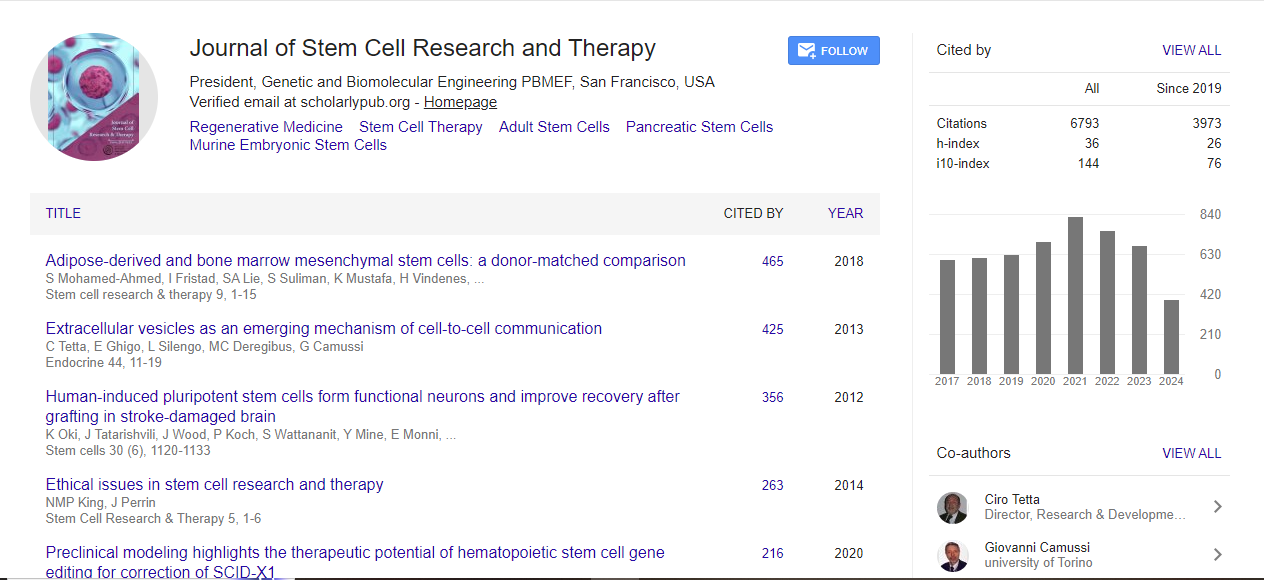
- Google Scholar
Useful Links
Share This Page
Journal Flyer
Open Access Journals
- Agri and Aquaculture
- Biochemistry
- Bioinformatics & Systems Biology
- Business & Management
- Chemistry
- Clinical Sciences
- Engineering
- Food & Nutrition
- General Science
- Genetics & Molecular Biology
- Immunology & Microbiology
- Medical Sciences
- Neuroscience & Psychology
- Nursing & Health Care
- Pharmaceutical Sciences
Stem Cell Therapy for Chronic Diabetic Wound Healing
9th Annual Conference on Stem Cell and Regenerative
April 14-15, 2026 | Budapest, Hungary
Olivia Bennett
University of Melbourne, Australia
Scientific Tracks Abstracts: J Geol Geophy
Abstract:
Diabetic foot ulcers are among the most common complications of diabetes mellitus, frequently leading to prolonged hospitalization, infection, and lower-limb amputation. Conventional wound management often fails to achieve complete tissue regeneration due to impaired angiogenesis, chronic inflammation, and reduced cellular repair mechanisms. Stem cell-based therapies have emerged as promising alternatives for enhancing tissue regeneration and improving wound healing outcomes. This study investigates the therapeutic potential of adipose-derived mesenchymal stem cells (AD-MSCs) combined with collagen-based hydrogel dressings in patients with chronic diabetic wounds. Mesenchymal stem cells possess immunomodulatory properties and secrete multiple growth factors, including vascular endothelial growth factor (VEGF), fibroblast growth factor (FGF), and transforming growth factor-beta (TGF-β), which collectively stimulate angiogenesis, fibroblast proliferation, and extracellular matrix remodeling. Clinical evaluation demonstrated accelerated wound closure, enhanced neovascularization, reduced inflammatory cytokine expression, and improved epithelial regeneration comparedwith conventional wound care. Histological analysis further confirmed increased collagen deposition and better tissue organization in treated wounds. Importantly, no severe adverse events or immune rejection were observed during follow-up, supporting the safety profile of autologous MSC therapy. Future research aims to optimize stem cell dosage, scaffold composition, and delivery techniques while incorporating bioengineered dressings capable of sustained growth factor release. Large multicentre clinical trials are needed to validate these findings and establish standardized treatment protocols. The integration of stem cell therapy into diabetic wound management may significantly reduce healthcare costs, improve patient quality of life, and decrease the incidence of diabetes-related amputations.
Biography :
Olivia Bennett is a regenerative medicine scientist at the University of Melbourne specializing in stem cell therapies for chronic wound repair. Her research focuses on tissue engineering, biomaterials, and translational regenerative medicine. She has published more than 60 scientific articles and serves on several international collaborative research projects.