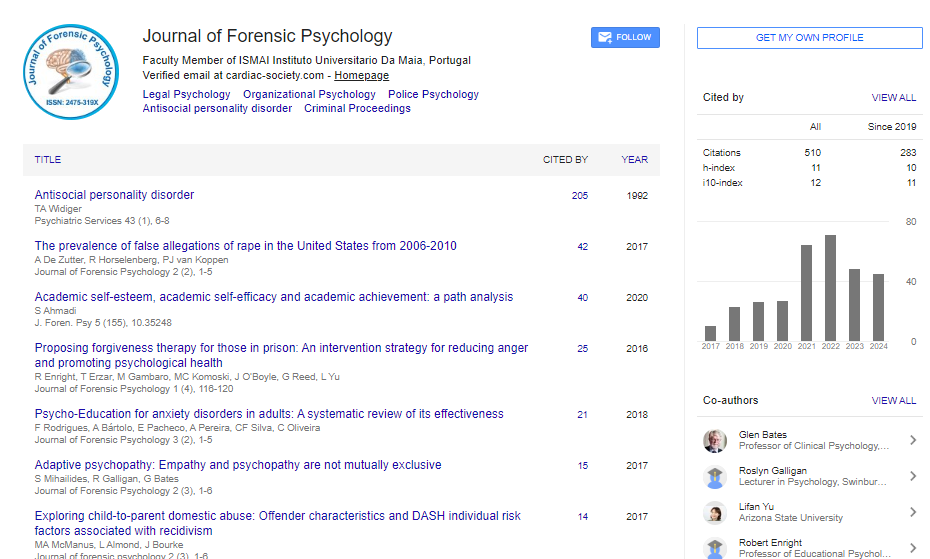


Indexed In
- RefSeek
- Hamdard University
- EBSCO A-Z
- Publons
- Geneva Foundation for Medical Education and Research
- Euro Pub
- Google Scholar
Useful Links
Share This Page
Journal Flyer

Open Access Journals
- Agri and Aquaculture
- Biochemistry
- Bioinformatics & Systems Biology
- Business & Management
- Chemistry
- Clinical Sciences
- Engineering
- Food & Nutrition
- General Science
- Genetics & Molecular Biology
- Immunology & Microbiology
- Medical Sciences
- Neuroscience & Psychology
- Nursing & Health Care
- Pharmaceutical Sciences
Perspective - (2026) Volume 11, Issue 1
The Impact of Correctional Psychology on Prison Reform
Eriksen Linda*Received: 28-Feb-2026, Manuscript No. JFPY-26-31470; Editor assigned: 02-Mar-2026, Pre QC No. JFPY-26-31470 (PQ); Reviewed: 16-Mar-2026, QC No. JFPY-26-31470; Revised: 23-Mar-2026, Manuscript No. JFPY-26-31470 (R); Published: 30-Mar-2026, DOI: 10.35248/2475-319X.26.11.411
Description
Correctional psychology is a vital subfield within Forensic Psychology that focuses on the assessment, treatment, and management of individuals within correctional settings such as prisons, jails, and rehabilitation centers. It aims to understand criminal behavior, reduce recidivism, and facilitate the successful reintegration of offenders into society. By applying psychological principles in institutional environments, correctional psychologists contribute to both offender rehabilitation and institutional safety.
One of the primary roles of correctional psychology is the assessment of inmates’ mental health and behavioral risks. Many individuals within correctional systems experience psychological disorders, including depression, anxiety, substance use disorders, and personality disorders. Early identification of these conditions is essential for providing appropriate interventions and preventing escalation of problematic behaviors. Psychological assessments also help classify inmates based on risk levels, guiding housing decisions and management strategies within facilities.
Rehabilitation is a central goal of correctional psychology. Intervention programs are designed to address the underlying factors contributing to criminal behavior, such as poor impulse control, cognitive distortions, substance abuse, and lack of social skills. Cognitive-behavioral therapy is widely used to help offenders recognize and modify harmful thought patterns and behaviors. Educational and vocational training programs further support rehabilitation by equipping individuals with skills necessary for lawful employment after release.
Risk assessment and management are crucial components of correctional psychology. Professionals evaluate the likelihood of reoffending by analyzing factors such as criminal history, behavioral patterns, and environmental influences. These assessments inform decisions related to parole, probation, and conditional release. While structured tools enhance consistency, psychologists must interpret results carefully and consider individual differences, as risk predictions are not absolute.
Correctional psychologists also play a role in maintaining institutional order and safety. They may work with correctional staff to develop strategies for managing aggressive or disruptive behavior among inmates. Conflict resolution, crisis intervention, and suicide prevention are key responsibilities in these settings. Given the high-stress environment of correctional facilities, psychologists must also support staff well-being, as exposure to violence and tension can affect mental health and job performance.
Ethical challenges are inherent in correctional psychology. Professionals must balance their duty to the institution with their responsibility to the individuals they assess and treat. Issues such as confidentiality, informed consent, and dual roles can create complex situations. For example, information disclosed during therapy may have implications for security decisions, requiring careful judgment and adherence to ethical guidelines.
The effectiveness of correctional psychology is closely tied to broader social and systemic factors. Overcrowding, limited resources, and inadequate staffing can hinder the delivery of psychological services within correctional facilities. Additionally, stigma associated with criminal records can create barriers to reintegration, increasing the risk of recidivism. Addressing these challenges requires coordinated efforts between legal systems, mental health services, and community organizations.
In conclusion, correctional psychology plays a critical role in shaping modern criminal justice systems by integrating psychological knowledge into correctional practices. Through assessment, rehabilitation, and risk management, it seeks to reduce reoffending and promote safer communities. Continued advancements in research, ethical practice, and policy development are essential to enhancing the impact of correctional psychology and ensuring that correctional systems move beyond punishment toward meaningful rehabilitation and social reintegration.
Citation: Linda E. (2026). The Impact of Correctional Psychology on Prison Reform. J Foren Psy. 11:411.
Copyright: © 2026 Linda E. This is an open-access article distributed under the terms of the Creative Commons Attribution License, which permits unrestricted use, distribution, and reproduction in any medium, provided the original author and source are credited.