
Indexed In
- Open J Gate
- Genamics JournalSeek
- Academic Keys
- JournalTOCs
- The Global Impact Factor (GIF)
- China National Knowledge Infrastructure (CNKI)
- Ulrich's Periodicals Directory
- RefSeek
- Hamdard University
- EBSCO A-Z
- OCLC- WorldCat
- Publons
- Geneva Foundation for Medical Education and Research
- Euro Pub
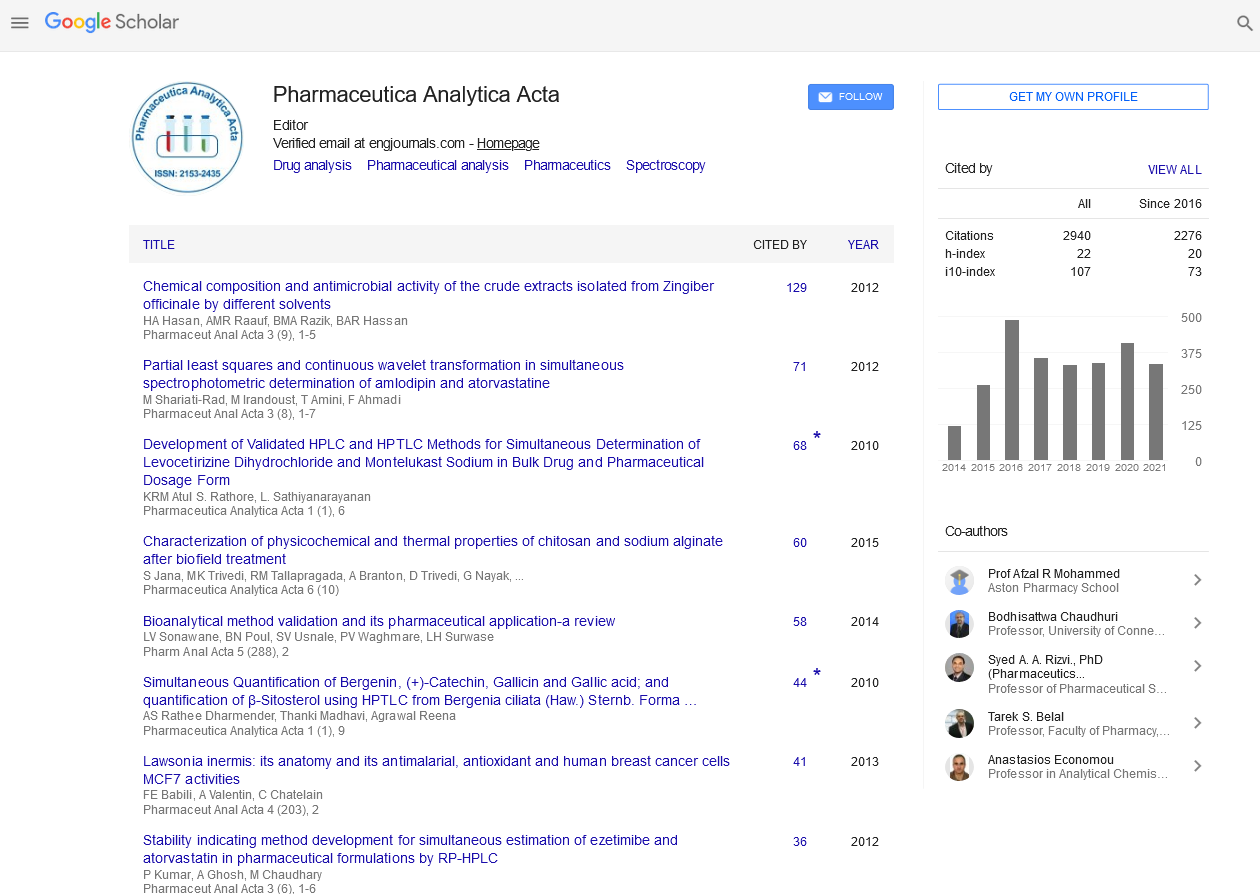
- Google Scholar
Useful Links
Share This Page
Journal Flyer
Open Access Journals
- Agri and Aquaculture
- Biochemistry
- Bioinformatics & Systems Biology
- Business & Management
- Chemistry
- Clinical Sciences
- Engineering
- Food & Nutrition
- General Science
- Genetics & Molecular Biology
- Immunology & Microbiology
- Medical Sciences
- Neuroscience & Psychology
- Nursing & Health Care
- Pharmaceutical Sciences
Opinion Article - (2026) Volume 17, Issue 1
Systematic Approaches in Pharmaceutical Assay Development for Accurate Quantification of Drug Substances
Miguel Alvarez *Received: 25-Feb-2026 , Manuscript No. PAA-26-31790; Editor assigned: 27-Feb-2026 , Pre QC No. PAA-26-31790; Reviewed: 13-Mar-2026 , QC No. PAA-26-31790; Revised: 20-Mar-2026 , Manuscript No. PAA-26-31790; Published: 27-Mar-2026 , DOI: 10.35248/2153-2435.26.17.848
Abstract
Description
Pharmaceutical assay development refers to the process of designing and optimizing analytical procedures used to determine the quantity of active pharmaceutical ingredients in drug substances and finished dosage forms. This activity plays a central role in ensuring that medicinal products contain the correct amount of active compound as declared on their label and that they maintain consistency throughout manufacturing and storage. Accurate assay methods support product quality evaluation, manufacturing control and regulatory submission processes. The development of an assay begins with a clear understanding of the chemical nature of the active pharmaceutical ingredient. Factors such as solubility, stability, polarity and molecular structure influence the choice of analytical technique. These characteristics determine how the compound interacts with solvents, reagents and analytical instruments. A suitable method must provide consistent measurement of the target compound without interference from other components present in the sample. Selection of analytical technique is a major step in assay development.
Chromatographic methods are widely used due to their ability to separate complex mixtures. High-performance liquid chromatography is commonly applied for quantitative determination of drug substances in both raw materials and finished products. Gas chromatography is used for volatile compounds, while thin-layer chromatography may serve for preliminary evaluation or qualitative assessment. Each technique is chosen based on the properties of the compound and the intended application of the assay.
Spectroscopic techniques are also frequently applied in assay development. Ultraviolet-visible spectroscopy allows rapid quantification of compounds that absorb light within specific wavelength ranges. Infrared spectroscopy provides structural information and may assist in identifying functional groups associated with the active ingredient. Nuclear magnetic resonance spectroscopy, while more complex, offers detailed structural confirmation that supports assay method design and validation. A well-developed assay method must demonstrate appropriate selectivity. Selectivity ensures that the analytical procedure can accurately measure the active ingredient without interference from excipients, degradation products or impurities. Achieving selectivity often requires optimization of chromatographic conditions, such as mobile phase composition, column selection and detection parameters. These adjustments help ensure clear separation between the target compound and other substances in the sample.
Sensitivity is another important consideration during assay development. The method must be capable of detecting and quantifying the active ingredient within a defined concentration range. Sensitivity is influenced by instrument capability, detection technique and sample preparation procedures. High sensitivity allows accurate measurement even at low concentration levels, which is particularly important for dosage forms with minimal active ingredient content. Linearity assessment is performed to ensure that the method produces results proportional to the concentration of the analyte. A linear relationship between response and concentration allows reliable quantification across different sample levels. This is typically evaluated by preparing standard solutions at varying concentrations and analyzing the corresponding response values. A consistent linear relationship confirms that the method can be used for accurate measurement.
Precision evaluation is included in assay development to determine the reproducibility of results under consistent conditions. Repeated measurements of the same sample are performed to assess variability. Low variability indicates that the method provides stable and consistent results. Precision is evaluated at different levels, including repeatability and intermediate precision, to ensure method reliability across different conditions and operators. Accuracy assessment ensures that the method produces results close to the true value of the analyte. This is typically evaluated by comparing measured values with known reference standards. Accurate methods provide confidence that the assay reflects the actual content of the active ingredient in the sample. Recovery studies are often used to assess accuracy by adding known quantities of analyte to the sample matrix and measuring the recovery rate. The criterica and s a m p l e p re p a r a t i o n i s a n i m p o r t a n t a s p e c t o f a s s a y development. Proper preparation ensures that the analyte is efficiently extracted from the sample matrix and presented in a suitable form for analysis. Techniques such as dissolution, filtration, dilution and extraction are commonly used depending on the nature of the sample. Inadequate sample preparation can lead to inaccurate results and variability in assay performance. Validation is performed after method development to confirm that the assay meets predefined performance criteria. Validation includes evaluation of selectivity, accuracy, precision, linearity, sensitivity and reproducibility. These parameters demonstrate that the method is suitable for routine use in quality control laboratories. Validation data are documented to support regulatory submissions and internal quality assurance systems.
Citation: Alvarez M (2026). Systematic Approaches in Pharmaceutical Assay Development for Accurate Quantification of Drug Substances. Pharm Anal Acta. 17:848.
Copyright: © 2026 Alvarez M. This is an open-access article distributed under the terms of the Creative Commons Attribution License, which permits unrestricted use, distribution and reproduction in any medium, provided the original author and source are credited.