
Indexed In
- Open J Gate
- Academic Keys
- JournalTOCs
- RefSeek
- Hamdard University
- EBSCO A-Z
- OCLC- WorldCat
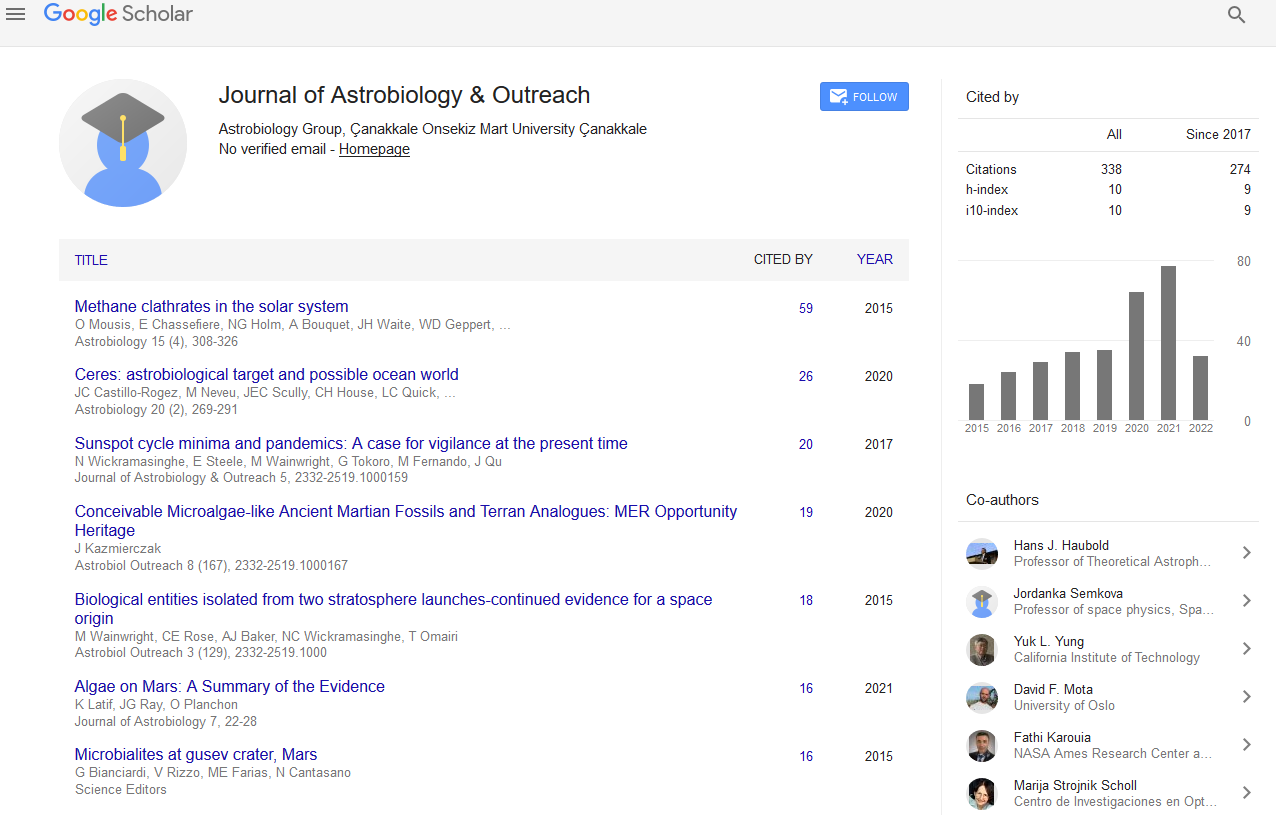
- Google Scholar
Useful Links
Share This Page
Journal Flyer
Open Access Journals
- Agri and Aquaculture
- Biochemistry
- Bioinformatics & Systems Biology
- Business & Management
- Chemistry
- Clinical Sciences
- Engineering
- Food & Nutrition
- General Science
- Genetics & Molecular Biology
- Immunology & Microbiology
- Medical Sciences
- Neuroscience & Psychology
- Nursing & Health Care
- Pharmaceutical Sciences
Perspective - (2026) Volume 14, Issue 1
Speaking Science Clearly: Building Meaningful Connections Between Knowledge and Society
Isabelle Moreau*Received: 27-Mar-2026, Manuscript No. JAO-26-31421; Editor assigned: 03-Mar-2026, Pre QC No. JAO-26-31421 (PQ); Reviewed: 16-Mar-2026, QC No. JAO-26-31421; Revised: 23-Mar-2026, Manuscript No. JAO-26-31421 (R); Published: 30-Mar-2026, DOI: 10.35248/2332-2519.26.14.405
Description
Science communication plays a vital role in shaping how people understand discoveries, evidence, and the methods used to produce reliable knowledge. It involves more than simply presenting facts; it requires thoughtful consideration of audience perspectives, cultural context, and the ways in which information is interpreted. Effective communication allows scientific ideas to move beyond academic circles and become part of everyday conversations, influencing decisions related to health, environment, and technology.
One of the central challenges in science communication lies in translating complex ideas into language that is accessible without losing accuracy. Scientific research often relies on specialized terminology that can create distance between experts and the public. By using clear language, relatable examples, and structured explanations, communicators can make information easier to grasp while preserving its essential meaning. This balance is not always simple to achieve, as oversimplification can lead to misunderstanding, while excessive detail may discourage engagement .
Understanding the audience is an important aspect of communication strategy. Different groups bring varying levels of prior knowledge, interests, and expectations. A presentation designed for school students will differ significantly from one intended for policymakers or industry professionals. By considering factors such as age, educational background, and cultural influences, communicators can adapt their approach to ensure that information resonates with the intended audience.
Storytelling has emerged as a powerful tool in conveying scientific ideas. Narratives provide structure and emotional context, making information more memorable and relatable. By framing research within a story that includes challenges, observations, and outcomes, communicators can capture attention and maintain interest. Stories also allow audiences to connect with the human aspects of science, such as curiosity, persistence, and collaboration, which are often overlooked in purely technical descriptions.
Visual communication is another essential component. Graphs, diagrams, animations, and images can convey complex relationships in ways that words alone cannot. Effective visuals highlight key points, reduce cognitive load, and support understanding. However, poorly designed visuals can confuse or mislead, so careful attention must be given to clarity, accuracy, and relevance.
Digital platforms have expanded the reach of science communication, enabling information to be shared quickly and widely. Social media, online videos, podcasts, and interactive websites allow scientists and communicators to engage with audiences across geographical boundaries. These platforms also encourage dialogue, enabling audiences to ask questions, share perspectives, and participate in discussions. While digital communication offers many advantages, it also presents challenges related to misinformation and the rapid spread of inaccurate content.
Trust is a fundamental element in science communication. Audiences are more likely to engage with and accept information when they perceive the source as credible and honest. Building trust involves consistency, openness about uncertainties, and acknowledgment of limitations in current knowledge. Communicators who present information with clarity and integrity contribute to a more informed public and encourage constructive dialogue.
Collaboration between scientists and communication professionals can enhance the effectiveness of outreach efforts. Scientists bring subject expertise, while communicators contribute skills in language, design, and audience engagement. By working together, they can develop strategies that combine accuracy with accessibility. Educational institutions, research organizations, and media outlets often play a role in supporting such collaborations, creating opportunities for knowledge sharing and skill development.
Engaging with communities directly is another important approach. Public lectures, workshops, science festivals, and interactive exhibits provide opportunities for face-to-face interaction. These events allow audiences to ask questions, express concerns, and explore topics in a more personal setting. Such interactions can also provide valuable feedback to scientists, helping them understand public perspectives and identify areas where further explanation may be needed.
Ethical considerations are also relevant in science communication. Presenting information responsibly includes avoiding exaggeration, acknowledging uncertainties, and respecting diverse viewpoints. Communicators must be mindful of how information may influence decisions and perceptions, particularly in areas such as health and environmental issues. By maintaining ethical standards, science communication contributes to informed decision-making and supports public confidence in scientific research.
In conclusion, science communication is a dynamic and multifaceted field that connects research with society. Through clear language, thoughtful adaptation to audience needs, effective use of visuals, and responsible engagement, communicators can make scientific knowledge more accessible and meaningful. As the volume of information continues to grow, the importance of effective communication will remain central to ensuring that knowledge is understood, trusted, and applied in ways that benefit individuals and communities.
Citation: Moreau I, (2026). Speaking Science Clearly: Building Meaningful Connections between Knowledge and Society. J Astrobiol Outreach. 14.405.
Copyright: © 2026, Moreau I. This is an open-access article distributed under the terms of the Creative Commons Attribution License, which permits unrestricted use, distribution, and reproduction in any medium, provided the original author and source are credited