

Indexed In
- RefSeek
- Hamdard University
- EBSCO A-Z
- Publons
- Geneva Foundation for Medical Education and Research
- Euro Pub
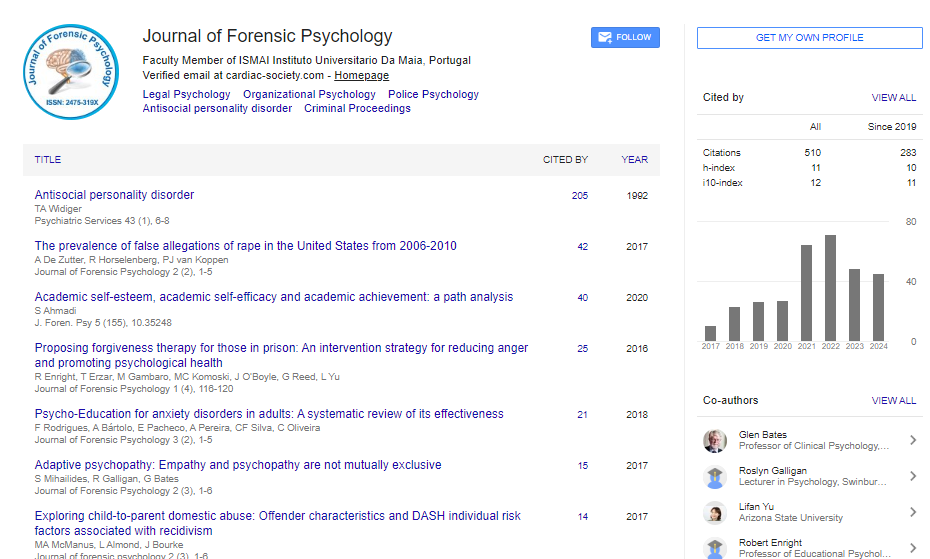
- Google Scholar
Useful Links
Share This Page
Journal Flyer

Open Access Journals
- Agri and Aquaculture
- Biochemistry
- Bioinformatics & Systems Biology
- Business & Management
- Chemistry
- Clinical Sciences
- Engineering
- Food & Nutrition
- General Science
- Genetics & Molecular Biology
- Immunology & Microbiology
- Medical Sciences
- Neuroscience & Psychology
- Nursing & Health Care
- Pharmaceutical Sciences
Perspective - (2025) Volume 10, Issue 4
Social Influences and Environmental Risks in Chronic Criminality
Sofia Martinez*Received: 28-Nov-2025, Manuscript No. JFPY-25-30935; Editor assigned: 01-Dec-2025, Pre QC No. JFPY-25-30935 (PQ); Reviewed: 15-Dec-2025, QC No. JFPY-25-30935; Revised: 22-Dec-2025, Manuscript No. JFPY-25-30935 (R); Published: 29-Dec-2025, DOI: 10.35248/2475-319X. 25.10.400
Abstract
Description
Chronic criminals represent a distinct subset of offenders who engage in repeated criminal behavior over an extended period of time. These individuals often begin offending in adolescence and continue into adulthood, displaying persistent patterns of antisocial behavior, disregard for societal rules and difficulty adhering to conventional norms. Chronic criminality has profound implications for society, the justice system and public safety. Understanding the characteristics, underlying causes and effective interventions for chronic criminals is essential for reducing recidivism, enhancing rehabilitation and promoting safer communities. Research in criminology, psychology and sociology has provided insights into the factors that contribute to persistent offending, guiding strategies to address this complex social problem.
Chronic criminals often exhibit early behavioural problems, including aggression, impulsivity and defiance, which are observable during childhood and adolescence. Conduct disorder, truancy, substance abuse and early delinquency are common indicators that predict future chronic offending. Family environment plays a significant role, as individuals exposed to neglect, inconsistent discipline, or criminal behavior within the family are more likely to develop persistent antisocial patterns. Peer influences and social networks also contribute; as chronic offenders may be reinforced by associations with delinquent peers or communities where criminal activity is normalized. Understanding these developmental trajectories is critical for early intervention and prevention strategies.
Psychological and neurobiological factors are key contributors to chronic criminal behavior. Many chronic offenders exhibit deficits in impulse control, emotional regulation and moral reasoning. Neuroimaging studies have identified structural and functional differences in brain regions associated with decisionmaking, empathy and reward processing. Personality traits such as callousness, lack of empathy and sensation-seeking are commonly observed, contributing to the persistence of criminal behavior despite adverse consequences. These insights highlight the importance of integrating psychological assessment and treatment into correctional and rehabilitation programs.
Societal and environmental factors further influence chronic offending. Poverty, limited educational opportunities, exposure to violence and social marginalization increase the likelihood of persistent criminal behavior. Neighborhoods with high crime rates, limited social support and inadequate access to health and social services create conditions that perpetuate criminal patterns. Addressing these structural issues requires coordinated interventions involving social services, education, law enforcement and community programs that provide alternatives to criminal behavior and support reintegration into society.
Intervention strategies for chronic criminals focus on rehabilitation, risk management and reducing recidivism. Cognitive behavioural therapy, anger management programs, substance abuse treatment and social skills training have been shown to improve behavioural outcomes. Individualized treatment plans that address underlying psychological, social and environmental factors are more effective than generic interventions. In addition, structured supervision, communitybased programs and mentorship initiatives help guide chronic offenders toward prosocial behavior and reduce opportunities for reoffending. Rehabilitation efforts are most successful when initiated early and maintained consistently over time.
Criminal justice policies also play a critical role in managing chronic offenders. Sentencing practices, parole systems and probation programs must balance public safety with opportunities for rehabilitation. Risk assessment tools are used to identify individuals at high risk of recidivism and to tailor interventions accordingly. Multidisciplinary collaboration between psychologists, social workers, probation officers and law enforcement ensures a comprehensive approach to managing chronic criminals. Evidence-based practices, continuous monitoring and evaluation of programs enhance the effectiveness of interventions and contribute to public confidence in the justice system.
Research continues to advance our understanding of chronic criminal behavior. Longitudinal studies, forensic assessments and criminological research provide data on the predictors, patterns and outcomes of persistent offending. Emerging approaches such as restorative justice, trauma-informed care and community-based rehabilitation offer promising alternatives to traditional punitive models. By focusing on underlying causes, addressing risk factors and promoting prosocial engagement, interventions can reduce the societal burden of chronic criminality and support the reintegration of offenders into lawabiding life.
Despite progress, challenges remain in addressing chronic criminal behavior. Resistance to rehabilitation, mental health comorbidities and limited resources hinder the effectiveness of interventions. Social stigma and discrimination further complicate reintegration efforts. Addressing these challenges requires sustained commitment, public awareness and the development of policies that support rehabilitation while maintaining accountability. Research, innovation and collaboration across disciplines are essential to enhance intervention strategies and reduce long-term criminal behavior.
In conclusion, chronic criminals represent a complex and persistent challenge to society and the justice system. Understanding the developmental, psychological and environmental factors that contribute to persistent offending is important for designing effective interventions. Evidence-based rehabilitation, risk management and community support are essential components of strategies to reduce recidivism and promote public safety. Continued research, multidisciplinary collaboration and the integration of psychological and social insights into criminal justice practices are vital for addressing the issue of chronic criminality and fostering safer and more resilient communities.
Citation: Martinez S (2025). Social Influences and Environmental Risks in Chronic Criminality. J Foren Psy. 10:400.
Copyright: © 2025 Martinez S. This is an open-access article distributed under the terms of the Creative Commons Attribution License, which permits unrestricted use, distribution, and reproduction in any medium, provided the original author and source are credited.