
Indexed In
- Open J Gate
- Academic Keys
- JournalTOCs
- RefSeek
- Hamdard University
- EBSCO A-Z
- OCLC- WorldCat
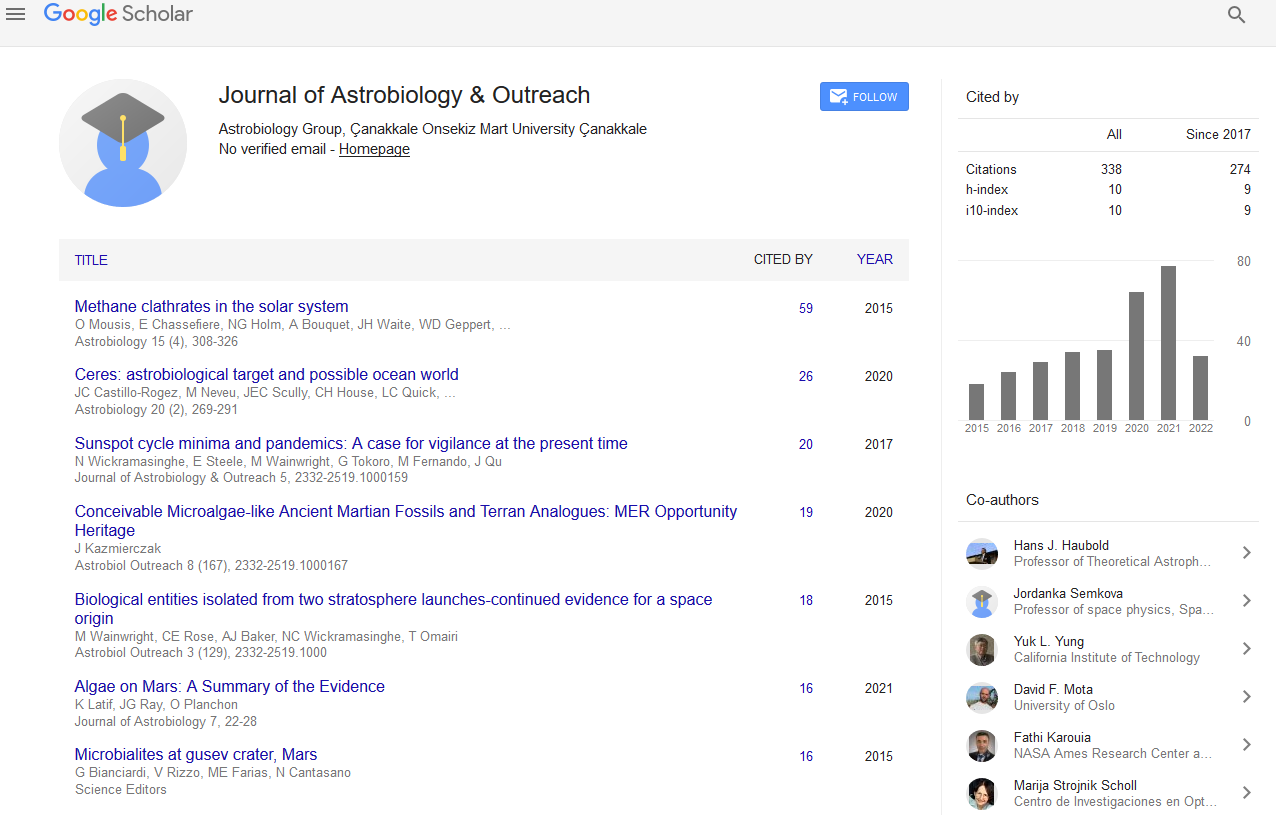
- Google Scholar
Useful Links
Share This Page
Journal Flyer
Open Access Journals
- Agri and Aquaculture
- Biochemistry
- Bioinformatics & Systems Biology
- Business & Management
- Chemistry
- Clinical Sciences
- Engineering
- Food & Nutrition
- General Science
- Genetics & Molecular Biology
- Immunology & Microbiology
- Medical Sciences
- Neuroscience & Psychology
- Nursing & Health Care
- Pharmaceutical Sciences
Opinion Article - (2025) Volume 13, Issue 3
Shaping Public Understanding of Scientific Discoveries
Tereza Ennico*Received: 29-Aug-2025, Manuscript No. JAO-25-30652; Editor assigned: 01-Sep-2025, Pre QC No. JAO-25-30652 (PQ); Reviewed: 15-Sep-2025, QC No. JAO-25-30652; Revised: 22-Sep-2025, Manuscript No. JAO-25-30652 (R); Published: 29-Sep-2025, DOI: 10.35248/2332-2519.25.13.388
Abstract
Description
Scientific discoveries drive human progress, from understanding the universe to improving health and technology. However, the impact of science depends not only on the research itself but also on how effectively the public understands and engages with it. Public understanding of science shapes decision-making, influences policy, and affects trust in scientific institutions. Therefore, shaping this understanding is an important part of the scientific enterprise, requiring thoughtful communication, education, and outreach strategies.
One of the primary challenges in shaping public understanding is the inherent complexity of scientific knowledge. Discoveries often involve specialized terminology, abstract concepts, and complex data, which can make them difficult for non-experts to grasp. For example, topics like climate change, genetic engineering, or exoplanet research involve interdisciplinary knowledge that can be intimidating without proper context. Simplifying these concepts without compromising accuracy is essential for conveying their significance to a broader audience. Visualizations, analogies, and storytelling are effective tools for translating complex findings into accessible narratives that capture both the facts and the wonder of scientific discovery.
The rise of digital media has transformed how scientific discoveries are shared and perceived. Social media platforms, online news outlets, and educational videos allow scientists and institutions to reach global audiences instantly. While this offers unprecedented opportunities for engagement, it also presents challenges. Misinformation can spread rapidly, and sensationalized or oversimplified reporting may distort public perception. Effective science communication requires not only clarity and accuracy but also strategies to engage audiences critically, helping them distinguish reliable information from misleading claims.
Education plays a central role in shaping public understanding. Incorporating recent scientific discoveries into school curricula, university courses, and informal learning environments fosters curiosity and critical thinking. Citizen science initiatives allow people to participate directly in research, whether by classifying galaxies, monitoring wildlife, or collecting environmental data. These hands-on experiences make discoveries tangible and personal, demonstrating the processes of science rather than just its results. By actively involving the public, educators help develop an informed society capable of engaging with science thoughtfully.
Cultural context and societal values also influence how scientific discoveries are received. Public perceptions are shaped not only by knowledge but also by trust, beliefs, and previous experiences with science. Communities with higher trust in scientific institutions tend to embrace discoveries more readily, whereas skepticism may arise in regions where science is perceived as disconnected from societal needs. Engaging communities through dialogue, addressing concerns respectfully, and demonstrating the relevance of discoveries to everyday life are critical for bridging gaps between scientists and the public.
The communication of scientific uncertainty is another important factor. Discoveries often involve probabilities, models, and ongoing research, which can be misinterpreted as indecision or error. Educators and communicators must help the public understand that uncertainty is an inherent part of the scientific process and that it enables continuous refinement of knowledge. Explaining how evidence is collected, tested, and updated fosters appreciation for the rigor of science and counters misconceptions about inconsistency.
Outreach programs, museums, science festivals, and public lectures provide additional avenues for shaping understanding. These platforms create opportunities for dialogue, hands-on learning, and exposure to cutting-edge research. By making science visible, engaging, and relevant, these programs encourage curiosity, lifelong learning, and informed participation in societal discussions about technology, health, and the environment.
In conclusion, shapeing public understanding of scientific discoveries is more than a communication task it is a societal imperative. Clear, accessible, and engaging science communication, combined with education and public participation, empowers individuals to make informed decisions and to appreciate the role of science in shaping the future. By connecting discoveries to the lives and values of people, scientists and educators can foster trust, curiosity, and a shared sense of responsibility for advancing knowledge. Ultimately, bridging the gap between discovery and public understanding ensures that science fulfills its promise not just in laboratories but in the lives of society at large.
Citation: Ennico T (2025) Shaping Public Understanding of Scientific Discoveries. J Astrobiol Outreach.13:388.
Copyright: © 2025 Ennico T. This is an open-access article distributed under the terms of the Creative Commons Attribution License, which permits unrestricted use, distribution, and reproduction in any medium, provided the original author and source are credited.