

Indexed In
- Open J Gate
- Academic Keys
- JournalTOCs
- RefSeek
- Hamdard University
- EBSCO A-Z
- OCLC- WorldCat
- Google Scholar
Useful Links
Share This Page
Journal Flyer
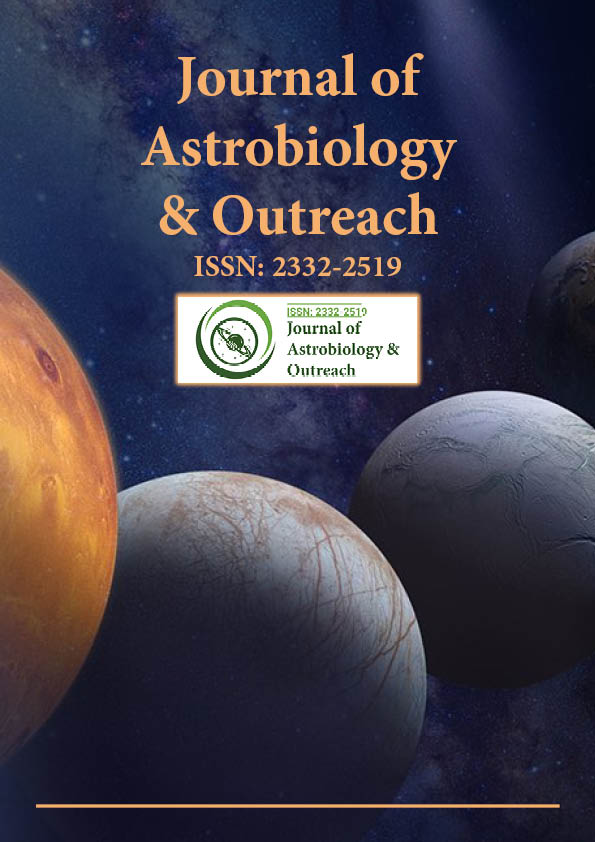
Open Access Journals
- Agri and Aquaculture
- Biochemistry
- Bioinformatics & Systems Biology
- Business & Management
- Chemistry
- Clinical Sciences
- Engineering
- Food & Nutrition
- General Science
- Genetics & Molecular Biology
- Immunology & Microbiology
- Medical Sciences
- Neuroscience & Psychology
- Nursing & Health Care
- Pharmaceutical Sciences
Commentary - (2025) Volume 13, Issue 3
Origins of Life Research and the Search for Life in the Universe
Manasvi Williams*Received: 29-Aug-2025, Manuscript No. JAO-25-30645; Editor assigned: 01-Sep-2025, Pre QC No. JAO-25-30645 (PQ); Reviewed: 15-Sep-2025, QC No. JAO-25-30645; Revised: 22-Sep-2025, Manuscript No. JAO-25-30645 (R); Published: 29-Sep-2025, DOI: 10.35248/2332-2519.25.13.381
Description
The early earth was a dramatically different world from the planet we know today. Billions of years ago, it had a thinner atmosphere, a hotter surface, intense volcanic activity, and a bombardment of meteorites. Yet these harsh conditions also provided a fertile environment for chemistry. Minerals, ultraviolet radiation, and geothermal energy created a dynamic setting in which simple molecules such as water, carbon dioxide, methane, and ammonia could react and assemble into more complex organic compounds. Experiments mimicking early earth conditions including classic studies such as the Miller-Urey experiment and modern, more refined versions show that amino acids, nucleotides, and lipid-like molecules can emerge naturally under the right conditions. These building blocks form the foundation of proteins, genetic material, and cell membranes.
A key focus in origins-of-life research is understanding how simple molecules transitioned into self-replicating systems capable of evolution. One leading idea, often called the “RNA world” hypothesis, proposes that early life relied on RNA-like molecules that could both store information and catalyze chemical reactions. Laboratory studies have demonstrated that RNA strands can form under plausible prebiotic conditions and can even evolve new functions when subjected to selection pressures. While this model is not the only possibility, it provides a compelling framework for linking chemistry to biology. Other hypotheses explore metabolic networks that may have arisen on mineral surfaces or in hydrothermal vents, where chemical gradients could drive the first metabolic cycles. Together, these models provide multiple pathways for how life might originate.
The search extends far beyond our solar system. Thousands of exoplanets have been discovered, including rocky worlds in the habitable zones of their stars, where conditions may allow liquid water to persist. Scientists are now developing the capability to analyze exoplanet atmospheres for gases such as oxygen, methane, and other potential biosignatures. These signals, if detected in the right combinations, could hint at biological activity. Understanding how life arises on earth helps researchers interpret what these distant signals might mean and distinguishes biological processes from purely chemical or geological ones.
Icy moons such as Europa and Enceladus also play a central role in the search for life. Both worlds contain vast subsurface oceans beneath their frozen crusts, warmed by tidal forces and interactions with their parent planets. Data from spacecraft have revealed plumes of water vapor erupting from enceladus and evidence of possible ocean chemistry that includes organic molecules. These environments resemble earth’s deep-sea hydrothermal vents where microbial communities thrive today, suggesting that chemically rich oceans beneath ice layers could support their own evolutionary beginnings. The study of these worlds expands the potential habitats for life beyond traditional notions of surface environments warmed by starlight.
Origins-of-life research not only deepens our understanding of how life emerged on our planet but also shapes our strategies for detecting life beyond earth. By piecing together clues from early earth, exploring analog environments on other worlds, and refining theories of chemical evolution, scientists are gradually revealing the universal principles that govern life’s emergence. As we continue our search for life in the universe, the study of life’s beginnings remains a guiding light reminding us that the answers to the most profound cosmic questions may lie in understanding our own ancient origins.
In conclusion, guiding scientists in identifying environments elsewhere in the solar system that might have once hosted or may still host similar chemical processes. Mars, for example, shows strong evidence of past liquid water, a thicker atmosphere, and volcanic activity conditions potentially suitable for prebiotic chemistry. Robotic missions continue to analyze Martian rocks and soil for organic compounds and minerals that could preserve traces of ancient life. If Mars once produced its own building blocks or even early life forms, comparing them to earth chemistry would offer unprecedented insight into how universal the pathways to life may be.
Citation: Williams M (2025) Origins of Life Research and the Search for Life in the Universe. J Astrobiol Outreach.13:381.
Copyright: © 2025 Williams M. This is an open-access article distributed under the terms of the Creative Commons Attribution License, which permits unrestricted use, distribution, and reproduction in any medium, provided the original author and source are credited.