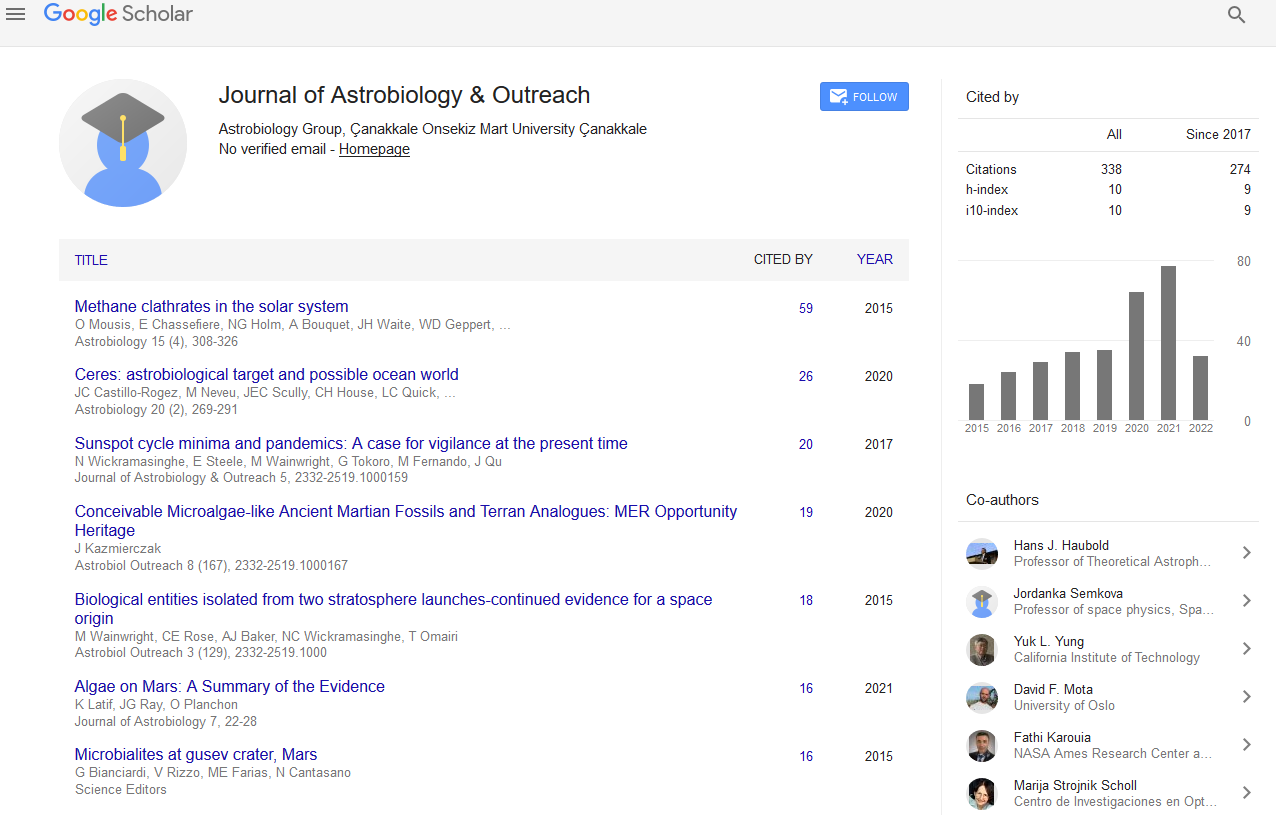

Indexed In
- Open J Gate
- Academic Keys
- JournalTOCs
- RefSeek
- Hamdard University
- EBSCO A-Z
- OCLC- WorldCat
- Google Scholar
Useful Links
Share This Page
Journal Flyer
Open Access Journals
- Agri and Aquaculture
- Biochemistry
- Bioinformatics & Systems Biology
- Business & Management
- Chemistry
- Clinical Sciences
- Engineering
- Food & Nutrition
- General Science
- Genetics & Molecular Biology
- Immunology & Microbiology
- Medical Sciences
- Neuroscience & Psychology
- Nursing & Health Care
- Pharmaceutical Sciences
Short Communication - (2026) Volume 14, Issue 1
Life Beyond Earth: Expanding the Scientific Study of Living Systems in the Universe
Zhanxue Guo*Received: 27-Feb-2026, Manuscript No. JAO-26-31416; Editor assigned: 02-Mar-2026, Pre QC No. JAO-26-31416 (PQ); Reviewed: 16-Mar-2026, QC No. JAO-26-31416; Revised: 23-Mar-2026, Manuscript No. JAO-26-31416 (R); Published: 30-Mar-2026, DOI: 10.35248/2332-2519.25.14.400
Description
Astrobiology is an interdisciplinary field that examines the origin, development, distribution, and future of life in the universe. It draws from biology, chemistry, physics, geology, and astronomy to address one of the oldest questions in human history: whether life exists beyond Earth. This area of study does not limit itself to searching for organisms on distant planets but also investigates how life begins and adapts under a wide range of environmental conditions. By analyzing both terrestrial life and extraterrestrial environments, scientists build a broader understanding of what life can be and where it might be found.
The study begins with Earth, the only known location where life exists. By examining extreme environments such as deep-sea hydrothermal vents, acidic lakes, frozen polar regions, and arid deserts, researchers identify organisms that survive under conditions once thought incompatible with life. These extremophiles have altered the traditional view that life requires moderate temperature, neutral pH, and abundant sunlight. Instead, they demonstrate that life can persist with minimal resources, relying on chemical energy rather than sunlight, and tolerating high radiation or pressure. Such findings expand the criteria used when evaluating other planets and moons.
Astrobiology also considers the chemical origins of life. Early Earth conditions likely involved simple molecules such as water, methane, ammonia, and carbon dioxide interacting under the influence of energy sources like lightning or ultraviolet radiation. Laboratory simulations have shown that these basic compounds can form amino acids, which are essential building blocks of proteins. This supports the idea that the fundamental components of life may arise naturally under suitable conditions, suggesting that similar processes could occur elsewhere in the universe.
Planetary exploration plays a central role in this field. Mars has long been a primary target due to evidence of ancient water flows, sedimentary rocks, and mineral deposits that suggest a wetter past. Rovers and orbiters have gathered data indicating that Mars once had conditions that might have supported microbial life. Although no direct evidence of life has been confirmed, ongoing missions continue to analyze soil samples and atmospheric composition for signs of biological activity, past or present.
Beyond Mars, icy moons such as Europa and Enceladus have attracted increasing attention. These moons, orbiting Jupiter and Saturn respectively, possess subsurface oceans beneath thick ice layers. Observations of water plumes erupting from Enceladus indicate the presence of organic molecules and hydrothermal activity, conditions that on Earth support microbial ecosystems. Europa’s ocean, kept liquid by tidal heating, may also provide a stable environment for life. These discoveries suggest that habitable environments may exist even far from a star’s traditional habitable zone.
The concept of the habitable zone itself has evolved over time. Initially defined as the region around a star where liquid water can exist on a planet’s surface, it is now understood that internal heat sources, atmospheric composition, and geological activity also influence habitability. Planets outside this zone might still support life if they possess subsurface oceans or thick atmospheres that trap heat. This broader perspective has increased the number of potential locations where life could exist.
The detection of exoplanets has further expanded the scope of astrobiology. Thousands of planets have been identified orbiting stars beyond our solar system, many of which vary widely in size, composition, and temperature. Some resemble Earth in terms of mass and orbital distance, making them candidates for further study. Scientists analyze the atmospheres of these distant worlds using spectroscopy, searching for gases such as oxygen, methane, and carbon dioxide that might indicate biological processes. While interpreting these signals is complex, advancements in observational technology continue to improve accuracy.
Another important aspect of astrobiology involves understanding the limits of life and the possibility of alternative biochemistries. Earth-based life relies on carbon, water, and DNA, but it is conceivable that life elsewhere could be based on different elements or molecular structures. Silicon-based life, for instance, has been proposed as a theoretical alternative, though no evidence currently supports its existence. Exploring such possibilities encourages scientists to avoid narrow definitions and remain open to unfamiliar forms of life.
Astrobiology also addresses the future of life, both on Earth and beyond. As the Sun ages, conditions on Earth will gradually become less favorable for life. This long-term perspective raises questions about the survival and spread of life in the cosmos. Human space exploration and potential colonization of other planets are often discussed in this context, although significant technological and ethical challenges remain. Ensuring that other worlds are not contaminated by terrestrial organisms is a major concern, as it could interfere with the search for indigenous life.
Ethical considerations extend further into the discussion of how humanity should respond if extraterrestrial life is discovered. Even microbial life would have profound implications for science, philosophy, and culture. Questions about protection, study, and interaction would need careful evaluation. The discovery of intelligent life would introduce even more complex issues, including communication and coexistence.
Astrobiology continues to evolve as new data emerges from space missions, laboratory experiments, and theoretical models. It encourages collaboration across scientific disciplines and promotes a deeper understanding of life’s adaptability. While definitive evidence of life beyond Earth remains elusive, each discovery contributes to a clearer picture of the conditions that support living systems.
By studying both the resilience of life on Earth and the diverse environments found throughout the universe, astrobiology provides a framework for addressing fundamental questions about existence. It challenges assumptions, refines scientific methods, and expands the boundaries of knowledge. Whether or not life is ultimately found elsewhere, the insights gained from this field enhance our understanding of life’s place in the cosmos.
Citation: Guo Z, (2026). Life beyond Earth: Expanding the Scientific Study of Living Systems in the Universe J Astrobiol Outreach. 14.400.
Copyright: © 2026, Guo Z. This is an open-access article distributed under the terms of the Creative Commons Attribution License, which permits unrestricted use, distribution, and reproduction in any medium, provided the original author and source are credited