
Indexed In
- Open J Gate
- The Global Impact Factor (GIF)
- Open Archive Initiative
- VieSearch
- International Society of Universal Research in Sciences
- China National Knowledge Infrastructure (CNKI)
- CiteFactor
- Scimago
- Ulrich's Periodicals Directory
- Electronic Journals Library
- RefSeek
- Directory of Research Journal Indexing (DRJI)
- Hamdard University
- EBSCO A-Z
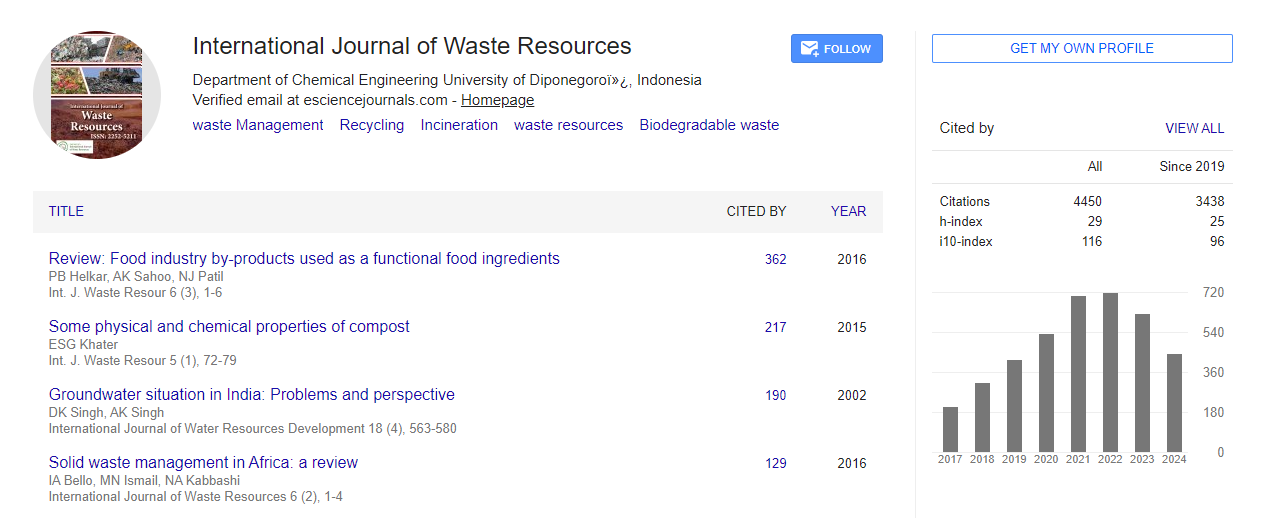
- Publons
- Google Scholar
Useful Links
Share This Page
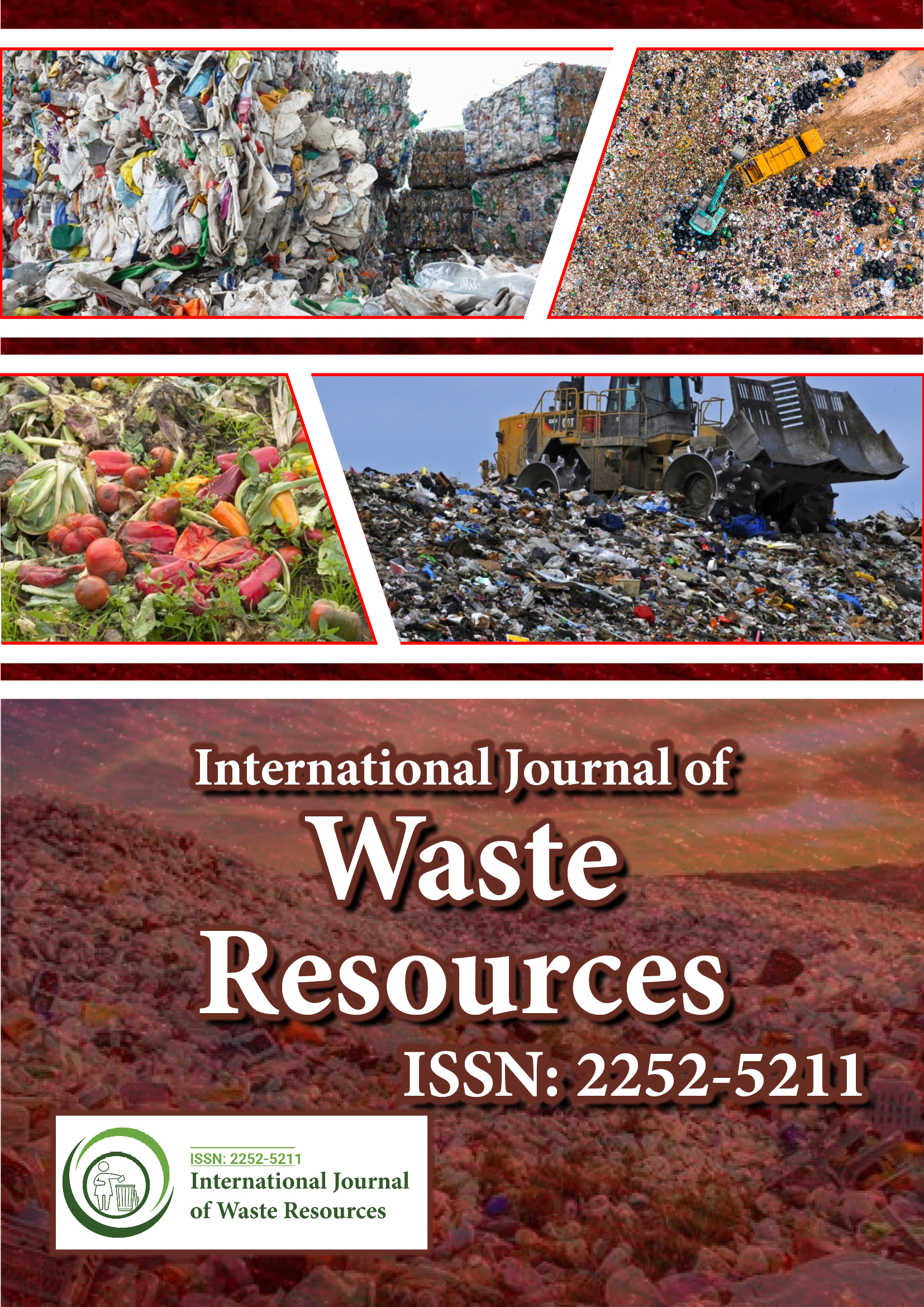
Journal Flyer
Open Access Journals
- Agri and Aquaculture
- Biochemistry
- Bioinformatics & Systems Biology
- Business & Management
- Chemistry
- Clinical Sciences
- Engineering
- Food & Nutrition
- General Science
- Genetics & Molecular Biology
- Immunology & Microbiology
- Medical Sciences
- Neuroscience & Psychology
- Nursing & Health Care
- Pharmaceutical Sciences
Perspective - (2025) Volume 15, Issue 3
Global Approaches and Sustainable Strategies for Effective Waste Resources Management Systems
Meena Krishnan*Received: 31-Jul-2025, Manuscript No. IJWR-25-30264; Editor assigned: 04-Aug-2025, Pre QC No. IJWR-25-30264; Reviewed: 18-Aug-2025, QC No. IJWR-25-30264; Revised: 25-Aug-2025, Manuscript No. IJWR-25-30264; Published: 01-Sep-2025, DOI: 10.35248/2252-5211.25.15.624
Description
Waste resources management has become a central focus of sustainable development in the 21st century as nations across the globe struggle with rising levels of waste generation due to population growth, urbanization and industrial expansion. The concept of waste resources management extends beyond the simple act of waste disposal; it involves systematic collection, transportation, treatment, recycling and recovery of materials to reduce environmental impact and promote circular economy principles. The objective is not merely to eliminate waste but to transform it into valuable resources that contribute to economic development and environmental preservation.
The increasing demand for consumer goods and the expansion of manufacturing sectors have resulted in vast quantities of municipal, industrial, agricultural and electronic waste. These waste streams, if unmanaged, lead to severe consequences such as soil contamination, water pollution and air quality degradation. Proper management of these wastes can conserve natural resources, reduce greenhouse gas emissions and create new employment opportunities. The transition from a linear economy of “produce, use and dispose” to a circular economy of “reduce, reuse and recycle” is essential for achieving global sustainability goals.
Effective waste resources management begins with waste minimization at the source. This involves redesigning products, modifying manufacturing processes and encouraging consumers to adopt sustainable consumption patterns. Industries are now implementing cleaner production techniques that utilize fewer raw materials and produce less waste. The promotion of ecofriendly packaging, durable goods and renewable materials further helps reduce the overall waste burden. In households, awareness campaigns encouraging segregation at source play a vital role in facilitating efficient recycling and resource recovery.
Recycling and resource recovery form the backbone of modern waste management systems. Materials such as paper, plastics, metals and glass can be reprocessed and used in new production cycles, thus reducing the demand for virgin resources. Advanced technologies such as automated sorting systems, material recovery facilities and composting plants enable efficient processing of different waste types. Organic waste, for instance, can be converted into compost or biogas, providing both soil nutrients and renewable energy. In developing nations, promoting informal recycling sectors and integrating them into formal waste management systems can significantly enhance recovery rates while improving livelihoods.
Waste-to-energy technologies represent another crucial component of waste resource utilization. Incineration, anaerobic digestion and gasification allow for the conversion of nonrecyclable waste into usable forms of energy such as electricity, heat, or fuel. When equipped with modern pollution control systems, these technologies can substantially reduce landfill dependency while contributing to clean energy generation. However, the implementation of such systems requires careful assessment of environmental and economic factors to ensure long-term sustainability.
Landfills, though still widely used, should be regarded as the last resort in waste management. Engineered landfills with liners, leachate collection and gas recovery systems can mitigate environmental risks. Methane gas from decomposing organic waste can be captured and utilized as an energy source, turning potential pollutants into useful resources. Yet, reducing landfill waste through recycling and recovery remains the most effective approach to preserving land and preventing contamination.
Government policies and legislation play a critical role in promoting sustainable waste resources management. Many countries have introduced Extended Producer Responsibility programs that hold manufacturers accountable for the end-of-life management of their products. Such policies encourage innovation in product design and reduce the environmental burden of discarded goods. International cooperation through organizations like the United Nations Environment Programme helps in developing global strategies and guidelines for effective waste management practices.
Education and public participation are equally important for successful waste resource management. Awareness campaigns in schools, universities and communities can help individuals understand the environmental and economic value of waste reduction and recycling. Citizen participation in segregation, composting and waste reduction initiatives ensures greater efficiency in waste collection and processing. Moreover, collaboration between governments, private sectors and local communities fosters shared responsibility and innovation in waste management solutions.
Technological advancements have further revolutionized the waste management sector. Artificial intelligence, remote sensing and data analytics are being employed to optimize waste collection routes, monitor landfill emissions and improve recycling efficiency. Smart waste management systems allow cities to manage waste dynamically, saving resources and reducing carbon footprints. Digital platforms also enable waste tracking and transparent reporting, ensuring accountability and compliance with environmental regulations.
The global challenge of waste resource management is closely linked with climate change and sustainable development. Proper management can significantly reduce carbon emissions by minimizing waste decomposition in landfills and reducing energy consumption through material recovery. It also conserves natural resources such as water, minerals and forests by promoting reuse and recycling. Therefore, waste management should not be viewed merely as a technical or logistical issue but as a comprehensive environmental strategy for achieving sustainability.
Conclusion
In conclusion, waste resources management represents a vital pillar of modern environmental protection and sustainable growth. It requires a holistic approach combining policy reform, technological innovation, economic incentives and community participation. By recognizing waste as a valuable resource rather than an unwanted burden, societies can move toward circular economy models that ensure ecological balance and economic resilience. The future of waste resources management lies in global collaboration and continuous innovation, leading to a cleaner, more resource-efficient world.
Citation: Krishnan M (2025) Global Approaches and Sustainable Strategies for Effective Waste Resources Management Systems. Int J Waste Resour: 15:624.
Copyright: © 2025 Krishnan M. This is an open-access article distributed under the terms of the Creative Commons Attribution License, which permits unrestricted use, distribution and reproduction in any medium, provided the original author and source are credited.