
Indexed In
- Open J Gate
- Genamics JournalSeek
- JournalTOCs
- Ulrich's Periodicals Directory
- RefSeek
- Hamdard University
- EBSCO A-Z
- OCLC- WorldCat
- Publons
- Geneva Foundation for Medical Education and Research
- Euro Pub
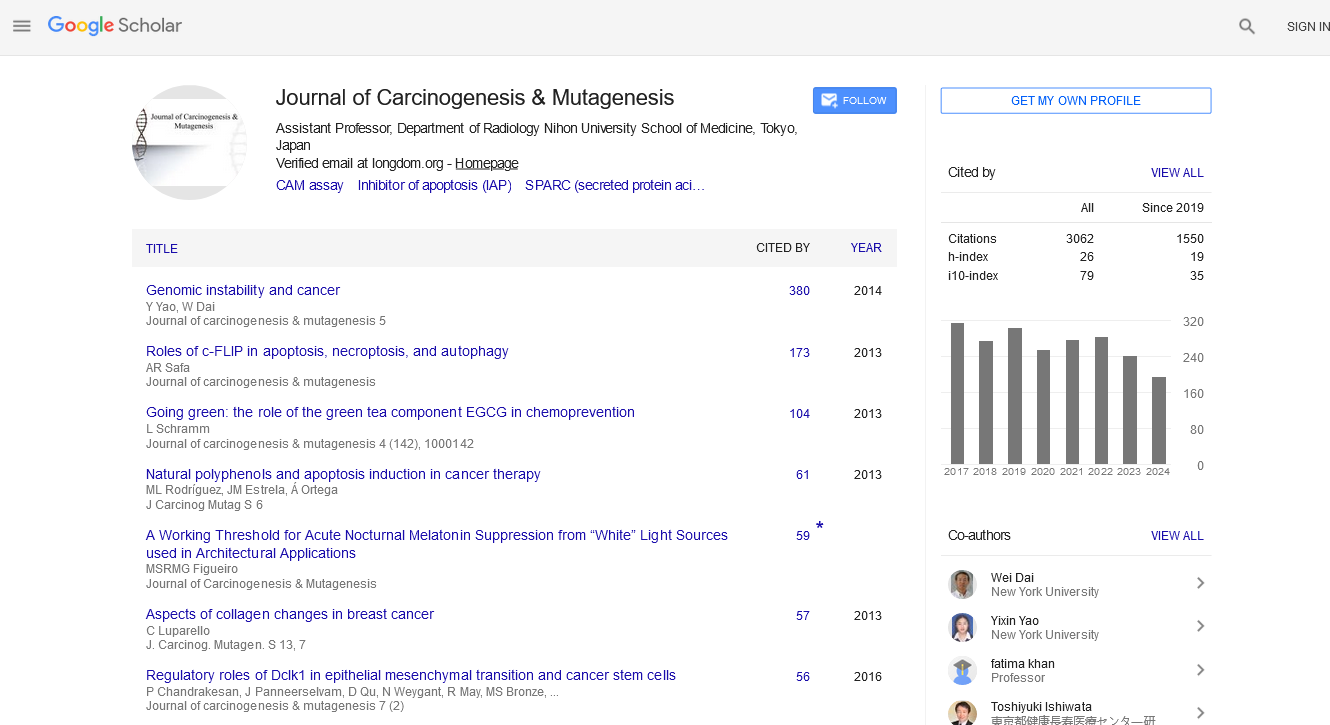
- Google Scholar
Useful Links
Share This Page
Journal Flyer

Open Access Journals
- Agri and Aquaculture
- Biochemistry
- Bioinformatics & Systems Biology
- Business & Management
- Chemistry
- Clinical Sciences
- Engineering
- Food & Nutrition
- General Science
- Genetics & Molecular Biology
- Immunology & Microbiology
- Medical Sciences
- Neuroscience & Psychology
- Nursing & Health Care
- Pharmaceutical Sciences
Perspective - (2026) Volume 17, Issue 1
Emerging Trends in Cytogenetics for Cancer Diagnosis and Therapy
Johanna Tian*Received: 31-Dec-2026, Manuscript No. JCM-26-31151; Editor assigned: 02-Jan-2026, Pre QC No. JCM-26-31151 (PQ); Reviewed: 16-Jan-2026, QC No. JCM-26-31151; Revised: 23-Jan-2026, Manuscript No. JCM-26-31151; Published: 30-Jan-2026, DOI: 10.35248/2157-2518.26.17.497
Description
Cytogenetics is a fundamental branch of genetics that focuses on the study of chromosome structure, function, and behavior, particularly in relation to cell division and heredity. It plays a critical role in understanding the genetic basis of diseases, especially cancer, where chromosomal abnormalities are a hallmark feature. By combining cytology and genetics, cytogenetics enables the visualization of chromosomes through microscopy, allowing researchers and clinicians to detect numerical and structural alterations that contribute to carcinogenesis and mutagenesis.
Chromosomal abnormalities can be broadly classified into numerical and structural changes. Numerical abnormalities, such as aneuploidy, involve the gain or loss of entire chromosomes and are frequently observed in various malignancies. Structural abnormalities include deletions, duplications, inversions, and translocations, which can disrupt gene function or create novel gene fusions. For example, chromosomal translocations can lead to the formation of oncogenic fusion genes that drive uncontrolled cell proliferation. These genetic alterations are not only diagnostic markers but also provide insights into disease prognosis and therapeutic strategies.
Advancements in cytogenetic techniques have significantly enhanced the ability to detect and analyze chromosomal changes. Conventional karyotyping remains a foundational method, enabling the visualization of entire chromosome sets during metaphase. However, it is limited by resolution constraints. To overcome this, molecular cytogenetic techniques such as Fluorescence In Situ Hybridization (FISH) have been developed, allowing for the detection of specific DNA sequences on chromosomes with higher precision. Comparative Genomic Hybridization (CGH) and array-based technologies further extend the capacity to identify copy number variations across the genome, even at submicroscopic levels.
In the context of carcinogenesis, cytogenetic abnormalities are often early events that initiate tumor development. These alterations can activate oncogenes or inactivate tumor suppressor genes, thereby disrupting normal cellular regulation. For instance, deletions in chromosomal regions harboring tumor suppressor genes can remove critical regulatory mechanisms, while amplifications of oncogenes can enhance proliferative signaling. Cytogenetic profiling of tumors has thus become an essential component in cancer diagnosis and classification, aiding in the identification of specific cancer subtypes.
Mutagenesis, the process by which genetic mutations arise, is closely linked to cytogenetic changes. Environmental factors such as radiation, chemical exposure, and viral infections can induce DNA damage, leading to chromosomal breakage and rearrangements. The study of cytogenetics provides valuable insights into how these mutagens affect genomic stability and contribute to cancer risk. Moreover, cytogenetic assays are widely used in genotoxicity testing to evaluate the potential of substances to cause chromosomal damage, making them important tools in public health and regulatory science.
Cytogenetics also plays a significant role in personalized medicine. By identifying specific chromosomal abnormalities in a patient’s tumor, clinicians can tailor treatment strategies to target the underlying genetic defects. For example, targeted therapies have been developed to inhibit the activity of proteins produced by fusion genes resulting from chromosomal translocations. This approach not only improves treatment efficacy but also reduces adverse effects by minimizing damage to normal cells.
Despite its advances, cytogenetics faces challenges, including the complexity of chromosomal rearrangements and the need for high-resolution techniques to detect subtle changes. The integration of cytogenetics with next-generation sequencing and other genomic technologies is paving the way for more comprehensive analyses of cancer genomes. This multidisciplinary approach enhances our understanding of tumor biology and opens new avenues for diagnosis, treatment, and prevention.
In conclusion, cytogenetics remains an indispensable tool in unraveling the chromosomal basis of cancer and mutation- driven diseases. Its evolving methodologies continue to refine our ability to detect, interpret, and target genetic abnormalities, thereby strengthening its role in early diagnosis, risk assessment, and the development of precision therapies for improved clinical outcomes.
Citation: Tian J (2026). Emerging Trends in Cytogenetics for Cancer Diagnosis and Therapy. J Carcinog Mutagen. 17:497.
Copyright: © 2026 Tian J. This is an open-access article distributed under the terms of the Creative Commons Attribution License, which permits unrestricted use, distribution and reproduction in any medium, provided the original author and source are credited.