
Indexed In
- Genamics JournalSeek
- RefSeek
- Hamdard University
- EBSCO A-Z
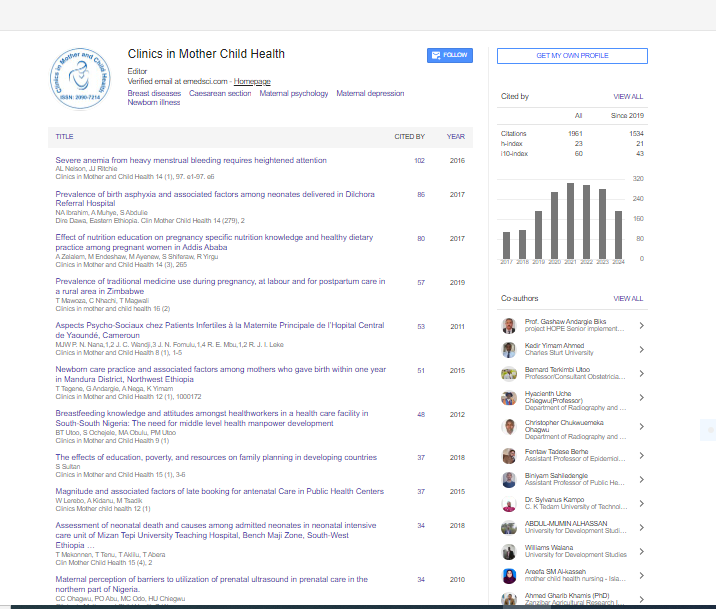
- Publons
- Geneva Foundation for Medical Education and Research
- Euro Pub
- Google Scholar
Useful Links
Share This Page
Journal Flyer
Open Access Journals
- Agri and Aquaculture
- Biochemistry
- Bioinformatics & Systems Biology
- Business & Management
- Chemistry
- Clinical Sciences
- Engineering
- Food & Nutrition
- General Science
- Genetics & Molecular Biology
- Immunology & Microbiology
- Medical Sciences
- Neuroscience & Psychology
- Nursing & Health Care
- Pharmaceutical Sciences
Short Communication - (2026) Volume 23, Issue 6
Emerging Perspectives in Obstetrics and Gynecology for Comprehensive Maternal and Reproductive Healthcare
Hildursdotte Løvaas *Received: 26-May-2026 , Manuscript No. CMCH-26-32357; Editor assigned: 28-May-2026 , Pre QC No. CMCH-26-32357 (PQ); Reviewed: 11-Jun-2026 , QC No. CMCH-26-32357; Revised: 18-Jun-2026 , Manuscript No. CMCH-26-32357 (R); Published: 25-Jun-2026 , DOI: 10.35248/2090-7214.26.23.587
Abstract
Description
Obstetrics and gynecology is a specialized medical discipline dedicated to the healthcare needs of women, focusing on pregnancy, childbirth, reproductive health, hormonal disorders, and diseases affecting the female reproductive system [1]. Obstetrics primarily involves the management of pregnancy, labor, delivery, and postpartum care, whereas gynecology focuses on the diagnosis and treatment of conditions affecting reproductive organs such as the uterus, ovaries, fallopian tubes, and cervix. Together, these interconnected specialties provide comprehensive healthcare throughout a woman’s reproductive life and contribute significantly to improving maternal health outcomes and quality of life [2].
Obstetric care begins before conception through preconception counseling and continues throughout pregnancy and after childbirth. Preconception healthcare allows healthcare professionals to evaluate a woman’s general health, nutritional status, lifestyle factors, and existing medical conditions that may influence pregnancy outcomes. Counseling regarding folic acid supplementation, vaccination status, medication safety, chronic disease management, and genetic risks helps prepare women for healthy pregnancies. Early planning and medical assessment reduce the likelihood of pregnancy-related complications and support optimal maternal and fetal health [3].
Antenatal care is a fundamental component of obstetric practice. Regular prenatal visits allow healthcare providers to monitor maternal well-being, fetal growth, and pregnancy progression. Assessments typically include blood pressure monitoring, weight evaluation, blood tests, urine analysis, ultrasound examinations, and screening for pregnancy-related disorders. Conditions such as Gestational Diabetes Mellitus (GDM), preeclampsia, anemia, and infections require timely identification and management to reduce risks for both mother and fetus. Consistent antenatal care improves pregnancy outcomes by enabling early intervention and individualized clinical management [4].
High-risk pregnancy management represents an important area within modern obstetrics. Certain maternal conditions, previous pregnancy complications, multiple pregnancies, advanced maternal age, and fetal abnormalities may increase pregnancy risks. Obstetric specialists collaborate with maternal-fetal medicine experts, neonatologists, nutritionists, and other healthcare professionals to provide coordinated care. Advanced diagnostic technologies, including fetal ultrasound, genetic screening, and laboratory investigations, support accurate assessment and appropriate treatment planning [5].
Gynecological care is equally important in maintaining women’s health throughout the reproductive years and beyond. Regular gynecological examinations help in the early detection and management of conditions such as menstrual disorders, Polycystic Ovary Syndrome (PCOS), endometriosis, uterine fibroids, pelvic infections, and reproductive tract cancers. Screening procedures such as cervical cancer screening and breast examinations, when appropriate, support early diagnosis and timely treatment. Reproductive health counseling also helps women make informed decisions regarding contraception, fertility, and family planning [6-8].
Postpartum and postnatal care are essential components of comprehensive obstetric services. Following childbirth, healthcare professionals monitor maternal recovery, blood pressure, breastfeeding, nutritional status, wound healing, and emotional well-being. Women are also provided with guidance on contraception, birth spacing, physical recovery, and recognition of postpartum warning signs. Continued follow-up after delivery promotes healthy recovery and allows complications to be identified and treated promptly, supporting the long-term health of both mother and child [9].
Patient education and preventive healthcare are important aspects of obstetric and gynecological practice. Women are educated about menstrual hygiene, sexually transmitted infection prevention, healthy lifestyle choices, reproductive rights, and the importance of regular medical examinations. Effective communication between healthcare providers and patients encourages women to discuss symptoms openly and seek timely medical care. This patient-centered approach promotes early diagnosis, informed decision-making, and better overall reproductive health [10].
Conclusion
Obstetrics and gynecology provide essential healthcare services that address pregnancy care, reproductive health, disease prevention, and treatment of female reproductive disorders. Digital healthcare innovations have further enhanced obstetric and gynecological services. Electronic Health Records (EHRs), telemedicine consultations, digital pregnancy monitoring applications, and remote health platforms improve communication between patients and healthcare providers. These technologies support continuity of care, especially for women living in areas with limited access to specialized medical services. The integration of preventive strategies, advanced diagnostics, personalized medicine, and patient-centered approaches continues to improve outcomes for women worldwide. Strengthening obstetric and gynecological healthcare systems through research, education, accessibility, and multidisciplinary collaboration remains essential for protecting maternal health and promoting reproductive well-being across generations
References
- Doraiswamy S, Jithesh A, Chaabane S, Abraham A, Chaabna K, Cheema S. Perinatal mental illness in the middle east and north africa region. A systematic overview. Int. J. Environ. Res. Public Health 2020;17:54-87.
[Cross Ref] [Google Scholar] [PubMed]
- Hariton E, Alvero R, Hill MJ, Mersereau JE, Perman S, Sable D, et al. Meeting the demand for fertility services: The present and future of reproductive endocrinology and infertility in the United States. Fertil. Steril. 2023;120:755-766.
[Cross Ref] [Google Scholar] [PubMed]
- Sharma B, Smith R, E Pennell C. Global trends in maternal mortality and efforts to improve maternal outcomes through sociomedical interventions. Reproductive Sciences. 2026:1-1.
[Cross Ref] [Google Scholar] [PubMed]
- Hoffman SR, Farland LV, Doll KM, Nicholson WK, Wright MA, Robinson WR. The epidemiology of gynaecologic health: Contemporary opportunities and challenges. J. Epidemiol. Community Health 2021;75:398-401.
[Cross Ref] [Google Scholar] [PubMed]
- Vos T, Lim SS, Abbafati C, Abbas KM, Abbasi M, Abbasifard M, et al. Global burden of 369 diseases and injuries in 204 countries and territories: A systematic analysis for the Global Burden of Disease Study. 2020;396(10258):1204-1222.
[Cross Ref] [Google Scholar] [PubMed]
- World Health Organization. Protect the Promise: 2022 Progress report on the every woman every child global strategy for women’s, children’s and adolescent’s health (2016-2030); World Health Organization: Geneva, Switzerland, 2022.
[Cross Ref] [Google Scholar] [PubMed]
- Wang H, Zhang W, Du X, Kuang Y, Li X, Ma X, et al. Expert consensus on the management process of gynecological emergency under the regular epidemic prevention and control of COVID-19. Gynecol. Obstet. Clin. Med. 2021;1:100-105.
[Cross Ref] [Google Scholar] [PubMed]
- Steffen MR, Jiang H, Beninato T, Pool A, Tummala S, Poulas E, et al. Subspecialty faculty in obstetrics and gynecology: Distribution, demographics, and implications for training and clinical practice. Cureus 2023;15:e48736.
[Cross Ref] [Google Scholar] [PubMed]
- Rayburn WF, Xierali IM. Subspecialization in obstetrics and gynecology: Is it affecting the future availability of women’s health specialists? obstet. Gynecol. Clin. N. Am. 2021;48:737-744.
[Cross Ref] [Google Scholar] [PubMed]
- Pearse WH, Gant NF, Hagner AP. Workforce projections for subspecialists in obstetrics and gynecology. Obstetrics & Gynecology. 2000;95(2):312-314.
[Cross Ref] [Google Scholar] [PubMed]
Citation: Løvaas H (2026). Emerging Perspectives in Obstetrics and Gynecology for Comprehensive Maternal and Reproductive Healthcare. Clinics Mother Child Health.23.587
Copyright: © 2026 Løvaas H. This is an open-access article distributed under the terms of the Creative Commons Attribution License, which permits unrestricted use, distribution and reproduction in any medium, provided the original author and source are credited.