
Indexed In
- Academic Journals Database
- Open J Gate
- Genamics JournalSeek
- JournalTOCs
- China National Knowledge Infrastructure (CNKI)
- Scimago
- Ulrich's Periodicals Directory
- RefSeek
- Hamdard University
- EBSCO A-Z
- OCLC- WorldCat
- Publons
- MIAR
- University Grants Commission
- Geneva Foundation for Medical Education and Research
- Euro Pub
- Google Scholar
Useful Links
Share This Page
Open Access Journals
- Agri and Aquaculture
- Biochemistry
- Bioinformatics & Systems Biology
- Business & Management
- Chemistry
- Clinical Sciences
- Engineering
- Food & Nutrition
- General Science
- Genetics & Molecular Biology
- Immunology & Microbiology
- Medical Sciences
- Neuroscience & Psychology
- Nursing & Health Care
- Pharmaceutical Sciences
Research Article - (2025) Volume 16, Issue 4
Effect of Storage Temperature on the Quality Stability of Nanoparticle Aluminum Hydroxide Adjuvant
Xifei Yang and Feiwei Zhang*Received: 24-Sep-2024, Manuscript No. JVV-24-26988; Editor assigned: 27-Sep-2024, Pre QC No. JVV-24-26988 (PQ); Reviewed: 11-Oct-2024, QC No. JVV-24-26988; Revised: 08-Oct-2025, Manuscript No. JVV-24-26988 (R); Published: 15-Oct-2025, DOI: 10.35248/2157-7560.25.16.602
Abstract
The aluminum hydroxide adjuvant exhibits a Poorly Crystalline Boehmite (PCB) structure, which is influenced by storage conditions. In this research, we comprehensively disclosed the alterations in the crystal structure, combination conventional quality indicators of the adjuvant during storage under different temperature conditions. Three batches of aluminum hydroxide adjuvants were respectively stored at 2-8°C, 18-25°C, and 37°C for 6 months. We detected the X-ray diffraction, pH, Isoelectric point (pI), adsorption rate, and average particle size of the adjuvants. X-ray diffraction revealed that the aluminum hydroxide adjuvants were PCB. After being stored at 37°C for 1 months, new diffraction peaks emerged at 18.2° 2θ in the diffract grams of the adjuvants, and the peak intensity increased along with the extension of the storage time. Meanwhile, the decreases of pI and pH were the greatest, being 0.78 and 1.33 respectively. When the adjuvant was stored at 2-8°C and 18-25°C for 6 months, only weak diffraction peaks at 18.2° 2θ were observed, showing that the crystal structure was stable or began to change. The decreases of pI and pH were the minimum, being 0.43 and 0.80 respectively. The nanoparticle aluminum hydroxide adjuvant retains a high level of adsorption capacity throughout the storage process, making it an extraordinary vaccine adsorbent. However, the increase in storage temperature will accelerate the aging of the adjuvant and the formation of highly crystalline gibbsite or bayerite, which is detrimental to the quality stability of the adjuvant.
Keywords
Aluminum hydroxide adjuvant; Poorly crystalline boehmite; X-ray diffraction; Isoelectric point; Adsorption capacity; Average particle size; Storage temperature
Introduction
In recent years, several novel adjuvants, such as MF59, ASO3, and liposomes, have been utilized in human vaccines to enhance the vaccine immunization effect [1,2]. Nevertheless, aluminum adjuvant is currently the most commonly used in human vaccines and has been verified to be safe and effective. Aluminum hydroxide adjuvant mainly adsorbs antigens through group exchange, electrostatic attraction, etc., and it is a potent enhancer of antibody production by creating a local inflammatory environment at the injection site, which activates innate immune cells [3].
Aluminum hydroxide, Al(OH)3, has numerous crystalline polymorphs, for instance, amorphous aluminum gels, and highly crystalline gibbsite, bayerite, pseudoboehmite, and nordstradite [4]. However, the aluminum hydroxide adjuvant is chemically aluminum oxyhydroxide, AlO(OH). Its X-ray diffraction pattern is Poorly Crystalline Boehmite (PCB) which is sometimes referred to as pseudoboehmite. Only PCBs possess the characteristics of a large specific surface area and strong adsorption capacity, which can serve as an excellent vaccine adsorbent [5].
Aluminum hydroxide adjuvant can be produced by precipitation from salt solutions, the hydrolysis of aluminum alkoxides, and the thermal treatment of amorphous aluminum hydroxide, Al(OH)3 [6,7]. The methods of precipitating the aluminum hydroxide adjuvant from salt solutions mainly involve the reaction of aluminum salt solution with ammonia water or sodium hydroxide. Several factors can affect the formation of PCB, such as pH, the OH/Al ratio, the rate of base addition, the presence of clay minerals, stirring, and temperature. Pure and stable PCBs can only be synthesized under specific reaction conditions [8]. In this study, the aluminum hydroxide adjuvant was prepared through the reaction of aluminum trichloride and ammonia, followed by dialysis and thermal treatment at 121°C for 60 minutes. This adjuvant is nanoparticle which is smaller than the traditional aluminum hydroxide [9].
It is reported that nanoparticle aluminum hydroxide adjuvants possess a large specific surface area and exhibit stronger adsorption capacity as well as vaccine adjuvant activity compared to traditional aluminum hydroxide adjuvants. As the particle size of the adjuvant-antigen conjugate grows, the antigenpresentation effect of APCs is weakened. Moreover, nanoparticle aluminum hydroxide adjuvant proves to be more efficient in reducing inflammatory responses in mouse models of allergic asthma.
Aluminum hydroxide adjuvant mainly adsorbs antigens through group exchange and electrostatic attraction, and it can enhance antigen stability and protect them from thermal degradation. Isoelectric point (pI) and pH are significant quality indicators of aluminum hydroxide adjuvant. During either autoclaving or aging at room temperature, aluminum hydroxide adjuvant undergoes deprotonation and dehydration reactions, which causes a decrease in pH and pI, eventually leading to a reduction in width at half-height and protein adsorption capacity.
"The Chinese Pharmacopoeia" stipulates that the conventional quality indicators for aluminum hydroxide adjuvants including pH and adsorption rate. Aiming to enhance the production and quality control of aluminum-containing vaccines, the China medical products administration has freshly issued the "Technical Guidelines for Vaccines Containing Aluminum Adjuvants for Prophylaxis", recommending that X-ray diffraction and pI should be included in the quality stability study of adjuvants. There are relatively few reports regarding the effect of storage temperature on the quality stability of nanoparticle aluminum hydroxide adjuvant. In this research, we comprehensively disclosed the changes in the crystal structure and combined conventional quality indicators of the adjuvant during storage under different temperature conditions, providing references for the storage of the adjuvant and ensuring the effectiveness and safe production of vaccines.
Materials and Methods
Aluminium hydroxide adjuvant
Aluminum hydroxide adjuvants were produced by the reaction of aluminum trichloride and ammonia solution, followed by dialysis and thermal treatment at 121°C for 60 minutes. Bovine serum albumin (BSA; sigma) was commercially available.
Storage and measurement of aluminum hydroxide adjuvant
Three batches of aluminum hydroxide adjuvants were stored respectively at 2-8°C, 18-25°C, and 37°C for 6 months, and the X-ray diffraction, pH, pI, adsorption rate, and average particle size were measured on the 1st, 3rd, and 6th months
X-ray diffraction
Samples for X-ray diffraction were prepared as random powder mounts after air drying. X-ray diffraction patterns were obtained using a powder X-ray diffractometer (3100 XRG, Philips) operated at 40 kV and 30 mA with CuKa radiation. The scanning range was from 5 to 70° 2θ with a step size of 0.026° 2θ and a scanning speed of 0.22°/min.
Isoelectric point
The pI of the aluminum hydroxide adjuvants was determined by measuring the zeta potential at various pH values using a Zetasizer Nano ZS (2000, Malvern), and then interpolating to obtain the pH value at which the zeta potential was zero.
Adsorption capacity
Aluminum hydroxide adjuvant samples were diluted to an Al3+ concentration of 1 mg/mL with a 9 g/L sodium chlorideprepared adjuvant solution, and the pH was adjusted to 6.0-7.0. The BSA solution was prepared by diluting BSA to 10 mg/mL with 9 g/L sodium chloride, and the pH was adjusted to be the same as that of the adjuvant solution. Then, 0.08, 0.16, 0.40, 0.80, and 1.20 mL of the BSA solution were added into five centrifuge tubes respectively, and 9 g/L sodium chloride solution was added to make a total volume of 4.0 ml. The mixtures were mixed for 5 minutes, and 1 ml of the adjuvant solution was added to each tube. The mixture was then left to adsorb for 1 hour at room temperature, shaken every 10 minutes, and centrifuged to collect the supernatant. The concentration of proteins in the supernatant was quantified using a UV-vis spectrophotometer (UV1800) with the Lowry assay. The adsorption rate was determined by analyzing the total protein in the supernatant.
Average particle size
The average particle size of the aluminum hydroxide adjuvants was measured by Zetasizer Nano ZS (2000, Malven). The aluminum hydroxide adjuvant was diluted 100-fold with purified water, and then a 1 mL diluted sample was detected to obtain the average particle size.
Statistical analysis
Statistical analysis was conducted using SPSS 18.0 software, and Origin 9.0 was used as the mapping tool. The pH and isoelectric point drop value was the average difference of the three batches of adjuvants before and after storage for 6 months.
Results
X-ray diffraction
As presented by the X-ray diffractograms, the presence of five distinct peaks at 14.3, 28.0, 38.2, 48.8, and 64.5° 2θ across three different batches of adjuvants at months 1, 3, and 6 respectively, which align perfectly with the crystal structure of PCB. When the new bands at 18.2° 2θ appeared, corresponding to a dspacing of 4.84 Å, highly crystalline bayerite or gibbsite was generated, with a large particle size.
As shown in Figure 1, the adjuvant had no obvious diffraction peak at 18.2° 2θ after being stored at 2-8 °C for 6 months, indicating that the crystal structure of the adjuvant was stable.
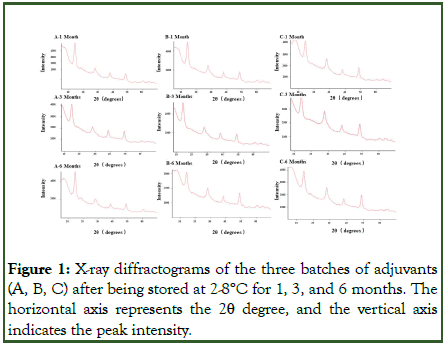
Figure 1: X-ray diffractograms of the three batches of adjuvants (A, B, C) after being stored at 2-8°C for 1, 3, and 6 months. The horizontal axis represents the 2θ degree, and the vertical axis indicates the peak intensity.
As shown in Figure 2, for 2 batches of the adjuvant, a weak diffraction peak at 18.2° 2θ was shown after being stored at 18-25°C for 6 months, indicating that the crystal structure was beginning to change.
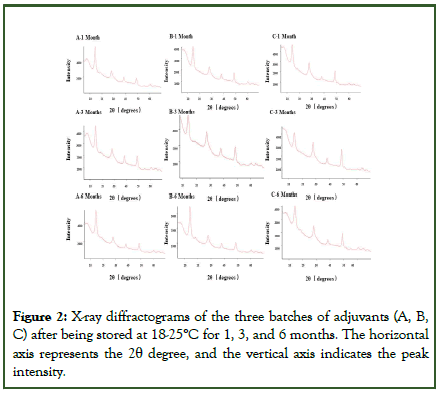
Figure 2: X-ray diffractograms of the three batches of adjuvants (A, B, C) after being stored at 18-25°C for 1, 3, and 6 months. The horizontal axis represents the 2θ degree, and the vertical axis indicates the peak intensity.
As shown in Figure 3, for three batches of the adjuvant, obvious diffraction peaks at 18.2° 2θ emerged after being stored at 37°C for 6 months, indicating that the high temperature enhanced the order of the crystal structure, resulting in the appearance of highly crystalline gibbsite or bayerite.
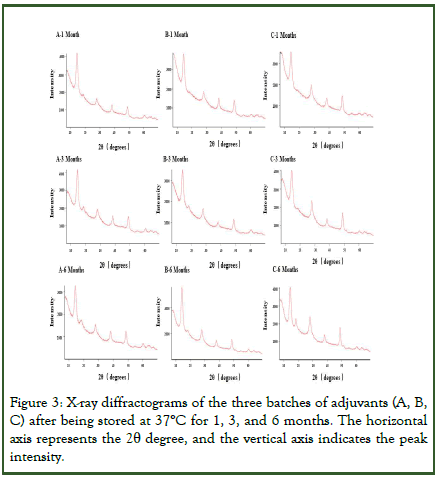
Figure 3: X-ray diffractograms of the three batches of adjuvants (A, B, C) after being stored at 37°C for 1, 3, and 6 months. The horizontal axis represents the 2θ degree, and the vertical axis indicates the peak intensity.
As shown in Table 1, new diffraction peaks emerged at 18.2° 2θ for the adjuvant after being stored at 37°C for 1 month, and the peak intensity increased along with the storage time. Whereas only weak diffraction peaks appeared in the adjuvant after being stored at 2-8°C and 18-25°C for 6 months, indicating that the crystal structure was stable or began to change.
| Storage time (months) | 2-8 °C | 18-25 °C | 37°C | ||||||
| A | B | C | A | B | C | A | B | C | |
| 1 | N | N | N | N | N | N | + | N | N |
| 3 | N | N | N | N | N | N | ++ | + | + |
| 6 | + | N | N | N | + | + | +++ | + | +++ |
| Note: “N” means no diffraction peak, “+” indicates a weak diffraction peak, and “+++” represents a strong diffraction peak. | |||||||||
Table 1: X-ray diffraction peaks at 18.2° 2θ of the three batches of adjuvants (A, B, C) after storage at 2-8°C, 18-25°C, and 37°C for 6 months.
pH and isoelectric point
As shown in Figure 4, the pH decreases by 0.78, 0.64, and 0.43 respectively, and the pI drops by 1.33, 1.13, and 0.80 respectively after the adjuvant is stored at 37°C, 18-25 °C, and 2-8°C for 6 months. Notably, as the storage temperature increases, the downward trends of both the pH and pI become more marked.
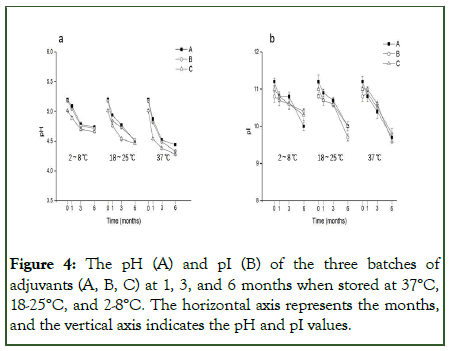
Figure 4: The pH (A) and pI (B) of the three batches of adjuvants (A, B, C) at 1, 3, and 6 months when stored at 37°C, 18-25°C, and 2-8°C. The horizontal axis represents the months, and the vertical axis indicates the pH and pI values.
Adsorption capacity
As shown in Figure 5, the adjuvant maintained a high protein adsorption capacity when stored at 2-8°C, 18-25°C, and 37°C for 6 months. The adsorption rate was all above 90% at a BSA concentration of ≤ 8 mg/mg Al3+, and the adsorption rate of the adjuvant was approximately 8 mg BSA/mg Al3+. There was no statistically significant difference in the adsorption rate when the adjuvants were stored under different temperature conditions (P>0.05).
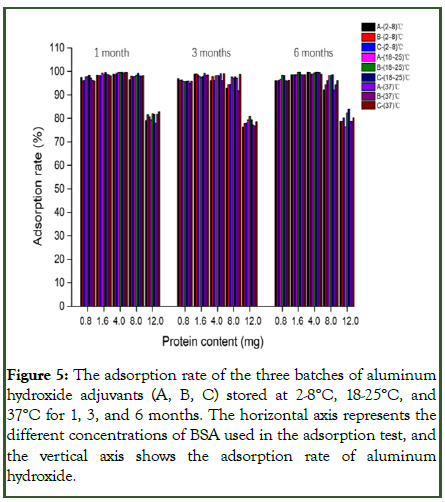
Figure 5: The adsorption rate of the three batches of aluminum hydroxide adjuvants (A, B, C) stored at 2-8°C, 18-25°C, and 37°C for 1, 3, and 6 months. The horizontal axis represents the different concentrations of BSA used in the adsorption test, and the vertical axis shows the adsorption rate of aluminum hydroxide.
Average particle size
As depicted in Figure 6, the three batches of adjuvants consist of nanoparticle, and the average particle size ranges from 110 to 140 nm. The average particle size of aluminum hydroxide adjuvants tends to increase over time when they are stored at 37°C (P<0.05).
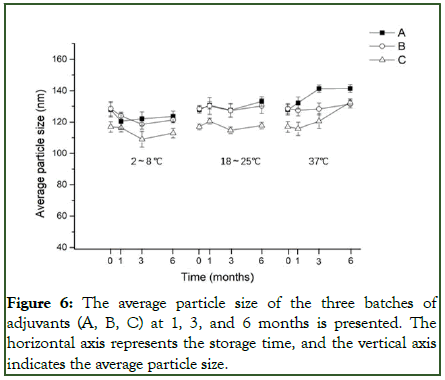
Figure 6: The average particle size of the three batches of adjuvants (A, B, C) at 1, 3, and 6 months is presented. The horizontal axis represents the storage time, and the vertical axis indicates the average particle size.
Discussion
The crystal structure of the aluminum hydroxide adjuvant was PCB. After being stored at 37°C for 1 month, new diffraction peaks emerged at 18.2° 2θ in the diffract grams of the adjuvant, and the peak intensity increased with the extension of the storage time. However, only weak diffraction peaks at 18.2° 2θ appeared in the adjuvant after being stored at 2-8°C and 18-25°C for 6 months, indicating that the crystal structure was stable or began to change. An increase in storage temperature can accelerate the change of the crystal structure. In this study, the aluminum hydroxide adjuvant was produced by the reaction of aluminum trichloride and ammonia, followed by dialysis and thermal treatment at 121°C for 60 minutes. The main substance is amorphous aluminum hydroxide Al(OH)3, and it is converted into PCB after before 121°C, 60 min thermal treatment. A pure and stable adjuvant can be formed only when all the amorphous aluminum hydroxide converted into PCB. The common crystalline forms of Al(OH)3 are bayerite and gibbsite. The aluminum hydroxide adjuvant is chemically hydroxyl alumina AlO(OH), which is unstable during storage, it can spontaneously transform to highly crystalline phases, and the residual amorphous aluminum hydroxide promotes the formation of highly crystalline gibbsite or bayerite. The increase of the storage temperature will accelerate the change of the crystal structure.
When the aluminum hydroxide adjuvant was stored at 37 °C for 6 months, the pH and pI decreased the most, attaining 0.78 and 1.33 respectively. While the pH and pI decreased the least, being 0.43 and 0.80 respectively, when the aluminum hydroxide adjuvant was stored at 2-8°C for 6 months. As the storage temperature increases, the downward trends of both the pH and pI become more marked. The chemical composition of the aluminum hydroxide adjuvant is AlO(OH). The adjuvant’s crystalline phases became more orderly, with the deprotonation and dehydration reaction occurring, resulting in a decrease in pH and pI. There are various immune proteins such as TT, PT, DT, PRN, etc., all of which are acidic proteins in the DTaP vaccine. The aluminum hydroxide adjuvant and the antigen are mainly electrostatically adsorbed through opposing charges in a neutral pH environment. The adsorption capacity of adjuvant is very important for the immune response of vaccine. However, the reduction of the pH and pI is not conducive to the adsorption of antigens by adjuvant.
The quality characteristics of aluminum hydroxide adjuvants prepared through different crafts present significant variations. In this study, the aluminum hydroxide adjuvant was produced by the reaction of aluminum trichloride and ammonia. This adjuvant possesses a smaller particle size, with the average particle size ranging from 110 to 140 nm and a large specific surface area, consequently, it has a high adsorption rate. During the 6 months’ storage process, the adsorption rate of BSA by the adjuvants was approximately 8 mg BSA/mg Al3+, which was higher than that of traditional micron-scale aluminum hydroxide adjuvants (about 9 μm), which was 2-4 mg BSA/mg Al3+. Also, aluminum hydroxide nanoparticle adjuvants were more efficient in reducing inflammation than traditional aluminum hydroxide adjuvants. Concurrently, we find that the average particle size of aluminum hydroxide adjuvants is prone to increase over time when they are stored at 37°C. As shown in the previous results, the rise in storage temperature will expedite the aging of the adjuvants, leading to the formation of highly crystalline gibbsite or bayerite. These substances, which are large particle precipitates, can be witnessed in the later stage of storage, and resulting in an increase in the average particle size of the adjuvant. Furthermore, when these large particles precipitate into the human body, they are likely to cause side effects.
Factors influencing the immune efficacy of the aluminum hydroxide adjuvant include the adsorption rate, adsorption strength, particle size and uniformity, adjuvant dose, and antigen type. The increase in storage temperature accelerates the aging of the adjuvant, enhances the order of the crystals, and leads to the decrease of pH and pI. This does not affect the adsorption rate of adjuvant, but it can affect the adsorption strength of adjuvant on antigen and may affect the immune effect of vaccine.
Conclusion
The nanoparticle aluminum hydroxide adjuvant retains a high level of adsorption capacity throughout the storage process, making it an extraordinary vaccine adsorbent. However, the increase in storage temperature will accelerate the aging of the adjuvant and the formation of highly crystalline gibbsite or bayerite, which is detrimental to the quality stability of the adjuvant. The optimal storage temperature for the aluminum hydroxide adjuvant is 2-8°C, at this temperature, the crystal structure of the adjuvant can remain stable for 6 months, and the pH and isoelectric point decrease minimally.
Author Contributions
Xifei Yang: Experimental design, research implementation, data collection and analysis, article drafting.
Feiwei Zhang: Experimental design, research implementation, paper revision, supporting contributions.
Acknowledgments
The authors would like to express their gratitude to Dr. Zhimin Song in the College of Sichuan University’s Analysis and Testing Center for kindly assisting us in testing X-ray diffraction in his lab.
Conflict of Interest Statement
All authors have no conflict of interest.
Data Availability Statement
Data are available upon reasonable request.
References
- Reed SG, Orr MT, Fox CB. Key roles of adjuvants in modern vaccines. Nat Med. 2013;19:1597–1608.
[Crossref] [Google Scholar] [PubMed]
- Bonam SR, Partidos CD, Halmuthur SKM, Muller S. An overview of novel adjuvants designed for improving vaccine efficacy. Trends Pharmacol. Trends Pharmacol Sci. 2017;38:771–793.
[Crossref] [Google Scholar] [PubMed]
- Zhang LY, Zhou X. Research status of aluminum hydroxide adjuvant for vaccines. Chin J Biologicals 2020;33:213-221.
- Prodromou KP, Pavlatou-Ve AS. Formation of aluminum hydroxides as influenced by aluminum salts and bases. Clays Clay Miner. 1995;43:111-115.
- Baker BR, Pearson RM. Water content of pseudoboehmite: A new model of its structure. J Catal. 1974;33:265-278.
- Wang SL, Johnston CT, Bish DL, White JL, Hem SL. Water-vapor adsorption and surface area measurement of poorly crystalline boehmite. J Colloid Interface Sci. 2003;260:26-35.
- Hsu PH. Effect of salts on the formation of bayerite versus pseudo-boehmite. Soil Sci. 1967;103:101-110.
- Burrell LS, Johnston CT, Schulze D, Klein J, White JL, Hem SL. Aluminum phosphate adjuvants precipitated at constant pH I: Composition and structure. Vaccine 2000;19:275-281.
- Gupta RK, Rost BE. Aluminum compounds as vaccine adjuvants. In: Vaccine adjuvants: preparation methods and research protocols. Adv Drug Deliv Rev. 1998;32:153-288.
Citation: Yang X, Zhang F (2025) Effect of Storage Temperature on the Quality Stability of Nanoparticle Aluminum Hydroxide Adjuvant. J Vaccines Vaccin. 16:602.
Copyright: © 2025 Yang X, et al. This is an open-access article distributed under the terms of the Creative Commons Attribution License, which permits unrestricted use, distribution, and reproduction in any medium, provided the original author and source are credited.