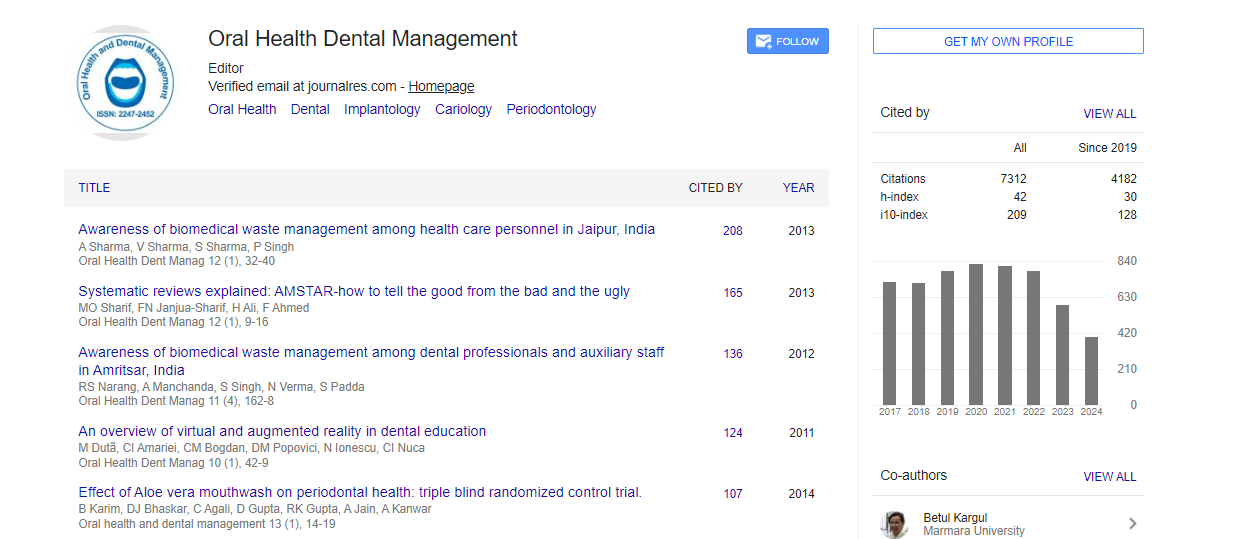

Indexed In
- The Global Impact Factor (GIF)
- CiteFactor
- Electronic Journals Library
- RefSeek
- Hamdard University
- EBSCO A-Z
- Virtual Library of Biology (vifabio)
- International committee of medical journals editors (ICMJE)
- Google Scholar
Useful Links
Share This Page
Journal Flyer
Open Access Journals
- Agri and Aquaculture
- Biochemistry
- Bioinformatics & Systems Biology
- Business & Management
- Chemistry
- Clinical Sciences
- Engineering
- Food & Nutrition
- General Science
- Genetics & Molecular Biology
- Immunology & Microbiology
- Medical Sciences
- Neuroscience & Psychology
- Nursing & Health Care
- Pharmaceutical Sciences
Commentary - (2025) Volume 24, Issue 4
Educational programs and public awareness on dental fluorosis prevention
Elena Maria*Received: 03-Sep-2024, Manuscript No. OHDM-24-26860; Editor assigned: 05-Sep-2024, Pre QC No. OHDM-24-26860 (PQ); Reviewed: 19-Sep-2024, QC No. OHDM-24-26860; Revised: 03-Oct-2025, Manuscript No. OHDM-24-26860 (R); Published: 10-Oct-2025, DOI: 10.35248/2247-2452.25.24.1133
Abstract
Description
Educational programs and public awareness campaigns play a significant role in the prevention of dental fluorosis, a condition resulting from excessive fluoride exposure during tooth development. Dental fluorosis manifests as discoloration or mottling of the teeth, which, although typically mild and cosmetic, can impact an individual's appearance and selfesteem. Effective prevention strategies focus on informing the public about fluoride use, potential risks, and appropriate measures to maintain optimal fluoride levels. One key component of educational programs is informing communities about the sources of fluoride and its benefits. Fluoride is widely used in dental care products, such as toothpaste and mouth rinses, and is also present in some drinking water supplies. While fluoride is effective in preventing tooth decay by strengthening tooth enamel, excessive exposure, especially during the formative years when teeth are developing, can lead to dental fluorosis. Education efforts emphasize the balance needed to maximize the benefits of fluoride while minimizing the risk of fluorosis.
Public awareness campaigns often target specific populations at higher risk for dental fluorosis, including young children who are more susceptible to excessive fluoride intake. These programs typically address the importance of using fluoridecontaining products in moderation and ensuring that fluoride intake from various sources, such as drinking water and dental products, remains within recommended levels. Parents are provided with guidance on appropriate toothpaste use for children, including the recommended amount and the importance of supervising young children to prevent swallowing toothpaste. Another important aspect of prevention is the regulation of fluoride levels in community water supplies. Many public health initiatives focus on maintaining optimal fluoride concentrations in drinking water to reduce the incidence of dental caries while preventing fluorosis. Educational programs may provide information on how fluoride levels are monitored and adjusted to ensure safety and effectiveness. They also offer guidance on how individuals can access information about the fluoride content of their local water supply and take appropriate actions if necessary.
Educational efforts also include promoting the use of fluoride treatments and dental products that are designed to be safe and effective. Dentists and dental hygienists play a key role in educating patients about the benefits of fluoride and how to use fluoride-containing products correctly. Professional advice often covers the selection of appropriate dental products, such as fluoride toothpaste and mouth rinses, and the benefits of periodic fluoride treatments provided in dental offices. In addition to individual education, public health campaigns often address broader community concerns and involve collaboration with schools, healthcare providers, and community organizations. School-based programs are particularly effective in reaching young children and their families. These programs may include interactive workshops, educational materials, and fluoride varnish applications to educate students about dental health and the importance of proper fluoride use. Schools often serve as a central point for disseminating information and encouraging good oral hygiene practices.
Community outreach programs also contribute to raising awareness about dental fluorosis prevention. Local health fairs, community centers, and other public events provide opportunities to distribute educational materials, offer free dental screenings, and engage with the public about oral health. These outreach efforts aim to reach a diverse audience and address any misconceptions or concerns related to fluoride use and dental fluorosis. To measure the effectiveness of educational programs and public awareness campaigns, evaluations and feedback are essential. Surveys and assessments can gauge the public's knowledge and attitudes regarding fluoride use and dental fluorosis prevention. This information helps identify areas where further education is needed and allows for the refinement of strategies to improve outreach and impact.
Conclusion
In conclusion, educational programs and public awareness campaigns are vital in preventing dental fluorosis by informing the public about the benefits and risks of fluoride use. These initiatives provide essential guidance on maintaining optimal fluoride levels, using dental products correctly, and understanding the sources of fluoride. Collaborative efforts involving schools, healthcare providers, and community organizations enhance the reach and effectiveness of these programs. By fostering informed decision-making and promoting responsible fluoride use, these educational efforts contribute to reducing the incidence of dental fluorosis and improving overall oral health.
Citation: Maria E. Educational programs and public awareness on dental fluorosis prevention. Oral Health Dent Manage 2025;24(4):1133.