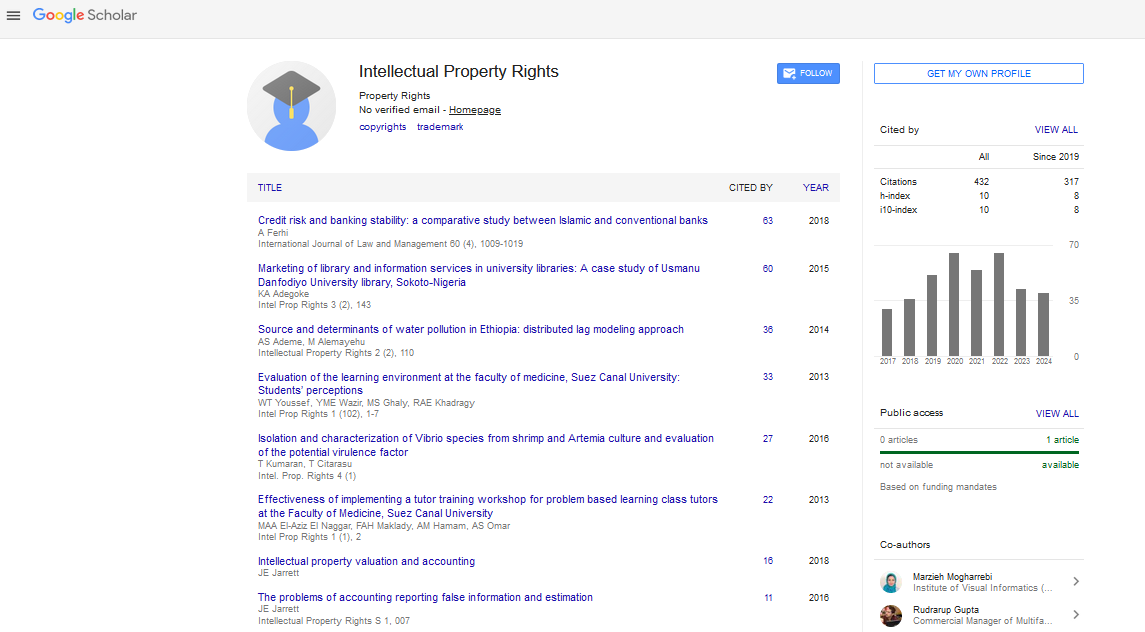

Indexed In
- Open J Gate
- RefSeek
- Hamdard University
- EBSCO A-Z
- OCLC- WorldCat
- SWB online catalog
- Publons
Useful Links
Share This Page
Journal Flyer
Open Access Journals
- Agri and Aquaculture
- Biochemistry
- Bioinformatics & Systems Biology
- Business & Management
- Chemistry
- Clinical Sciences
- Engineering
- Food & Nutrition
- General Science
- Genetics & Molecular Biology
- Immunology & Microbiology
- Medical Sciences
- Neuroscience & Psychology
- Nursing & Health Care
- Pharmaceutical Sciences
Short Communication - (2025) Volume 13, Issue 1
Copyright Protection in the Digital Era: Evolving Legal Frameworks and Emerging Challenges
Ethan Walker*Received: 19-May-2025, Manuscript No. IPR-25-31941; Editor assigned: 21-May-2025, Pre QC No. IPR-25-31941; Reviewed: 05-Jun-2025, QC No. IPR-25-31941; Revised: 12-Jun-2025, Manuscript No. IPR-25-31941; Published: 19-Jun-2025, DOI: 10.35248/2375-4516.25.13.262
Description
Copyright is a legal mechanism designed to protect original works of authorship by granting creators exclusive rights over the use and distribution of their creations. It serves as one of the oldest and most widely recognized branches of intellectual property law, providing a framework through which authors, artists, musicians, filmmakers, software developers, and other creators can benefit from their intellectual efforts. The concept emerged from the need to prevent unauthorized reproduction of creative works and has evolved significantly with technological and societal changes. In modern economies, copyright plays an important role in encouraging artistic expression, cultural development, and knowledge dissemination while supporting industries that depend on creative output. The foundation of copyright lies in the principle that individuals who create original works should have control over how those works are reproduced, communicated, adapted, and distributed. Copyright protection generally arises automatically once a work is fixed in a tangible form, eliminating the need for extensive formalities in many jurisdictions [1,2].
This automatic protection distinguishes copyright from certain other intellectual property rights that require registration before legal protection becomes available. By recognizing ownership rights from the moment of creation, copyright law seeks to foster an environment where creativity can flourish without fear of immediate exploitation by others. Copyright extends to a wide range of works, including literary writings, musical compositions, paintings, sculptures, photographs, cinematographic productions, architectural designs, computer software, and digital content. The diversity of protected subject matter reflects the expanding nature of human creativity and technological advancement. As new forms of expression emerge through digital platforms and online communication, copyright law continues to adapt to accommodate evolving methods of creating and sharing content. The digital era has significantly increased opportunities for creators to reach global audiences, making copyright protection more relevant than ever before [3-5].
The economic significance of copyright is evident in the growth of creative industries around the world. Publishing, music production, film, television, gaming, advertising, and software development generate substantial economic value and employment opportunities. Copyright protection encourages investment in these industries by providing legal assurance that creators and investors can derive benefits from their contributions. Without such protection, unauthorized copying could diminish incentives to produce new works, potentially reducing innovation and cultural diversity. Consequently, copyright functions as an important component of knowledgebased economies where intellectual assets contribute significantly to national development. The advancement of digital technologies has transformed copyright protection and enforcement. The internet has enabled instantaneous sharing of creative works across geographical boundaries, creating opportunities for both legitimate distribution and unauthorized use [6,7].
Digital piracy, file sharing, streaming platforms, and online content reproduction have generated complex legal issues concerning infringement and enforcement. Rights holders increasingly rely on technological measures, digital rights management systems, and online monitoring tools to protect their works from unauthorized exploitation. Meanwhile, courts and policymakers continue to address questions regarding liability, platform responsibility, and cross-border enforcement in the digital environment. International cooperation has become essential in the field of copyright due to the global nature of creative industries. Various international agreements establish common standards for copyright protection and facilitate recognition of rights across national borders. These agreements seek to ensure that creators receive protection in multiple jurisdictions while promoting international cultural and economic exchange. However, differences in legal traditions, economic priorities, and technological capacities continue to influence how copyright laws are implemented and enforced worldwide. Such diversity contributes to ongoing discussions regarding harmonization and reform within the international copyright system [8].
Recent developments in artificial intelligence have introduced new dimensions to copyright discourse. AI-generated content raises questions regarding authorship, ownership, originality, and the scope of protection available for machine-assisted creations. Similarly, the use of copyrighted materials in training artificial intelligence systems has generated debates concerning consent, licensing, and fair use. These developments demonstrate the dynamic nature of copyright law and the necessity of adapting legal frameworks to address emerging technological realities. As innovation progresses, copyright systems must continue evolving to accommodate new forms of creativity while preserving the rights and interests of human creators. Copyright also possesses a cultural dimension that extends beyond economic considerations. Creative works contribute to the preservation of history, identity, language, and artistic heritage. By protecting authors and artists, copyright law supports the production and preservation of cultural expressions that enrich societies and strengthen collective memory [9,10].
Conclusion
In conclusion, copyright remains a fundamental institution for protecting original creative expression in an increasingly interconnected world. By granting creators exclusive rights over their works, it encourages artistic production, supports economic growth, and promotes cultural enrichment. At the same time, copyright law must maintain an appropriate balance between private ownership and public access to ensure that creativity and knowledge continue to serve broader societal interests. As technological innovations reshape methods of creation and distribution, copyright will continue to evolve as a significant legal framework governing the relationship between creators, users, and the expanding landscape of human expression.
References
- Morrison H, Desautels L. Open access, copyright and licensing: basics for open access publishers. J Orthop Case Rep. 2016;6(1):1.
- Carroll MW. Creative commons and the openness of open access. N Engl J Med. 2013;368(9):789-791.
- Singhal S, Kalra BS. Publication ethics: Role and responsibility of authors. Indian J Gastroenterol. 2021;40(1):65-71.
- Gould KA. Understanding copyright and reuse agreements in professional publication. Dimens Crit Care Nurs. 2024;43(1):49.
- Feldman R, Newman J. Copyright at the bedside: should we stop the spread? Stanf Technol Law Revl. 2013;16(3):623.
- Newman JC, Feldman R. Copyright and open access at the bedside. N Engl J Med. 2011;365(26):2447-2449.
- Samuelson P. Generative AI meets copyright. Science. Science. 2023;381(6654):158-161.
- Mondal H. Copyright and creative commons licenses in scholarly publishing: A practical guide for researchers. J Clin Imaging Sci. 2025; 15:32.
- Fkirin A, Attiya G, El-Sayed A, Shouman MA. Copyright protection of deep neural network models using digital watermarking: a comparative study. Multimed Tools Appl. 2022;81(11):15961-15975.
- Kappel K, Luetkemeyer LM, Mannebach M. The “rights” prescription: Navigating copyright law in practice of medicine. Mo Med. 2024;121(4):257.
Citation: Walker E (2025). Copyright Protection in the Digital Era: Evolving Legal Frameworks and Emerging Challenges. Intel Prop Rights. 13:262.
Copyright: ©2025 Walker E. This is an open-access article distributed under the terms of the Creative Commons Attribution License, which permits unrestricted use, distribution, and reproduction in any medium, provided the original author and source are credited.