

Indexed In
- Open J Gate
- Genamics JournalSeek
- Academic Keys
- JournalTOCs
- CiteFactor
- Ulrich's Periodicals Directory
- Access to Global Online Research in Agriculture (AGORA)
- Electronic Journals Library
- Centre for Agriculture and Biosciences International (CABI)
- RefSeek
- Directory of Research Journal Indexing (DRJI)
- Hamdard University
- EBSCO A-Z
- OCLC- WorldCat
- Scholarsteer
- SWB online catalog
- Virtual Library of Biology (vifabio)
- Publons
- Geneva Foundation for Medical Education and Research
- Euro Pub
- Google Scholar
Useful Links
Share This Page
Journal Flyer
Open Access Journals
- Agri and Aquaculture
- Biochemistry
- Bioinformatics & Systems Biology
- Business & Management
- Chemistry
- Clinical Sciences
- Engineering
- Food & Nutrition
- General Science
- Genetics & Molecular Biology
- Immunology & Microbiology
- Medical Sciences
- Neuroscience & Psychology
- Nursing & Health Care
- Pharmaceutical Sciences
Research Article - (2025) Volume 15, Issue 3
Comparative Virulence of Xanthomonas campestris Pv. Musacearum Isolates Causing Bacterial Wilt of Enset Collected from Severely Diseased Areas
Misgana Mitiku*Received: 03-Oct-2024, Manuscript No. JPPM-24-27108; Editor assigned: 07-Oct-2024, Pre QC No. JPPM-24-27108 (PQ); Reviewed: 21-Oct-2024, QC No. JPPM-24-27108; Revised: 03-Sep-2025, Manuscript No. JPPM-24-27108 (R); Published: 10-Sep-2025, DOI: 10.35248/2157-7471.25.16.765
Abstract
For this purpose, pot experiment was conducted using three Xcm isolates and three enset clones having different level of resistance in CRD design. Analysis of variance showed that among the tested isolates and enset clones, there is significant level of difference in disease severity and total area of disease progress curve but they didn’t show significant difference in percentage of final disease severity index. The treatment 1 has highest numerical values (4.33) and (2933.3%-day) respectively from these treatments. Therefore, we recommend to you Xcm isolates collected from this area for further breeding (clonal screening) and some other pathological activities. Also Further virulence characterization of the X. campestris pv. musacearum strains collected from different locations should be carried out by using the existing available evaluation methods. In addition, the genetic diversity among both the enset and the pathogen should be investigated further.
Keywords
Bacterial wilt of enset; Xanthomonas campestris pv. musacearum (Xcm); Enset; Environment
Introduction
Infecting enset collected from three different agro-ecological zones in Ethiopia, each with distinct climatic conditions and edaphic factors, is scarce. Hence, the primary objective of the current study was to evaluate the virulence spectrum and level of aggressiveness of Xanthomonas campestris pv. musacearum (Xcm) isolates on enset clones with different level of reaction. The findings from this research will aid farmers in devising effective control strategies and assist breeders in developing cultivars resistant to the bacterium [1,2].
Materials and Methods
Planting of enset suckers
The experiment was conducted using CRD design. Suckers of enset clones Mazia, Kuro and Arkiya having different level of resistance (previously identified as resistant/tolerant, moderately resistance/tolerance and susceptible) respectively were planted in an open environment using plastic pots of 5 kg capacity filled with sterilized balanced soil (sand, peat and garden soil). Three suckers per pot were planted and watered as required (Figure 1).
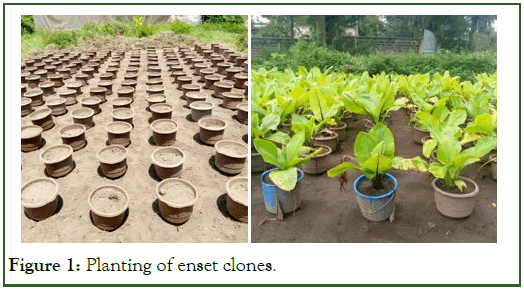
Figure 1: Planting of enset clones.
Sample collection and inoculums preparation
Diseased enset/Bacterial wilt pathogen (Xcm) isolate samples were collected from naturally infected enset fields of Gurage, Sidama and Dawro zones. Fresh pure culture cells of Xcm from the collected samples of each location were prepared in sterile distilled water in the lab and the cells concentration in suspension was adjusted to 108 cfu/ml (adjusted to 0.3 OD at 460 nm using spectrophotometer) was prepared and ready for inoculation (Figures 2 and 3) [3-5].
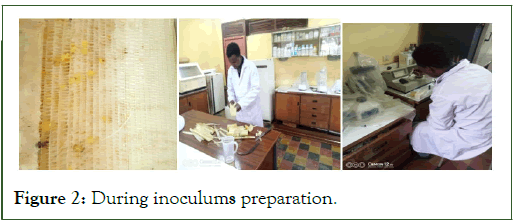
Figure 2: During inoculums preparation.
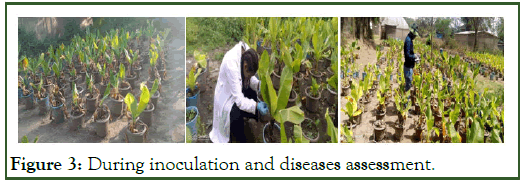
Figure 3: During inoculation and diseases assessment.
Disease severity assessment was made using 0-5 disease scoring scale; where 0=no visible disease symptom, 1=yellow necrotic and 1 leaf wilted, 2=2-3 leaves wilted, 3=4 leaves wilted, 4=all leaves wilted, and 5=the whole plant dead. Disease severity scales were transformed into Percentage Severity Index (PSI) for analysis following the formula suggested by Wheeler as below

The area under disease progress curve was computed from disease severity data recorded at different DAI for each plot following the formula advised by Campbell and Madden [6].

where n is the total number of disease assessments, ti is the time of the ith assessment in days from the first assessment date and xi is the disease severity of XCM at the ith assessment. AUDPC value was expressed in % days because severity (x) is expressed in percent and time (t) in days. Then all data were subject to analysis using SAS software version 9.0.
Results and Discussion
During the course of the experiment all isolates on the inoculated enset clones showed initial yellowing symptoms on the inoculated leaves after 30 days of artificial inoculation. Analysis of variance showed that among the tested isolates and enset clones, there is significant level of difference in disease severity and total area of disease progress curve but they didn’t show significant difference in percentage of final disease severity index (Table 1).
| Source of variation | DF | DS | PSIf (%) | TAUDPC (% days) |
| Treat | 11 | 1.63263** | 4.13ns | 584747** |
| Error | 24 | 0.09818 | 0.1939 | 187708 |
| CV (%) | 9.05 | 3.3 | 18.22 |
Table 1: Significance of mean square value for disease severity, percent severity index and total area of disease progress curve for the treatments.
The virulence of Xcm isolates to the three enset clones were tested in the experiments. Among the treatments treatment 1 (Mazia+Gurage isolate) was significantly different from 2, 3, 4, 5, 6, 11 and 12 but not from 7, 8, 9 and 10. Even thought the treatment 1 is not statistically different from treatment 7, 8, 9 and 10 in-terms of disease severity but it has highest numerical values (4.33). The highest mean wilt disease severity (4.3333) was recorded from treatment 1 and 10 followed by treatment 7, 8 and 9. Whereas the lowest wilt disease severity (2.11, 2.66, 2.99, 3.11, 3.11, 3.22 and 3.22) were recorded from treatment 2,3,4,5,6,11 and 12 respectively (Table 2) [7].
| Treatment | DS (1-5 scale) | PSIf (%) | TAUDPC (% days) |
| Mazia+Gurage isolate | 4.3333a | 13.331a | 2933.3a |
| Mazia+Sidama isolate | 3.1100bc | 13.331a | 2283.3abc |
| Mazia+Dawro isolate | 2.9967bc | 13.331a | 2466.7abc |
| Kuro+Gurage isolate | 3.2200b | 13.331a | 2450.0abc |
| Kuro+Sidama isolate | 3.2200b | 13.333a | 2016.7cd |
| Kuro+Dawro isolate | 3.1100bc | 13.331a | 2183.3bc |
| Arkiya+Gurage isolate | 4.1111a | 13.333a | 2583.3abc |
| Arkiya+Sidama isolate | 4.1111a | 13.331a | 2616.7abc |
| Arkiya+Dawro isolate | 4.2222a | 13.333a | 2816.7ab |
| Arkiya un inoculated | 4.3333a | 13.331a | 2800.0ab |
| Mazia un inoculated | 2.1100d | 13.333a | 1350.0d |
| Kuro un inoculated | 2.6633c | 13.331a | 2033.3cd |
| CV | 9.05 | 3.3 | 18.22 |
| LSD | 0.528 | 6.5452 | 730.1 |
| Note: Means with the same letter are not significantly different | |||
Table 2: Mean values of disease severity, final percent severity index and total area under disease progress curve for the tested isolates on different enset clones.
Regarding total areas under disease progress curve there is significant difference between treatment 1 and 5, 6, 11 and 12 but not from treatment 2, 3, 4, 7, 8, 9, 10. Even though the treatment 1 is not statistically different from 2, 3, 4, 7, 8, 9, 10 in-terms of total areas under disease progress curve but it has highest numerical values (2933.3% day) (Table 2).The current study finding was in agreement with those of Alemayehu et al. who reported there is a significant difference in virulence among Xcm isolates [8,9].
Conclusion
Even though the treatment 1 is not statistically different from treatment 7, 8, 9 and 10 in-terms of disease severity and total areas under disease progress curve but it has highest numerical values (4.33) and (2933.3% day) respectively from these treatments. Therefore, we recommend to you XCM isolates collected from this area for further breeding (clonal screening) and some other pathological activities. Also Further virulence characterization of the X. campestris pv. musacearum strains collected from different locations should be carried out by using the existing available evaluation methods. In addition, the genetic diversity among both the enset and the pathogen should be investigated further.
Acknowledgment
The study was financed by the National Enset Research Program. We thank Areka, Hawassa, Agricultural Research Centers and South Ethiopia Agricultural Research Institute former Southern Agricultural Research Institute for hosting and provision of necessary services and facilities during pot experiment.
References
- Chala A, Kebede T, Blomme G. Natural occurrence and pathogenicity of Xanthomonas bacteria on selected plants. Afr J Biotechnol. 2016;15:2146-2155.
- Aritua V, Nanyonjo A, Kumakech F, Tushemereirwe W. RepPCR reveals high genetic homogeneity among Ugandan isolates of Xanthomonas campestris pv. musacearum. Afr J Biotechnol. 2007;6:179-183.
- Ashagari D. Studies on the bacterial wilt of enset (Ensete ventricosum) and prospects for its control. Ethiop J Agric Sci. 1985;7(1): 1-14.
- Gezahegn G. In vitro regeneration of disease-free Enset planting materials from bacterial wilt diseased plants using shoot tip culture. M.Sc. Thesis. Haramaya University, Ethiopia. 2014;1-62.
- Quimio JA. Enset Team Support Project Sidama Gamo Gofa. Peasants Agricultural Development Program-PADEPIII. Awasa Research Center (IAR). 1992.
- Quimio AJ, Mesfin T. Diseases of enset. In: Enset-based sustainable agriculture in Ethiopia. Tsedeke Abate, Clifton Hiebsch, and Steve Brandt, eds. Proceedings of the First International Workshop on Enset. 1996;188-203.
- Taye B. An overview of enset research and the future technological needs for enhancing its production and utilization. In Enset-based Sustainable agriculture in Ethiopia (Tsedeke Abate, Clifton Hiebsch and Steve Brandt eds.). Proceedings of the First international workshop on Enset, Dec 13-21 1993. IAR, Addis Ababa, Ethiopia. 1996;1-14.
- Welde-Michael G. Variations in isolates of enset wilt pathogen (Xanthomonas campestris pv. musacearum) and reaction of enset (Ensete ventricosum) (Welw.) .2000;61.
- Wondimagegne E. The role of Poecilocarda nigrinervis, Pentalonia nigeronervosa, and Planococcus ficus in the transmission of enset wilt pathogen. Wolaita, Ethiopia. M.Sc. Thesis. Addis Ababa University. 1981.
Citation: Mitiku M (2025) Comparative Virulence of Xanthomonas campestris Pv. Musacearum Isolates Causing Bacterial Wilt of Enset Collected from Severely Diseased Areas. J Plant Pathol Microbiol. 16:765.
Copyright: © 2025 Mitiku M. This is an open-access article distributed under the terms of the Creative Commons Attribution License, which permits unrestricted use, distribution, and reproduction in any medium, provided the original author and source are credited.