
Indexed In
- Open J Gate
- Genamics JournalSeek
- CiteFactor
- Cosmos IF
- Scimago
- Ulrich's Periodicals Directory
- Electronic Journals Library
- RefSeek
- Hamdard University
- EBSCO A-Z
- Directory of Abstract Indexing for Journals
- OCLC- WorldCat
- Proquest Summons
- Scholarsteer
- ROAD
- Virtual Library of Biology (vifabio)
- Publons
- Geneva Foundation for Medical Education and Research
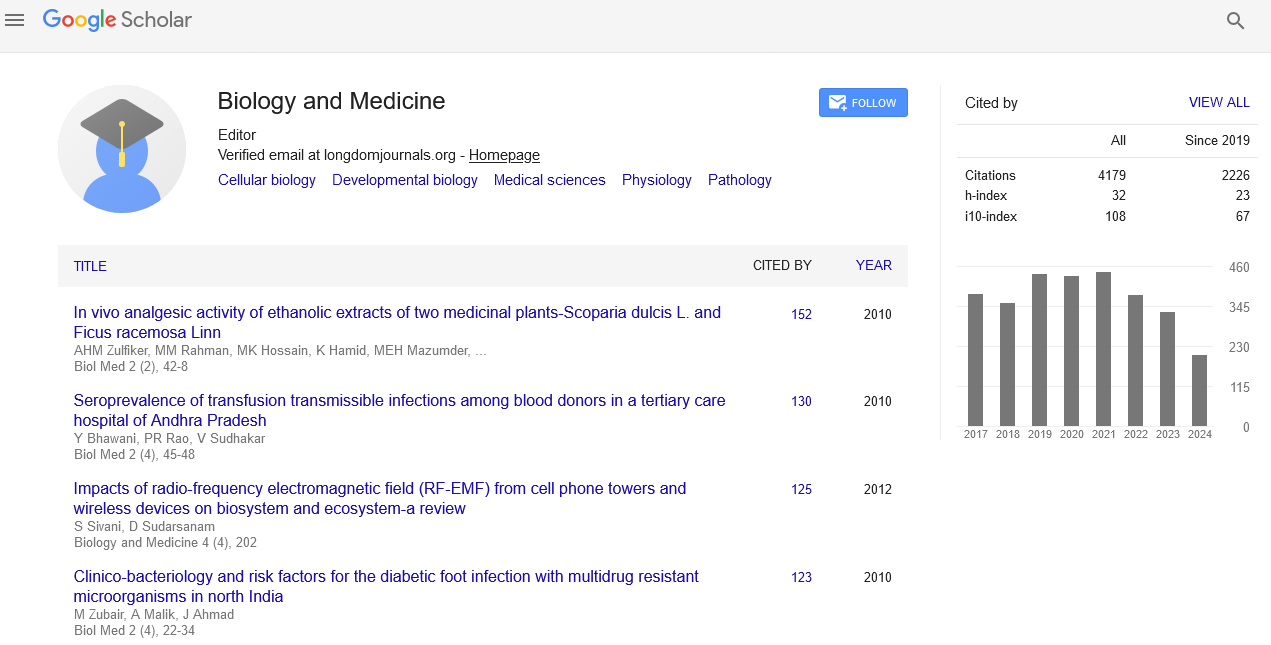
- Google Scholar
Useful Links
Share This Page
Journal Flyer
Open Access Journals
- Agri and Aquaculture
- Biochemistry
- Bioinformatics & Systems Biology
- Business & Management
- Chemistry
- Clinical Sciences
- Engineering
- Food & Nutrition
- General Science
- Genetics & Molecular Biology
- Immunology & Microbiology
- Medical Sciences
- Neuroscience & Psychology
- Nursing & Health Care
- Pharmaceutical Sciences
Commentary Article - (2025) Volume 17, Issue 12
Biological Mechanisms Underlying Aging and Longevity in Humans
Thomas Reynolds*Received: 01-Feb-2025, Manuscript No. BLM-26-30995; Editor assigned: 03-Dec-2025, Pre QC No. BLM-26-30995 (PQ); Reviewed: 17-Dec-2025, QC No. BLM-26-30995; Revised: 24-Dec-2025, Manuscript No. BLM-26-30995 (R); Published: 31-Dec-2025, DOI: 10.35248/0974-8369.25.17.805
Description
Aging is a universal biological process characterized by a gradual decline in physiological function and increased vulnerability to disease. While aging was once considered an inevitable and poorly understood phenomenon, advances in biology and medicine have revealed complex molecular and cellular mechanisms that drive this process. Understanding the biological foundations of aging is critical not only for extending lifespan but also for improving healthspan, the period of life spent in good health. Aging results from the cumulative effects of genetic, environmental, and metabolic factors that interact over time to influence cellular integrity and organismal resilience.
At the cellular level, aging is associated with the accumulation of molecular damage. DNA damage arises from replication errors, environmental exposures, and oxidative stress. Although cells possess sophisticated repair mechanisms, these systems become less efficient with age, allowing mutations to accumulate. Genomic instability disrupts normal cellular function and increases the risk of cancer and degenerative diseases. Telomere shortening further contributes to cellular aging by limiting the replicative capacity of somatic cells, eventually triggering senescence or apoptosis.
Mitochondrial dysfunction is another central feature of aging. Mitochondria generate the energy required for cellular processes, but their efficiency declines over time. Damage to mitochondrial DNA and proteins impairs oxidative phosphorylation and increases the production of reactive oxygen species. This creates a feedback loop in which oxidative stress accelerates mitochondrial decline, contributing to tissue dysfunction. Mitochondrial quality control mechanisms, such as fusion, fission, and autophagy, play a critical role in maintaining cellular health, yet their effectiveness diminishes with age.
Protein homeostasis also deteriorates during aging. The accumulation of misfolded and aggregated proteins disrupts cellular processes and overwhelms degradation systems. This phenomenon is particularly evident in neurodegenerative diseases, where protein aggregates interfere with neuronal function. Molecular chaperones and proteolytic pathways normally protect cells from proteotoxic stress, but age-related decline in these systems compromises cellular resilience. Enhancing protein quality control has therefore become a target of aging research.
The aging process is closely linked to chronic inflammation, often described as inflammaging. With advancing age, the immune system undergoes functional changes that result in persistent low-grade inflammation. This inflammatory environment contributes to tissue damage and promotes the development of age-related diseases such as atherosclerosis, diabetes, and neurodegeneration. Immune cells exhibit altered signaling and reduced capacity to resolve inflammation, highlighting the interconnected nature of aging and immune regulation.
Metabolic regulation shifts significantly with age. Changes in nutrient sensing pathways influence energy balance, stress responses, and cellular maintenance. Pathways that detect nutrient availability modulate growth and repair processes, and their dysregulation contributes to metabolic disorders and reduced lifespan. Caloric restriction and dietary interventions have been shown to extend lifespan in various organisms, suggesting that metabolic control is a key determinant of longevity. Translating these findings to humans remains an area of active investigation.
From a medical perspective, aging is the primary risk factor for most chronic diseases. Understanding the biological mechanisms of aging provides a framework for preventing or delaying disease onset. Rather than targeting individual diseases, emerging approaches aim to address shared aging pathways, potentially reducing the burden of multiple conditions simultaneously. Lifestyle factors such as physical activity, nutrition, and social engagement influence aging trajectories by modulating biological processes at the cellular level.
Technological advances in biology have accelerated aging research. Genomic and proteomic analyses, combined with computational modeling, allow researchers to identify molecular signatures of aging and predict disease risk. Biomarkers of biological age offer potential tools for assessing intervention effectiveness. Ethical considerations accompany these developments, particularly regarding access to longevity-enhancing therapies and societal implications of extended lifespan.
In conclusion, aging is a multifaceted biological process driven by interconnected molecular and cellular mechanisms. Advances in biology and medicine have transformed understanding of aging from an inevitable decline to a modifiable process influenced by genetics, environment, and behavior. By targeting the fundamental biology of aging, future interventions may not only extend lifespan but also enhance quality of life, redefining aging in the context of human health.
Citation: Reynolds T (2025). Biological Mechanisms Underlying Aging and Longevity in Humans. Bio Med. 17:805.
Copyright: © 2025 Reynolds T. This is an open access article distributed under the terms of the Creative Commons Attribution License, which permits unrestricted use, distribution, and reproduction in any medium, provided the original author and source are credited.