
Indexed In
- Academic Journals Database
- Open J Gate
- Genamics JournalSeek
- JournalTOCs
- China National Knowledge Infrastructure (CNKI)
- Scimago
- Ulrich's Periodicals Directory
- RefSeek
- Hamdard University
- EBSCO A-Z
- OCLC- WorldCat
- Publons
- MIAR
- University Grants Commission
- Geneva Foundation for Medical Education and Research
- Euro Pub
- Google Scholar
Useful Links
Share This Page
Open Access Journals
- Agri and Aquaculture
- Biochemistry
- Bioinformatics & Systems Biology
- Business & Management
- Chemistry
- Clinical Sciences
- Engineering
- Food & Nutrition
- General Science
- Genetics & Molecular Biology
- Immunology & Microbiology
- Medical Sciences
- Neuroscience & Psychology
- Nursing & Health Care
- Pharmaceutical Sciences
Research Article - (2026) Volume 17, Issue 1
Bio-Engineered Plant-Produced Antigens, Self-Administered for Oral Vaccination: A Cottage Industry for Vaccines for Less Affluent Nations?
Shoumen Palit1* and Austin Datta22Department of Anesthesiology, Massachusetts General Hospital, Harvard Medical School, Cambridge, Massachusetts, USA
Received: 23-Nov-2024, Manuscript No. JVV-24-27563; Editor assigned: 26-Nov-2024, Pre QC No. JVV-24-27563 (R); Reviewed: 10-Dec-2024, QC No. JVV-24-27563; Revised: 12-Jan-2026, Manuscript No. JVV-24-27563 (PQ); Published: 19-Jan-2026, DOI: 10.35248/2157-7560.26.17.642
Abstract
In this unconventional and non-systematic review, we re-present published results indicating that transgenic plants engineered to express (foreign) antigens show significant levels of mRNA (from viral coding region) and viral antigen (protein) in plant tissues (leaves). Oral administration of plant-produced antigens was immuno-stimulatory in humans, capable of conferring immunity from the viral infection (specific for the viral antigen bioengineered for expression in plant). Use of antigen-containing plant products for oral (or sublingual) administration does not require purification. The plant “paste” may be sufficient (?) for immunizing humans (and animals). Scientific evidence supports advocacy for oral administration of “raw” plant-based products (sublingual) without purification. Implementing this proposal may accelerate the pace of global vaccination and preventive healthcare for less affluent communities by (0) eliminating the need for purification, eliminating the need for “cold” supply chain logistics, eliminating the dependency on medical professionals for vaccination and eliminating supply chain fulfillment dependencies by growing the antigen-producing “potted plants” in community gardens or at home, as a vaccine cottage industry. Communities may also brew the cottage industry for transgenic plants producing antigens as an entrepreneurial innovation endeavor and/or social business for vaccines. The latter, if built on pillars of ethical profitability, is expected to prioritize science as a service to society to improve access to global public goods with respect to health and healthcare.
Keywords
Sublingual; Transgenic plants; Vaccine; SARS-CoV-2; HBsAg
Introduction
The quantum leap from nothing (12 January 2020) to a mRNA vaccine (11 December 2020) for SARS-CoV-2 during the COVID-19 pandemic was a commercial “breakthrough” accomplished under one year. In reality it took ~50 years of academic engagement which finally exploded to substantiate the epitome of the age-old aphorism that necessity is the mother of invention.
From Edward Jenner (18th century) to Katalin Karikó (21st century) and others (e.g., John Enders, Jonas Salk and Albert Sabin in the 20th century) have made “vaccine” a part of the global vernacular even in households in remote corners of the world. Unfortunately, in recent years it has transmogrified into a socially divisive word, cherished by forward thinking people, the educated and wise, but derided by a few who may be uneducated, ignorant or irrational [1].
Unless prevented by immunization, global economic loss from future pandemics may exceed $250 trillion (~13x the GDP of EU or ~10x the GDP of USA or ~3x the global GDP). The estimate is based on economic disaster data due to COVID-19 and the list of microbes/viruses with pandemic potential. Human mortality due to COVID-19 may be triple or quadruple the number of reported deaths (~15 million lives). Governments invested ~$50 billion for vaccines against SARS-CoV-2 which produced ~13 billion doses, made available for the affluent nations. For >80% of the global population, vaccines will be out of reach due to corporate need for profitability. To prevent healthcare mediated global economic meltdown due to microbes, vaccines or vaccine-alternates must be accessible to less affluent nations (The Health of Nations), home to ~7 billion people (of ~8 billion global population).
Materials and Methods
Proposal
We propose an alternative to classical vaccines (inactivated, liveattenuated, mRNA) for global healthcare, based on scientific results. The central thesis of this rediscovery begins with the confirmation that Hepatitis B virus surface Antigen (HBsAg) mRNA and protein were detected in (inedible) transgenic tobacco leaf. HBsAg from tobacco leaves elicited HBsAg-specific antibodies in mice as proof of immunogenicity. Human study with transgenic edible lettuce plant, expressing hepatitis B virus surface antigen, developed specific serum-IgG response to HBsAg [2].
Human study with potato-expressed E. coli Labile Toxin B subunit (LT-B) resulted in toxin neutralizing IgG antibodies (10/11) as late as day 59 (ingestion of raw potato expressing LT-B on day 0, 7, 21). Human study with potato-expressed capsid protein of Norwalk virus (Norovirus; enteric pathogen) reported 95% of subjects (19/20) showing increases in antibody-secreting cells (IgA). Thus, plants engineered to express antigens, even when ingested (or sublingual administration of edible plants as a “leaf paste”) are immunogenic in humans, which may be sufficient for immunization and protection from infection [3].
Evidence
Expression of antigens in transgenic plants: Mason et al. expressed Hepatitis B surface Antigen (HBsAg) by genetically transforming tobacco (Nicotania tabacum; not an edible plant) plants with the gene encoding hepatitis B surface antigen linked to a nominally constitutive promoter (Figure 1). The gene encoding HBsAg was integrated into the plant genomic DNA via Agrobacterium tumefaciens-mediated transformation.
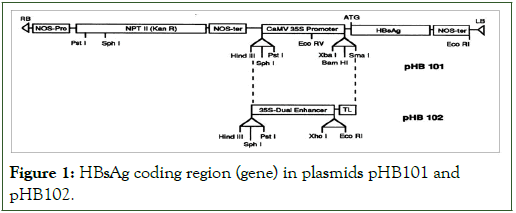
Figure 1: HBsAg coding region (gene) in plasmids pHB101 and pHB102.
Note: Left and right borders (LB, RB) demarcates the DNA sequences incorporated into Nicotania tabacum (tobacco plant) genomic DNA via Agrobacterium tumefaciens-mediated transformation. HBsAg coding region lies downstream of the CaMV 35S promoter in pHB101 (followed by the Nopaline Synthase (NOS) terminator). In pHB102, the 35S promoter is replaced by a modified CaMV 35S promoter with a duplicated transcriptional enhancer region, linked to the Tobacco Etch Virus (TEV) 5' Non-Translated Leader (TL) [4].
Enzyme-linked immunoassays using a monoclonal antibody directed against human serum-derived HBsAg revealed presence of HBsAg in extracts of transformed tobacco leaves (correlated with presence of recombinant HBsAg mRNA in tobacco leaves). Therefore, expression of foreign antigens (e.g., Ebola virus surface antigen, EBOV; SARS-CoV-2 surface antigen, S (Spike) protein, bacterial toxins) in plants, may not suffer from any limitations of transcription or translation in plants [5].
Intramuscular injection with rHBsAg (recombinant HBsAg) produced in yeast resulted in effective immunization and protection from viral infection (agnostic of potential for any variation in post-translational modifications in yeast, Saccharomyces cerevisiae). Each subject received a 10 μg dose of HBsAg at 0, 1, and 6 months. By one month, 27% to 40% of the vaccinees had antibody to HBsAg, and by three months 80% to 100% were antibody positive.
Levels of rHBsAg (Figure 2) in transgenic tobacco leaves appear to be less than 0.01% (maximal levels are closer to 0.006%). Assuming rHBsAg concentration of 0.005% (50 ng/mg protein), it will require ~200 mg of soluble protein (extracted from tobacco leaves) to deliver a single 10 μg dose of rHBsAg. How many leaves of a plant are necessary to deliver an adequate dose is an open question with respect to sublingual administration in the form of raw leaf-paste (only from edible plants, not tobacco) [6].
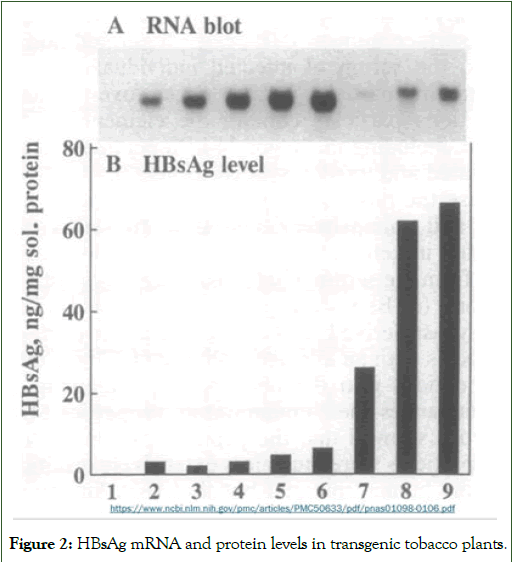
Figure 2: HBsAg mRNA and protein levels in transgenic tobacco plants.
Note: (A) Total RNA from wild-type untransformed or independent transgenic tobacco lines carrying either the pHB101 or the pHB102 construct was hybridized with a probe specific for the HBsAg coding region. (B) Protein extracts from the same leaves were tested for HBsAg with the Auszyme monoclonal kit (Abbott), and HBsAg levels were quantified using a standard curve of human serum derived HBsAg. Numbers: 1, wild-type control plant; 2-6, independent transformants harboring the construct in pHB101; 7-9, independent transformants harboring pHB102 (dual enhancer)[7].
Immunogenicity in humans: The ability of the body to differentiate between the “edible” plant proteins (e.g., may not generate a detectable immune response to lettuce leaves, potatoes, watercress) and the foreign antigen in the transgenic plant product (e.g., edible lettuce leaves, potatoes or watercress expressing foreign antigen) lies at the heart of the anticipated specificity of antigen-induced immunogenicity in humans. Induction of immunity by foreign antigens (sufficient to protect from infection) in healthy individuals is the ultimate “litmus” test for recombinant antigens produced in edible plants. The choice of edible plant products (oral “edible” products or sublingual administration for rapid absorption in the blood stream) may influence the intensity and duration of the immune response. We re-present a few seminal but old experimental results demonstrating that unpurified edible plant-based oral vaccines can induce immunity in humans [8].
Kapusta et al., fed lettuce containing 0.1–0.5 μg of HBsAg (per 100 g leaf) to volunteers (initial 200 g of lettuce leaves; after 2 months, 150 g). Blood samples were collected before (preimmune) and 2 week and 4 week after first 200 g lettuce and then 2 week, 4 week and 12 week after 150 g of lettuce (Figure 3).
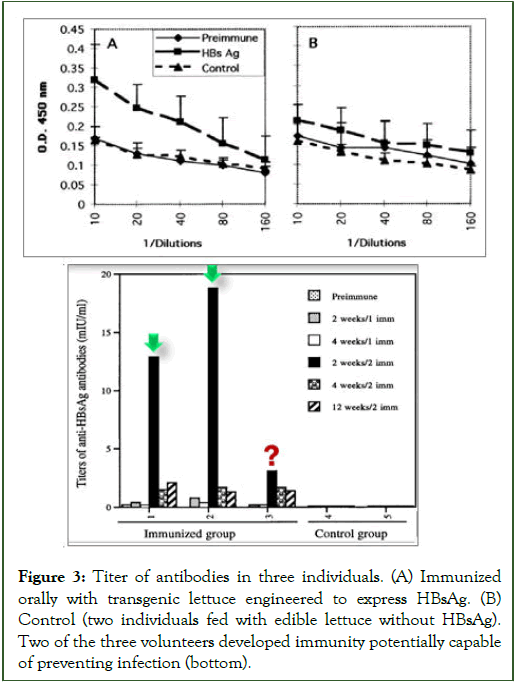
Figure 3: Titer of antibodies in three individuals. (A) Immunized orally with transgenic lettuce engineered to express HBsAg. (B) Control (two individuals fed with edible lettuce without HBsAg). Two of the three volunteers developed immunity potentially capable of preventing infection (bottom).
Tacket, et al. fed volunteers with genetically modified raw (uncooked, unpurified) potatoes expressing the enterotoxigenic Escherichia coli LT-B (B subunit of the E. coli enterotoxin is nontoxic and related to the B subunit of cholera toxin). Adult volunteers (n=14) ingested either 100 g of transgenic potato, 50 g of transgenic potato, or 50 g of wild-type potato. E. coli enterotoxin LT-B subunit protein in the potato was estimated to be 3.7-15.7 μg per gram (Figure 4). The amount of E. coli enterotoxin LT-B subunit protein ingested per 50 g or 100 g dose ranged from 0.4 mg to 1.1 mg per dose (mean 0.75 mg/dose) [9].
Tacket, et al. reaped similar success in delivering LT-B orally to humans via transgenic corn.
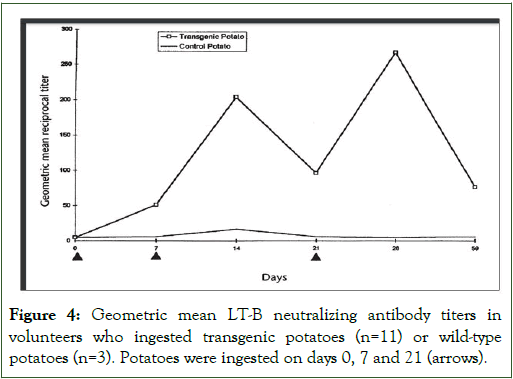
Figure 4: Geometric mean LT-B neutralizing antibody titers in volunteers who ingested transgenic potatoes (n=11) or wild-type potatoes (n=3). Potatoes were ingested on days 0, 7 and 21 (arrows).
Tacket, et al. explored immunization against Norovirus (causative agent for gastroenteritis, commonly referred to as stomach flu) using Plant-based Oral Vaccine (POV). The first norovirus outbreak occurred in Norwalk, Ohio, USA, in a school in 1968. For this reason, the first strain of norovirus is also known as the Norwalk virus. Tacket et al., used “Norwalk Virus Capsid Protein (NVCP), assembled into Virus-Like Particles (VLP), as a test antigen, to determine immune response in volunteers who had ingested transgenic potatoes (uncooked, unpurified). Healthy adult volunteers (n=24) received 2 or 3 doses of transgenic potato (n=20) or 3 doses of wild-type potato (n=4). Each dose consisted of 150 g of uncooked, raw, peeled, diced potato (unpurified) that contained 215–751 mg of NVCP. 19 (95%) of 20 volunteers who ingested transgenic potatoes developed significant increases in the numbers of specific IgA Antibody–Secreting Cells (ASC). 4 (20%) of 20 volunteers developed specific serum IgG, and 6 (30%) of 20 volunteers developed specific stool IgA. Overall, 19 of 20 volunteers (95%) developed an immune response of some kind, although the level of serum antibody increases was modest.”
The significance of edible Potatoes for Oral Vaccination (POV) is simplicity of delivery, as a food lifestyle for immunization. Potatoes can be grown from potatoes, potatoes can grow anywhere, potatoes can be grown indoors, potatoes can be grown in tires, potatoes can be grown in cardboard boxes or any container and potatoes are suitable for hydroponic growth. In addition to potatoes, edible leaves (thale cress, watercress, mustard greens) may be suitable for sublingual administration as “leaf paste” for rapid absorption in the bloodstream. Thus, these edible global vaccination solutions will benefit poor people (Table 1).
| Immunoassay | Transgenic potatoes | Wild-type potatoes, 3 doses (n=4) | ||
| 3 doses (n=10) | 2 doses (n=10) | Total (n=20) | ||
| IgA ASC anti-NVCP response rate | 9/10 (90%) | 10/10 (100%) | 19/20 (95%) | 0/4 |
| Geometric mean peak ASCs per 106 PBMCa | 32 | 26 | 28 | - |
| Range IgA ASCs per 106 PBMCa | 6-245 | 6-280 | 6-280 | - |
| IgG ASC anti-NVCP response rate | 2/10 (20%) | 4/10 (40%) | 6/20 (30%) | 0/4 |
| Geometric mean peak ASCs per 106 PBMCa | 103 | 34 | 49 | 0 |
| Range IgG ASCs per 106 PBMCa | 92-115 | 25-62 | 25-115 | 0 |
| Serum IgG anti-NVCP response rate | 3/10 (30%) | 1/10 (10%) | 4/20 (20%) | 0/4 |
| IgG peak geometric mean titer | 0.366667 | 2.263889 | 0.567361 | — |
| Mean peak fold rise | 13.3 | 8 | 12 | - |
| Serum IgM anti-NVCP response rate | 4/10 (40%) | 0/10 (0%) | 4/20 (20%) | 0/4 |
| IgM peak geometric mean titer | 0.111111 | - | 0.111111 | — |
| Mean peak fold rise | 7 | — | 7 | — |
| Stool IgA response rate | 4/10 (40%) | 2/10 (20%) | 6/20 (30%) | 0/4 |
| Stool IgA peak geometric mean titer | 01:48 | 01:38 | 01:45 | — |
| Mean peak fold rise | 17.8 | 16.6 | 17.4 | — |
Table 1: Immune response to Norovirus – unpurified potatoes expressing Norwalk Virus Capsid Protein (NVCP) vs. control (wildtype potatoes).
Results and Discussion
Bio-engineered edible transgenic (genetically modified) plants expressing recombinant vaccine immunogens for oral vaccination offer an attractive and potentially inexpensive alternative to classical vaccine approaches, an idea proposed, proven and even patented ~40 years ago. Other alternative potential vaccination strategies exist in various stages but none focused on the less affluent.
Bio-engineered transgenic plant-produced antigens, selfadministered for oral and/or sublingual vaccination (POV) eliminates industrial production, purification, packaging, storage, distribution and the “last mile” physical (injection) bottleneck due to the need for trained personnel. Potted plants or produce can be grown locally, anywhere. Sublingual consumption of leaf paste or raw produce may be less palatable but does not require special training. Eliminating upstream purification and downstream “cold” supply chain of vaccines as well as the “last mile” fulfillment problem will facilitate availability of POV for preventive healthcare (plant produced oral vaccines). Developing immunity in communities near and far is key to prevention of transmission/infection to reduce morbidity and mortality.
This is a clarion call for scientific leadership as well as others in finance, politics, policy and diplomacy to focus on the output from a rational scientific measure aimed specifically for the neglected less affluent ~7 billion people. Paralysis due to analysis and “purified to perfection” are hackneyed platitudes ready for retirement in the face of 22nd century challenges in global health and healthcare.
Translating the patent-free (or expired) published research to pragmatic working reality requires a few scientists who believe in science as a service to society, a few students skilled in molecular biology and plant genetics, a few human volunteers and a few host laboratories in a few corners of the world.
Operating funds may be sourced as a consortium with contributions from donors/foundations or ethical use of crowd funding. The entity can also be a business if investors agree to the convergence of for-profit and not-for-profit endeavors under one roof. Products and services for affluent nations may be forprofit operations (signatories at The Convention on the OECD, on 14 December 1960) while the not- for-profit operation will apply to the rest of the world where ~7 billion people are trying to survive/live.
The scientific credibility of this proposal assure outcomes which will be catalytic to rapidly build capacity (potted plants) for global vaccinations, focused on saving ~7 billion lives. However, sourcing the recombinant antigen vectors (plasmids) and creating the transgenic plants will need help from scientists (geneticists) and other global experts, from affluent as well as less affluent nations. There is a great need for education, scientific training and standardization of protocols in order to scale the production of transgenic plants and address public resistance to edible transgenic plants.
Logistics, however nominal, may become an inhibitor. An efficient distribution system with distributed control at local nodes is key to differentiating and adapting to the needs of the community. It is not enough to use supply chains as usual or depend on US/EU type of operations management practices.
Steps: Global health solution in 7 steps for ~7 billion people?
The vision of POV is half century old. Several vaccine efforts are in progress. But, we are still waiting to build the ramp to transform POV into reality to lift ~7 billion lives. It may not happen by committee. We need commitment from a few committed individuals who will provide the leadership.
Translational science
Translating these 7 steps into a production phase (when/where end users can obtain plants and know-how, i.e., how much to self-administer at what frequency) calls for establishing baselines, ranges and a skeleton of standard operating procedures. Errors due to estimating the immunogenicity of the Plant-Derived Antigen (PDA) and improper tests to establish the level of circulating immunoglobulins (mainly IgG but IgA, too, for mucosal membranes) in response to the recombinant antigen introduced orally (PDA) could be harmful. IgG antibody (to antigen) serves as an accessible quantitative biomarker of postvaccination protection because T-cell responses (umbrella response of CDn+ cells) are important but difficult to quantify. IgG titer and its duration is salient to “sterilizing” immunity which is the desired post-vaccination outcome for complete clinical protection from contracting infection (dose dependent). Viruses/bacteria invading the mucosal surfaces complicates the “sterilizing” immunity scenario because the number of invading infectious particles (e.g., virions) will influence (may overwhelm) the outcome.
Establishing threshold values for IgG antibody response to antigen (PDA) is confounded by the immune status of (test) individuals, pattern of cytokine response to antigen, pre-existing conditions, sex, age, race, ethnicity (population genetics) and per capita income level (proxy for nutritional status) (Figure 5). In addition, the quest for a protective titer34 may/will be influenced by (i) type of expression vector used in creating the transgenic plant (source of PDA) (ii) expression level of protein (antigen in ng/mg of soluble protein) in plants (leaves) (iii) ingested vs. absorbed amount of PDA (iv) individual (gut) microbiomes35 in the interplay between immune health and nutrition36 (v) testing/monitoring constraints (vi) others.
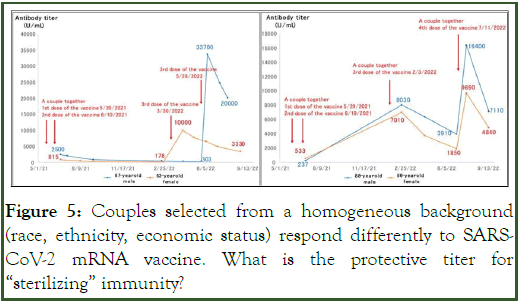
Figure 5: Couples selected from a homogeneous background (race, ethnicity, economic status) respond differently to SARSCoV- 2 mRNA vaccine. What is the protective titer for “sterilizing” immunity?
Identification of thresholds for the IgG antibody levels for sterilizing immunity (collect titer data for different infections, globally) is the translational science data for POV to inform the transition from the lab to locals. Establishing a “green zone” threshold of circulating IgG levels in response to PDA is the “target” that individuals want to know to assess (from selftesting) acquisition of immune protection. To arrive at this “target” the users must ingest a minimum weight of plant product to absorb PDA in their body (blood) within a specific period. Declaring the “green zone” threshold target for IgG antibody levels must take into account risk mitigation strategies. The latter must make room for high fault tolerance due to missteps, mis-information, and mis-calculations, inevitable from the self-administration of PDA.
The bridge of translational science knowledge from the Lab to Locals (LTL) holds the potential to save ~7 billion lives. But, the path to global vaccination will be non-linear even if the science of POV may be summarized in 6 (not 7) relatively simple sequential steps. There is a non-zero probability “new” lies will be manufactured to transform saving lives into a dying art. Scientists must be cognizant of their own hubris and desist from their desire to pursue perfection in determining the titer for “sterilizing” immunity. The latter is our penchant to understand immunological dynamics. If we are challenging uninfected humans with a live dose of a potentially fatal virus (Ebola, Lyssa, Marburg) then we should know the IgG levels for “sterilizing” immunity and adhere to safety measures advocated by the US FDA.
Steps 1-6 must proceed without any delay due to translational science related efforts. We must implement POV. The risk from exposure to deadly viruses far outweigh the risks due to ingestion of potatoes or watercress or mustard greens as a source of PDA even without any standard protocol or dietary guide to induction of immunity (IgG titers in blood). While we work in labs, the locals must not be kept waiting for this proven solution (steps 1-6) in hand. Even low levels of IgG may reduce fatalities and dampen the severity/acuity of infection. Should the luxury of pursuing translational science prevent us from the urgent implementation of POV and deliver potential death sentences for billions of people?
Concerns
Legitimate concerns about possible negative effects of Plant- Based Antigens (PDA) include people who may unknowingly eat such plants and will be exposed (without their consent) to material that will trigger an immune response. The latter may result in negative effects such as induction of autoimmunity or chronic inflammation. Reasonable caution by labelling plant products producing any foreign antigen, prevention of uncontrolled spread and assessment of potential side effects are prudent safety measures.
Few may not share the enthusiasm for administering Ebola virus to a volunteer (S. Datta, author) in step 7 and US safety regulations/criteria should apply. Should we test, first, in animals? To mitigate unknown health risks due to POV, edible Plant-Based Antigen (ePDA) administration in humans may test a virus that is widespread, already, so that the relative effectiveness of the vaccine can be assessed with minimal harm (e.g., for COVID-19 vaccines). Testing in human’s demand prior knowledge of “sterilizing” immunity. Establishing serum IgG levels for sterilizing immunity proportional to “dose” depends on determining the number of infectious particles (e.g., virions) but estimating the number of particles (10n) at the initial point of infection could be quite error prone (where n= {0, …,10}, if n=0, then it is 1 particle; n=1 indicates 10 particles; n=10 indicates10 billion particles at the initial point of infection). Thus, any claim for individual “sterilizing” immunity data may be overwhelmed if the number of infectious virions outweigh the individual’s immune preparedness to accept a certain challenge dose of infectious particles.
Commentary
For decades, the destructive demonization of transgenic plants and ill-informed fanatical resistance to genetically-modified crops has robbed the poor of global public goods, food, nutrition and healthcare. The cruel march of unreason is a debilitating blow to our sense of the future by forcibly destroying the fruits of science which could be of service to society, especially for communities under severe economic constraints. We view malicious, mis-information fueled social cataclysms as a point of inflection. We are optimistic that the tide is beginning to turn from bad to good in the court of public opinion, both in Africa and Asia, the geographies with the greatest need for bioengineered edible plant-produced antigens, self-administered for oral immunization (POV). The ability to prevent infection through low-cost self-vaccination and edible plant-based oral vaccines for immunization can reduce the horrendous scale of mortality and morbidity due to future infectious diseases and/or chronic diseases. Ethical globalization demands that affluent nations enable the less affluent nations to develop and implement this cottage industry of edible potted-plant based vaccines, in the economic interest related to immigration, travel, commerce, and growing markets. Our collective inaction and neglect of scientific proof to alternate sourcing of edible unpurified antigens from transgenic plants for global immunization is inhuman, unethical and immoral. Turning a blind eye to preventive healthcare measures for the global poor (~7 billion) is a form of anti-science and should not remain in the category of irremediable injustices. US COVID-19 misinformation campaign by anti-science anti-vaxxers resulted in 232,000 preventable deaths.
Based on published papers, it is a fact that foreign antigens can be produced in transgenic plants.
Table 2 (below) indicates that that outcome is largely ignored by the nations preparing for pandemic regulatory capacity. Oral (sublingual) administration of plant-produced unpurified antigens are capable of inducing immunogenicity in humans. Step 7 may prove that the immune response to plant-produced antigens are adequate to induce sterilizing immunity (i.e., protects from and prevents infection). The use of edible Arabidopsis thaliana (thale cress) and/or Brassica rapa (“fast” plants) may be palatable as transgenic plants of choice. Exploring the use of watercress (Nasturtium officinale) may offer an even more “tasty” option. Further explorations using potyviruses as vectors to deliver the recombinant antigen may lead to use of flowers (rose, tulips) to serve as vehicles for oral administration of foreign antigens (edible flowers are used in Eastern foods and tulips represent the world’s first financial bubble).
US and EU may balk at step 7 but most nations in Asia and Africa will embrace the opportunity for mass adoption of low cost vaccination solutions to mitigate risks due to public health catastrophes. POV represents a lifestyle practice similar to use of neem tree twigs for cleaning teeth (Azadirachta indica). Instead of the elusive quest for alms, developing nations with ~7 billion people may prefer bold approaches rather than waiting for ‘blessings’ from FDA, CDC, ECDC for POV solutions for healthcare (Figure 6).
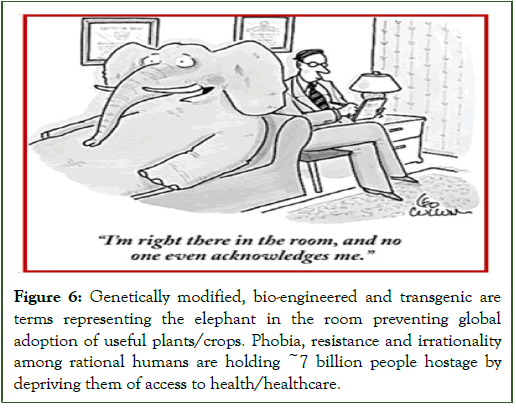
Figure 6: Genetically modified, bio-engineered and transgenic are terms representing the elephant in the room preventing global adoption of useful plants/crops. Phobia, resistance and irrationality among rational humans are holding ~7 billion people hostage by depriving them of access to health/healthcare.
| Pandemic regulatory capacity | |||
| Country | Regulatory authority | Maturity level | Scope of products |
| China | National Medical Products Administration (NMPA) | 3 | Vaccines (producing) |
| Egypt | Egyptian Drug Authority (EDA) | 3 | Vaccines (producing) |
| Ghana | Food and Drugs Authority (FDA) | 3 | Medicines; vaccines (non-producing) |
| India | Central Drugs Standard Control Organization (CDSCO) | 3 | Vaccines (producing) |
| Indonesia | National Agency of Drug and Food Control (BADAN POM) | 3 | Vaccines (producing) |
| Nigeria | National Agency for Food and Drug Administration and Control (NAFDAC) | 3 | Medicines; vaccines (non-producing) |
| Saudi Arabia | Saudi Food and Drug Authority (SFDA) | 4 | Medicines; vaccines (producing) |
| Serbia | Medicines and Medical Devices Agency of Serbia (ALIMS) | 3 | Vaccines (producing) |
| Singapore | Health Sciences Authority (HSA) | 4 | Medicines; vaccines (non-producing) |
| South Africa | South African Health Products Regulatory Authority (SAHPRA) | 3 | Vaccines (producing) |
| South Korea | Ministry of Food and Drug Safety (MFDS) | 4 | Medicines; vaccines (producing) |
| Tanzania | Tanzania Medicines and Medical Devices Authority (TMDA) | 3 | Medicines; vaccines (non-producing) |
| Thailand | Food and Drug Administration (FDA) | 3 | Vaccines (producing) |
| Turkey | Turkish Medicines and Medical Devices Agency (TITCK) | 3 | Medicines; vaccines (producing) |
| Vietnam | Vaccine regulatory system involving the Drug Administration of Vietnam (DAV); The Administration of Science, Technology, and Training (ASTT): The National Institute for the Control of Vaccines and Biologicals (NICVB); and The General Department of Preventive Medicine (GDPM) | 3 | Vaccines (producing) |
Table 2: Nations preparing for pandemic readiness are ignoring or ignorant about transgenic POV.
The global need for vaccines is the fuel to pursue Plant-based Oral Vaccines (POV). But one must add and admit that there will be errors and missteps in the process, even if the benefits vastly outweigh the problems. Almost nothing in science is always absolutely perfect, even the best solutions may present unexplained problems which may temporarily plunge the effort in a quandary, agnostic of how precisely it was planned, executed and/or implemented. POV may not be a panacea for all ills, it is expected to experience growing pains and it will expose gaps in our multi-disciplinary knowledge or even overwhelm us with unknown unknowns. Are these sufficient reasons to asphyxiate the pursuit of scientific solutions?
Despite the anticipated and unanticipated shortcomings of POV, let us use the Pareto principle and proceed to hypothesize that POV may be effective in preventing healthcare disasters 80% of the time for 80% of the ~7 billion people in less affluent nations. Is saving 80% of the world not worth the effort?
If the positivism of the 80% optimism is too sugary for Pareto pessimists, let us consider what if POV may be effective in preventing healthcare disasters for only 20% of the ~7 billion poor people. The pessimists of POV should reflect whether we can discard or bypass or scoff at the ability of POV to help
1.4 billion people (i.e., current population of India (~1.4 billion) or China (~1.4 billion)). In other words, are the nay-sayers of POV prefer to ignore scientific rationale and choose to be oblivious of the preventive health of ~1.4 billion poor people? Do POV pessimists “believe” that they are “protecting” poor people by their opposition? In reality, inaction about POV makes living a dying art.
The 20th century scientific research results, re-presented in this discussion, may become catalytic to save the world from public health cataclysms in the 22nd century. How common is resistance to reason?
In the 18th century, for sailors, disease during long sea voyages was often more dangerous than enemy action. One British expedition to raid Spanish holdings in the Pacific Ocean in the 1740’s lost 1,300 of an original complement of 2,000 men to illness. That illness was scurvy. In 1747, on board HMS Salisbury, James Lind (1716-1794) carried out the first controlled clinical trial in medical science. He took 12 men suffering from similar symptoms of scurvy, divided them into six pairs and treated them with remedies suggested by previous observers/ writers (in 1622, explorer Richard Hawkins recorded that "sower lemons and oranges" were "most fruitful”). In 1747, the results from James Lind’s “clinical trial” demonstrated that oranges and lemons were indeed a cure for scurvy. "Treatise of the Scurvy" appeared56 in 1753, but it was not until 1795 (42 years later) that the British Admiralty issued an order for distribution of lemon juice to sailors. Apparently, James Lind did not possess sufficient clout.
In the 19th century, John Snow (1813-1858), an anesthesiologist in London, conducted an epidemiological study of water supply from the Broad Street Pump in 1854. Results indicated that cholera was a water-borne disease. But, the “germ” theory was ignored by the Miasma theorists. It was not until the epidemic of cholera in Egypt in 1883 that Snow’s findings were rediscovered. The germ theory gained acceptance based on Snow’s observation that cholera was a water-borne disease. The means to prevent cholera had been identified by Snow ~30 years before the cholera epidemic. It wasn’t used as a preventive solution to save lives due to prevalent scientific ignorance which failed to grasp Snow’s scientific thinking and scientific insight, at least three decades ahead of the cholera epidemic, which was preventable.
In the 19th century, Ignaz Semmelweis (1818-1865) made a discovery by comparing a highly qualified clinic (death rate ~10%) with a clinic operated by midwifes (~2.5% death rate). Semmelweis observed58 that simply by washing hands, the death rates dropped (to ~2.5%). The news spread. Doctors thought it was too mystic, despite the results. Semmelweis, in his next job, did the same thing. Dropped the death rate just by washing hands and equipment. Semmelweis pioneered the habit of washing hands in hospitals, published papers about it but was rejected, had a mental breakdown and was sent to an asylum where he was beaten to death by the guards, in 1865. Merely two decades later, Louis Pasteur proved Ignaz Semmelweis was correct. In the 21st century, the medical profession may perish if sepsis61 was uncontrolled and medicine may struggle to exist without hand hygiene.
POV will remain a bright light obscured behind a bushel unless the less affluent nations are bold enough to focus on science as a service to society and people in need, first, of course with caution, but not excessive caution resulting in paralysis due to analyses. The interpretation of the "bold” (fortune favors the bold) approach advocated for POV means acknowledging that perfect is the enemy of good, rapid acceptance of promising results to save lives must take precedence over need for more data/results from the next experiment (in praise of imperfection) and prioritizing common sense of science that serves the people in that community. The “bold” approach does not exclude being careful to do no harm. The “bold” approach is less enthusiastic about the trend of repetitive studies fueled by bureaucratic see-saw or to re-consider, re-evaluate and re-validate (with even more platitudes) the initial results to re-confirm what we already know or wait for adverse effects to surface, sometime, somewhere, to placate politicians. Less affluent nations must not blindly mimic but adapt the protocols, procedures and processes in US/EU but find leaders who may possess the humility, knowledge and wisdom to inspire trust and responsibly shoulder the challenge of renewing that golden braid of choice, chance, and character with civilization (even in face of constraints and consternation).
The “hidden” 20th century science, re-presented in this discussion as POV (plant-based oral vaccines), may become catalytic to save the world from public health cataclysms in the 22nd century. If one must profit from “cottage industry of vaccines” then we suggest 1% net profit limit. For example, a charge of $10 or $100 year/person (for all vaccines) for 80% and 20%, respectively, of the 7 billion market, generates $196 billion per annum (pa) revenue from less affluent (poor) nations. Charging the affluent 1 billion people $1,000 or $10,000/year/ person, for 80% and 20%, respectively, translates to $2.8 trillion pa. 1% net profit from $3 trillion from a market of 8 billion is $30 billion pa. Even if this naïve optimistic what if scenario is 1% true, the net business profit from POV could be about $0.3 billion or $300 million pa (“enough for human need but not enough for human greed” – M. K. Gandhi).
In the short-term, creating and implementing the distribution of fast growing transgenic plants for rapid immunization from known culprits with pandemic potential (Ebola, Marburg, Lassa, etc.) is a wise path, as discussed thus far, in this call for action. The key elements in this approach is removal of the purification protocols and the cold supply chain logistics. These two elements are rooted in the industrial complex of affluent nations and are holding the less affluent world hostage.
In the long term, plant-based oral vaccines may explore tools from the food industry to convert the plant material (e.g., leaves from the transgenic plants producing the antigen in their leaves for oral immunization) into a dry packed form factor in doseadjusted supplements (e.g., turmeric) or sachets (e.g., dehydrated seaweed or vegetables included with Ramen and Miso as shown in Figure 7) with a long shelf life at room temperature to facilitate rapid distribution, in case of a public health emergency.
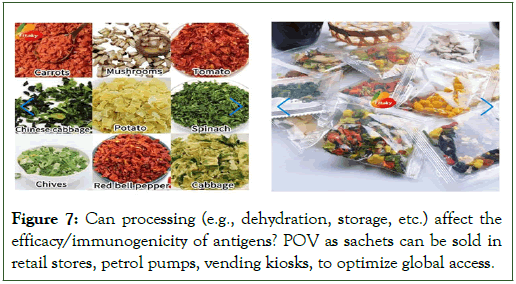
Figure 7: Can processing (e.g., dehydration, storage, etc.) affect the efficacy/immunogenicity of antigens? POV as sachets can be sold in retail stores, petrol pumps, vending kiosks, to optimize global access.
Conclusion
Molecular immunologists must address whether Food Technology Processed (post-FTP) antigen conserves sufficient number of epitopes to remain viable as an antigen (efficacy of immunogenicity).
Food technologists must explore post-processing dosage issues which could differ between the untreated transgenic leaves and post-FTP leaves in sachets, after periods of storage (low efficacy due to degradation during storage). We must investigate if expressing the whole antigen (e.g., EBOV-1, SARS-CoV-2 Spike) is necessary or do we create GMO/transgenic plants expressing a number of epitopes for each antigen? Natural changes in epitopes due to genetics of virulence and antigenic drift may make universal epitopes useful. A “first” dose of “universal” epitope may induce immunization to decrease the acuity of infection from specific variants if new epitopes are not covered by the universal dose. Research on epitope integrity, structure, function and post-FTP immunogenicity will transform GMO/ transgenic plant-based oral vaccines as effective, efficient, safe, and accessible preventive public health solution.
Food industries may reap ~$30 billion in annual net profit as a POV supplier if focused on PAPPU75, i.e., earning 1 penny/day/person (1 US penny as net profit/day/person) from ~8 billion global users.
References
- Barney GS, Sullivan NJ. Emerging viral diseases from a vaccinology perspective: preparing for the next pandemic. Nat Immunol. 2018;19(1):20-28.
[Crossref] [Google Scholar] [PubMed]
- Mason HS, Lam DM, Arntzen CJ. Expression of hepatitis B surface antigen in transgenic plants. Proc Natl Acad Sci USA. 1992; 89(24):11745-11749.
[Crossref] [Google Scholar] [PubMed]
- Thanavala Y, Yang YF, Lyons P, Mason HS, Arntzen C. Immunogenicity of transgenic plant-derived hepatitis B surface antigen. Proc Natl Acad Sci USA. 1995;92(8):3358-3361.
[Crossref] [Google Scholar] [PubMed]
- Kapusta J, Modelska A, Figlerowicz M, Pniewski T, Letellier M, Lisowa O, et al. (1999). A plant-derived edible vaccine against hepatitis B virus. FASEB J. 1999;13(13):1796-1799.
[Crossref] [Google Scholar] [PubMed]
- Tacket CO, Mason HS, Losonsky G, Estes MK, Levine MM, Arntzen CJ. Human immune responses to a novel norwalk virus vaccine delivered in transgenic potatoes. J Infect Dis. 2000;182(1):302-305.
- Valenzuela P, Medina A, Rutter WJ, Ammerer G, Hall BD. Synthesis and assembly of hepatitis B virus surface antigen particles in yeast. Nature. 1982;298(5872):347-350.
[Crossref] [Google Scholar] [PubMed]
- Scolnick EM, McLean AA, West DJ, McAleer WJ, Miller WJ, Buynak EB. Clinical evaluation in healthy adults of a hepatitis B vaccine made by recombinant DNA. JAMA. 1984; 251(21):2812-2815.
[Google Scholar] [PubMed]
- Tacket CO, Pasetti MF, Edelman R, Howard JA, Streatfield S. Immunogenicity of recombinant LT-B delivered orally to humans in transgenic corn. Vaccine. 2004; 22(31-32):4385-4389.
[Crossref] [Google Scholar] [PubMed]
- Lomonossoff GP, Evans DJ. Applications of plant viruses in bionanotechnology. Curr Top Microbiol Immunol. 2014;375:61-87.
[Crossref] [Google Scholar] [PubMed]
Citation: Palit S, Datta A (2026) Bio-Engineered Plant-Produced Antigens, Self-Administered for Oral Vaccination: A Cottage Industry for Vaccines for Less Affluent Nations?. J Vaccines Vaccin. 17:604.
Copyright: © 2026 Palit S, et al. This is an open-access article distributed under the terms of the Creative Commons Attribution License, which permits unrestricted use, distribution, and reproduction in any medium, provided the original author and source are credited.