
Indexed In
- Open J Gate
- Genamics JournalSeek
- Academic Keys
- JournalTOCs
- The Global Impact Factor (GIF)
- China National Knowledge Infrastructure (CNKI)
- Ulrich's Periodicals Directory
- RefSeek
- Hamdard University
- EBSCO A-Z
- OCLC- WorldCat
- Publons
- Geneva Foundation for Medical Education and Research
- Euro Pub
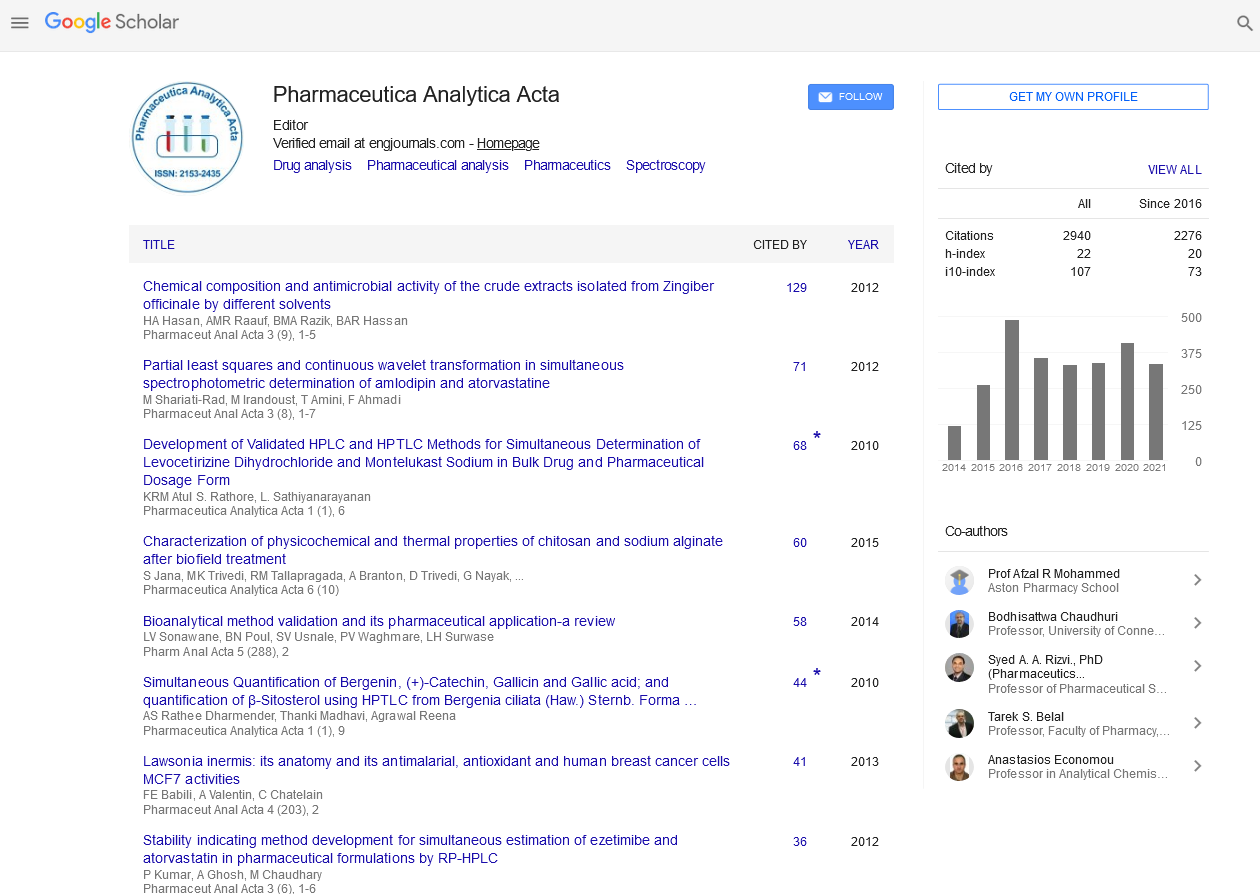
- Google Scholar
Useful Links
Share This Page
Journal Flyer
Open Access Journals
- Agri and Aquaculture
- Biochemistry
- Bioinformatics & Systems Biology
- Business & Management
- Chemistry
- Clinical Sciences
- Engineering
- Food & Nutrition
- General Science
- Genetics & Molecular Biology
- Immunology & Microbiology
- Medical Sciences
- Neuroscience & Psychology
- Nursing & Health Care
- Pharmaceutical Sciences
Commentary Article - (2026) Volume 17, Issue 2
Artificial Intelligence in Pharmaceutical Analysis: Enhancing Accuracy and Efficiency in Modern Drug Evaluation
Liora Bennett *Received: 27-May-2026 , Manuscript No. PAA-26-31818; Editor assigned: 29-May-2026 , Pre QC No. PAA-26-31818; Reviewed: 12-Jun-2026 , QC No. PAA-26-31818; Revised: 19-Jun-2026 , Manuscript No. PAA-26-31818; Published: 26-Jun-2026 , DOI: 10.35248/2153-2435.26.17.853
Description
The pharmaceutical sector continues to generate vast amounts of analytical data during drug development, manufacturing, quality assessment and post-market evaluation. Traditional analytical procedures have delivered dependable outcomes for decades, yet the increasing complexity of pharmaceutical products has created a demand for faster data interpretation and improved decision-making processes. Artificial intelligence has emerged as a valuable technological advancement that supports pharmaceutical analysis by processing extensive datasets, identifying hidden patterns and assisting scientists in obtaining meaningful conclusions from analytical measurements. Modern pharmaceutical products often contain complex molecular structures, multiple impurities and sophisticated formulations that require detailed examination. Analytical laboratories routinely utilize chromatographic systems, spectroscopic instruments and mass spectrometers to evaluate product quality and composition. These instruments generate enormous quantities of information that may take considerable time to interpret through conventional methods. Artificial intelligence provides computational support that can analyze such information rapidly while maintaining consistency in data assessment.
One of the most notable applications of artificial intelligence in pharmaceutical analysis is chromatographic data interpretation. High-performance liquid chromatography and related techniques produce peaks representing different compounds within a sample. Manual examination of chromatograms can be timeconsuming, especially when thousands of samples are processed. Artificial intelligence algorithms can recognize peak patterns, classify compounds and identify irregularities with minimal human intervention. This capability contributes to improved laboratory productivity and assists analysts in focusing on more complex tasks requiring scientific judgment. Mass spectrometry has also benefited from artificial intelligence integration. Pharmaceutical analysts frequently use mass spectrometric techniques to characterize active ingredients, degradation products and impurities. The interpretation of mass spectral data can become challenging due to the presence of numerous molecular fragments and overlapping signals. Artificial intelligence systems can compare spectral information against extensive databases, predict molecular structures and suggest potential compound identities. Such support reduces interpretation time and assists in obtaining reliable analytical outcomes.
Spectroscopic techniques represent another area where artificial intelligence contributes substantially. Infrared spectroscopy, Raman spectroscopy and nuclear magnetic resonance spectroscopy are widely employed for material characterization. Artificial intelligence can process spectral fingerprints and distinguish subtle differences between pharmaceutical materials. This capability is particularly useful in detecting counterfeit medicines, verifying raw material authenticity and evaluating product consistency across manufacturing batches. Quality control laboratories are increasingly adopting artificial intelligence-assisted analytical platforms. During routine testing, numerous parameters must be evaluated to ensure compliance with established specifications. Artificial intelligence can review historical analytical records and identify trends that may indicate potential deviations before they become significant concerns. Early recognition of such patterns supports proactive decisionmaking and helps maintain product quality throughout manufacturing operations.
The development of predictive analytical models has become another valuable application. Artificial intelligence can analyze historical pharmaceutical data and estimate future analytical outcomes based on existing patterns. For example, predictive systems may estimate the stability of a drug product under different storage conditions or anticipate impurity formation during manufacturing. These insights can assist pharmaceutical organizations in optimizing formulation strategies and refining production processes. Artificial intelligence also contributes to method development activities. Establishing an analytical method often requires repeated adjustments of experimental parameters such as mobile phase composition, temperature settings and detection conditions. Artificial intelligence platforms can evaluate previous analytical outcomes and recommend suitable parameter combinations. This approach reduces development time while supporting efficient utilization of laboratory resources.
Data integrity remains a critical consideration within pharmaceutical environments. Analytical laboratories generate records that must remain accurate, complete and traceable. Artificial intelligence systems can assist in detecting unusual entries, inconsistencies or data anomalies that may require further review. Such capabilities strengthen confidence in analytical documentation and support compliance with quality expectations. The increasing popularity of continuous manufacturing has created additional opportunities for artificial intelligence applications. Continuous production systems generate real-time analytical information throughout the manufacturing process. Artificial intelligence can monitor incoming data streams and provide immediate feedback regarding process performance. Rapid assessment enables manufacturers to respond promptly to variations and maintain product consistency. Artificial intelligence also supports pharmaceutical laboratories through automation of repetitive activities. Routine data processing, report generation and result classification can be completed efficiently using intelligent software platforms.
Citation: Bennett L (2026). Artificial Intelligence in Pharmaceutical Analysis: Enhancing Accuracy and Efficiency in Modern Drug Evaluation. Pharm Anal Acta. 17:853
Copyright: © 2026 Bennett L. This is an open-access article distributed under the terms of the Creative Commons Attribution License, which permits unrestricted use, distribution and reproduction in any medium, provided the original author and source are credited