

Indexed In
- Open J Gate
- Genamics JournalSeek
- SafetyLit
- RefSeek
- Hamdard University
- EBSCO A-Z
- OCLC- WorldCat
- Publons
- Google Scholar
Useful Links
Share This Page
Journal Flyer
Open Access Journals
- Agri and Aquaculture
- Biochemistry
- Bioinformatics & Systems Biology
- Business & Management
- Chemistry
- Clinical Sciences
- Engineering
- Food & Nutrition
- General Science
- Genetics & Molecular Biology
- Immunology & Microbiology
- Medical Sciences
- Neuroscience & Psychology
- Nursing & Health Care
- Pharmaceutical Sciences
Short Communication - (2025) Volume 14, Issue 3
Anthropocene and the Media
Jesper Taekke*Received: 16-Sep-2024, Manuscript No. JSC-24-26878; Editor assigned: 20-Sep-2024, Pre QC No. JSC-24-26878 (PQ); Reviewed: 04-Oct-2024, QC No. JSC-24-26878; Revised: 18-Aug-2025, Manuscript No. JSC-24-26878 (R); Published: 25-Aug-2025, DOI: 10.35248/2167-0358.25.14.268
Description
In the article “From Media Evolution to the Anthropocene: Unpacking Sociotechnical Autopoiesis” the thesis is that with the acquisition of oral language, the social domain transformed into a self-referring system. Previously, cooperation among hominins was governed by inherited instincts mediated through genes. With the emergence of oral language, cooperation began to be governed by social norms and rules mediated from generation to generation through language. According to Luhmann, language serves as a threshold that enables the emergence of the social as an autopoietic system, a system that increasingly began to regulate larger parts of human coexistence. At this threshold, the psychic system is also differentiated out as a self. From this point onward, humans had to determine themselves to follow socially constructed norms and develop the ability to postpone need satisfaction [1].
After the emergence of the social system, humans were captured by the social, which in the article is theoretically described and analyzed as a sociotechnical autopoiesis machine. This machine consisted of parts like technology, fire, meat, the dog, and language to coordinate between the psychic and social systems (Figure 1). The social “machine” thus became dynamic and hyper-adaptive, allowing humans to live in various climates. This highly complex “machine” continuously transformed itself and its environment [2-4]. Although these transformations occurred slowly by today's standards, they were rapid compared to the animal and plant world. Biological needs were now processed through consciousness guided by social norms and knowledge, leading humans to transform both themselves and their environment.
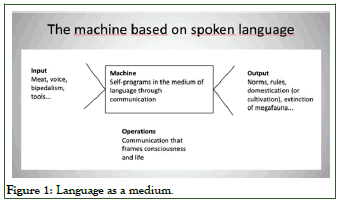
Figure 1: Language as a medium.
This transformative process has intensified the impact of the machine with each subsequent media revolution. We now find ourselves in an algorithmically digitized society, presenting an open situation where it is crucial which values are used as the basis for programming the algorithms. Whether we move towards an authoritarian state system like in China, an unregulated market system like in the USA, or a democratic state system like in the EU is decisive. Regardless of the chosen path, the biosphere's perspective must be considered. This involves understanding society as presented here, recognizing that epistemologically, we cannot make direct contact with the environment but can only communicate and think about it. Technological fixes alone do not carry the solution. We need to take nature's perspective in the sense that we allow it to govern substantial parts of the planet on its own–though this provides no security for humans, as Earth's developmental history in the long term consists of a series of climatic changes that often result in the breakdown of ecological systems [5].
Two perspectives argue against the idea that humans can do something beneficial for the environment and thereby increase their own chances of survival. First, the fundamental values of society (the machine), and second, functional differentiation.
First, the machine's self-destructive functionality was established with spoken language, after which the destruction of the biosphere has exponentially increased, from the first extinctions and burnings to the extinction of megafauna, the cultivation of landscapes, and the domestication of animals and plants, to the biodiversity and climate crisis characterizing the present. The transformation so far has replaced other parts of the biosphere with more people, domesticated plants, and livestock, creating a monoculture that threatens its own existence. The article argues that the machine's self-destructive effects (destruction of its natural basis) are due to humanity's animalistic natural foundation (desire, fear, and aggression on one hand and compassion, love, and protective instinct for one's offspring on the other) and constitute the basis for the machine's initial norms, values and rules of conduct. The machine's initial values evolved over a foundation that can be understood as the primate’s Machiavellian intelligence. On this background, it is probable that our self-destructive way of life will continue in the digital society [6].
Secondly, the concept of functional differentiation, as described in systems theory, posits that modern society is composed of various subsystems, each with its own distinct function and mode of operation. While this differentiation allows for specialized development and efficiency within each subsystem, it also creates significant barriers to comprehensive and coordinated action on complex issues such as the climate crisis. In the context of climate change, the scientific community unequivocally recognizes the severity of the problem, advocating for urgent and decisive action. Scientists warn that the situation is dire and that immediate measures are necessary to mitigate the impending disaster. However, the reactions from other subsystems illustrate the challenges posed by functional differentiation. The economic system, driven by market principles and short-term profitability, often resists actions that do not yield immediate financial benefits. For instance, addressing climate change might negatively impact share prices in the short term, leading to reluctance or outright opposition to necessary but costly interventions. Political systems, operating on electoral cycles and the need for public approval, frequently prioritize short-term gains over long-term sustainability. Politicians may acknowledge the need for action but are constrained by the imperative to secure re-election, which can lead to inadequate or delayed responses to climate issues. The legal system, grounded in established laws and property rights, may also pose obstacles to climate action. Initiatives that infringe upon private property or require significant legal changes can face substantial resistance, further complicating efforts to implement comprehensive environmental policies. Mass media, focusing on capturing public interest and maintaining viewership, often deems climate change a "boring subject." The lack of sustained media attention results in diminished public awareness and urgency, hindering the mobilization of collective action [7-9].
Conclusion
In conclusion, functional differentiation in modern society results in disparate and often conflicting responses from various subsystems when addressing the climate crisis. This fragmentation undermines the ability to implement cohesive and effective strategies, highlighting the need for a more integrated approach that transcends individual subsystem priorities and focuses on the overarching imperative of environmental sustainability.
References
- Frankopan P. Den foranderlige klode. København: Kristeligt Dagblads Forlag. (2023).
- Fitch WT. The Evolution of Language. (2010).
- Luhmann N. Social Systems. (1995).
- Tække J. From media evolution to the Anthropocene: Unpacking sociotechnical autopoiesis. Syst Res Behav Sci. 2024:1–13.
- Yidong L, Ruijun D, Zuoyu Z, Conghuan Z. The coordination mechanism of Modern University Governance: The perspective of the power triangle. Fudan Edu Forum. 2012;2:12-41.
- Kangning W. Three prerequisites for the construction of China's Modern University System. Explor Contention. 2013;8:43-46.
- Goedegebuure L, Vught V. Comparative higher education studies: The perspective from the policy sciences. Hig Edu. 1996;32(4):371-394.
- Lijuan C, Cong L, Yueqi L. Constructing a Modern University System with Chinese characteristics with strengthening autonomy as the core: Based on the experience of Singapore University Governance Reform. High Edu Rev. 2021;1:109-121.
- Wei C. Chinese characteristics of Modern University system construction. High Edu Res. 2013;4:20-25.
Citation: Taekke J (2025) Anthropocene and the Media. J Socialomics. 14:268.
Copyright: © 2025 Taekke J. This is an open-access article distributed under the terms of the Creative Commons Attribution License, which permits unrestricted use, distribution and reproduction in any medium, provided the original author and source are credited.