
Indexed In
- Academic Journals Database
- Open J Gate
- Genamics JournalSeek
- JournalTOCs
- China National Knowledge Infrastructure (CNKI)
- Scimago
- Ulrich's Periodicals Directory
- RefSeek
- Hamdard University
- EBSCO A-Z
- OCLC- WorldCat
- Publons
- MIAR
- University Grants Commission
- Geneva Foundation for Medical Education and Research
- Euro Pub
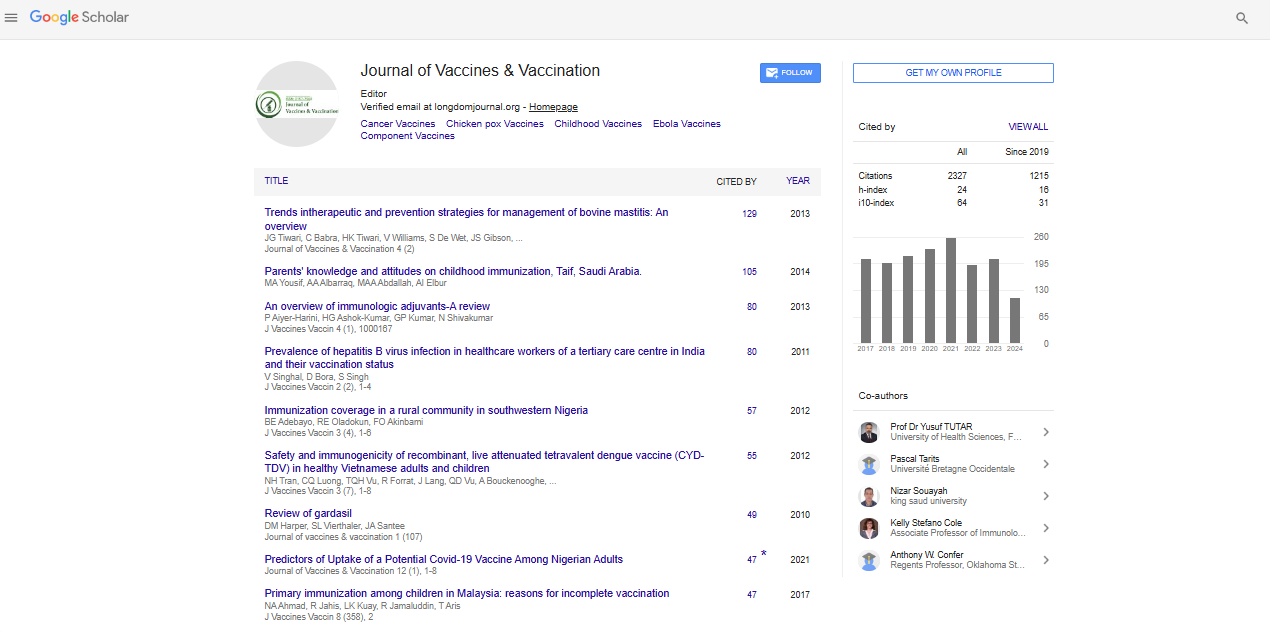
- Google Scholar
Useful Links
Share This Page
Open Access Journals
- Agri and Aquaculture
- Biochemistry
- Bioinformatics & Systems Biology
- Business & Management
- Chemistry
- Clinical Sciences
- Engineering
- Food & Nutrition
- General Science
- Genetics & Molecular Biology
- Immunology & Microbiology
- Medical Sciences
- Neuroscience & Psychology
- Nursing & Health Care
- Pharmaceutical Sciences
Commentary - (2025) Volume 16, Issue 9
Vaccinomics and the Evolution of Individualized Immunization Strategies
Einar Borud*Received: 29-Aug-2025, Manuscript No. JVV-25-31765; Editor assigned: 01-Sep-2025, Pre QC No. JVV-25-31765 (PQ); Reviewed: 15-Sep-2025, QC No. JVV-25-31765; Revised: 22-Sep-2025, Manuscript No. JVV-25-31765 (R); Published: 29-Sep-2025, DOI: 10.35248/2157-7560.25.16.623
Description
Vaccination has transformed public health by reducing the incidence of many infectious diseases that once caused widespread illness and death. Traditional vaccine development has largely relied on population-level observations, where vaccine effectiveness and safety are evaluated across large groups of people. Although this approach has achieved remarkable success, it has also revealed an important reality: individuals often respond differently to the same vaccine. Some develop strong and lasting immunity, while others generate weaker protection. Vaccinomics has emerged as a scientific discipline that seeks to understand these variations by examining the relationship between genetic factors and vaccine responses.
The concept of vaccinomics combines immunology, genetics, bioinformatics, and systems biology to evaluate why immune responses vary among individuals and populations. Rather than viewing vaccine recipients as a uniform group, this field examines biological characteristics that influence the development of protective immunity. Researchers investigate how genetic variations affect antibody production, cellular immune activity, and the duration of immune memory following vaccination.
One of the primary areas of interest within vaccinomics is the study of genetic polymorphisms. Small variations within genome sequences can influence how immune cells recognize vaccine antigens and initiate protective responses. Human leukocyte antigen genes are among the most widely studied genetic components in this area. These genes participate in antigen presentation, a process that allows immune cells to identify foreign substances and activate defence mechanisms. Variations in these genes may contribute to differences in vaccine effectiveness among individuals.
Research has demonstrated that responses to vaccines against diseases such as influenza, hepatitis B, measles, and COVID-19 can vary according to genetic profiles. Certain individuals produce high concentrations of protective antibodies after vaccination, whereas others display limited immune activation despite receiving identical doses. These observations have encouraged scientists to investigate molecular factors that influence vaccine outcomes. Understanding these factors may assist researchers in developing vaccination strategies that account for biological diversity.
Artificial intelligence and machine learning methods have also become valuable tools in this field. Computational models can examine vast quantities of biological information and identify patterns that may not be readily apparent through conventional analytical methods. These approaches assist researchers in predicting immune responses and identifying genetic signatures associated with vaccine efficacy. As computational resources continue to improve, predictive models may become increasingly accurate and clinically useful.
Vaccinomics extends beyond effectiveness and includes the study of vaccine safety. While vaccines are generally safe, adverse events occasionally occur in a small percentage of recipients. Genetic factors may influence susceptibility to certain reactions. By identifying biological markers associated with adverse outcomes, researchers may improve vaccine safety monitoring and support informed clinical decision-making. Such knowledge could contribute to more precise risk assessment while maintaining confidence in vaccination programs.
The growing availability of multi-omics technologies has expanded the scope of vaccinomics research. Scientists can now evaluate gene expression patterns, protein activity, metabolic changes, and immune cell behaviour following vaccination. These complementary datasets provide a broader understanding of how the body responds to immunization. Integrating information from multiple biological levels allows investigators to examine complex interactions that shape immune outcomes.
Another important application involves vaccine development for populations with distinct immunological characteristics. Elderly individuals often experience reduced immune responsiveness due to age-related changes in immune function. Similarly, newborns possess developing immune systems that respond differently to vaccines compared with adults. Vaccinomics may support the design of vaccination approaches better suited to these groups by identifying biological pathways associated with effective protection.
The field has also gained attention in the context of emerging infectious diseases. During outbreaks of novel pathogens, rapid vaccine development is often a public health priority. Vaccinomics can contribute valuable information regarding population susceptibility, immune variability, and potential determinants of vaccine performance. Such insights may support the development of vaccination programs that achieve broad protection while accounting for differences among recipients.
Conclusion
Vaccinomics represents an important intersection between genetics and immunology. By examining the biological factors that influence vaccine responses, this field contributes to a deeper understanding of protective immunity and population health. Continued research may improve vaccine development, strengthen safety assessments, and support more informed immunization strategies. As scientific knowledge expands, vaccinomics is expected to play an increasingly significant role in shaping the future of preventive medicine and infectious disease control.
Citation: Borud E (2025) Vaccinomics and the Evolution of Individualized Immunization Strategies. J Vaccines Vaccin. 16:623.
Copyright: © 2025 Borud E. This is an open access article distributed under the terms of the Creative Commons Attribution License, which permits unrestricted use, distribution and reproduction in any medium, provided the original author and source are credited.