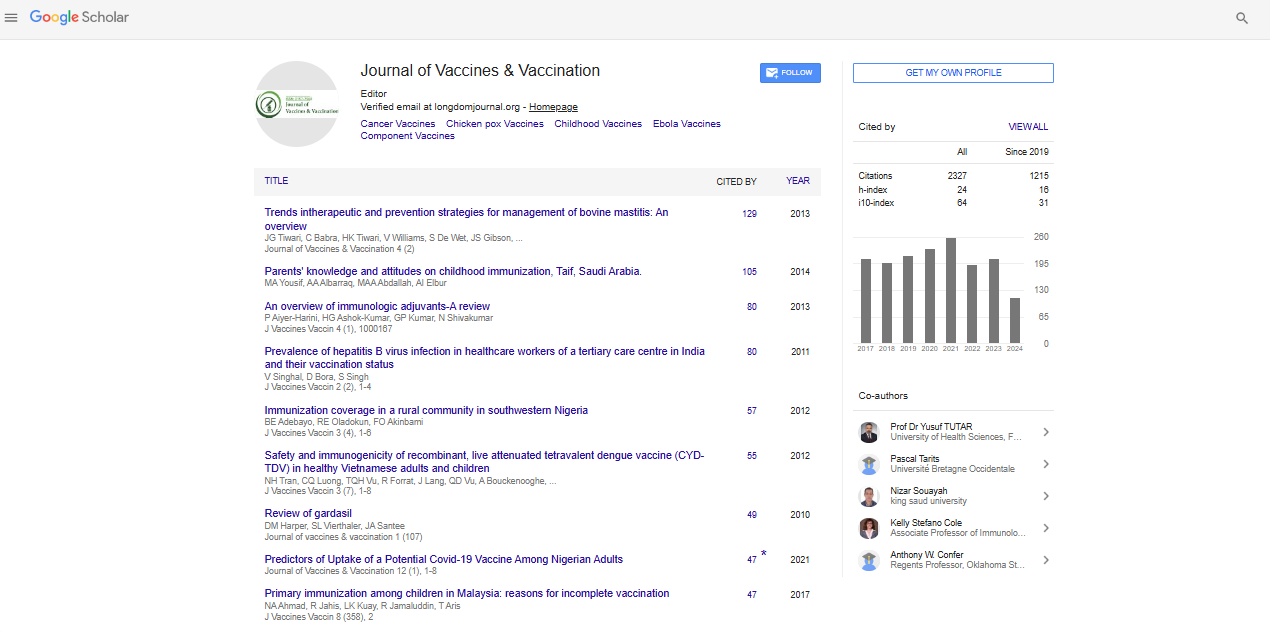
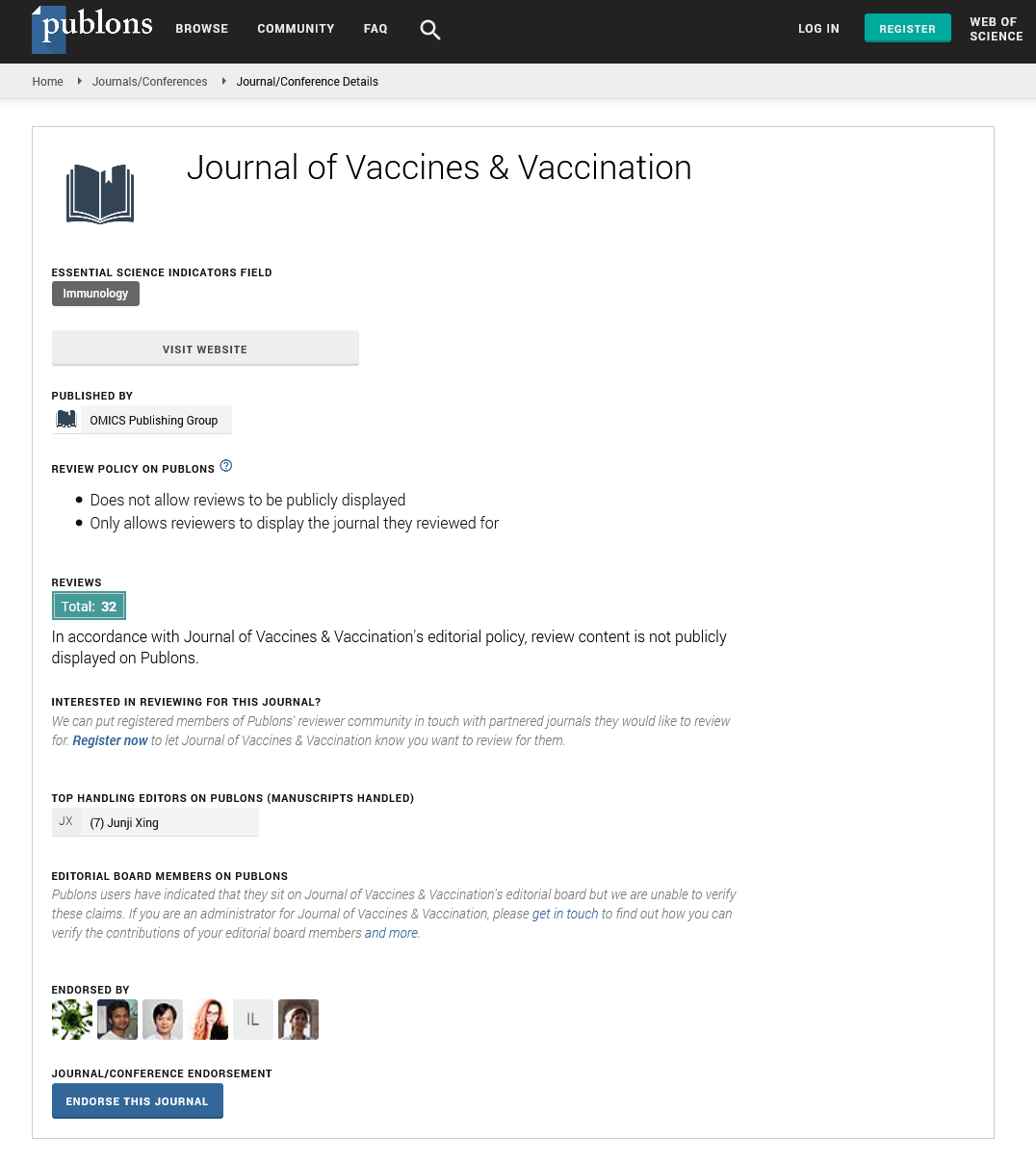

Indexed In
- Academic Journals Database
- Open J Gate
- Genamics JournalSeek
- JournalTOCs
- China National Knowledge Infrastructure (CNKI)
- Scimago
- Ulrich's Periodicals Directory
- RefSeek
- Hamdard University
- EBSCO A-Z
- OCLC- WorldCat
- Publons
- MIAR
- University Grants Commission
- Geneva Foundation for Medical Education and Research
- Euro Pub
- Google Scholar
Useful Links
Share This Page
Open Access Journals
- Agri and Aquaculture
- Biochemistry
- Bioinformatics & Systems Biology
- Business & Management
- Chemistry
- Clinical Sciences
- Engineering
- Food & Nutrition
- General Science
- Genetics & Molecular Biology
- Immunology & Microbiology
- Medical Sciences
- Neuroscience & Psychology
- Nursing & Health Care
- Pharmaceutical Sciences
Opinion Article - (2025) Volume 16, Issue 7
Vaccine-Induced Immune Responses in Modern Public Health
Matteo Vesperin*Received: 17-Jun-2025, Manuscript No. JVV-26-31574; Editor assigned: 19-Jun-2025, Pre QC No. JVV-26-31574; Reviewed: 03-Jul-2025, QC No. JVV-26-31574; Revised: 10-Jul-2025, Manuscript No. JVV-26-31574; Published: 17-Jul-2025, DOI: 10.35248/2157-7560.26.16.612
Abstract
Description
Vaccination has transformed public health by reducing the spread of infectious illnesses across different populations. The science behind vaccines is closely linked with immunology, which examines how the body identifies and reacts to harmful microorganisms. Vaccine immunology studies the interaction between vaccine components and immune cells, leading to defensive reactions that can prevent future infections. This area of research has contributed to safer medical interventions and improved disease control in many countries.
The human immune system contains several protective mechanisms that operate together to defend the body from bacteria, viruses, fungi and parasites. These defenses are generally divided into innate immunity and adaptive immunity. Innate immunity acts rapidly and includes physical barriers such as skin, along with white blood cells that attack invading organisms. Adaptive immunity develops more gradually and creates memory cells that can recognize a pathogen during future exposure. Vaccines mainly work by activating adaptive immune responses without causing severe disease.
When a vaccine enters the body, immune cells identify antigens present in the formulation. Antigens are molecules derived from pathogens that stimulate an immune reaction. Specialized cells known as antigen-presenting cells process these antigens and display them to lymphocytes. T lymphocytes and B lymphocytes then become activated. B cells produce antibodies that can attach to pathogens and block infection, while T cells help destroy infected cells and coordinate immune activity.
Different vaccine types stimulate immunity in distinct ways. Live attenuated vaccines contain weakened forms of microorganisms capable of triggering strong immune reactions. Inactivated vaccines use killed pathogens that cannot replicate but still encourage antibody production. Subunit vaccines include selected proteins or sugars from pathogens rather than the entire organism. Messenger Ribonucleic Acid (RNA) vaccines introduce genetic instructions that enable cells to temporarily produce antigenic proteins, leading to immune activation. Viral vector vaccines use modified viruses to deliver antigen-related genetic material into host cells.
One important aspect of vaccine immunology is immunological memory. After vaccination, memory B cells and memory T cells remain in the body for extended periods. These cells allow rapid recognition of pathogens if exposure occurs later. The secondary immune response generated by memory cells is usually stronger and faster than the initial response. This mechanism helps vaccinated individuals resist severe illness or avoid infection altogether.
Adjuvants are another important element in many vaccines. These substances enhance immune reactions and improve vaccine performance. Aluminum salts have been widely used as adjuvants for decades. Newer adjuvants may stimulate pattern recognition receptors on immune cells, leading to increased cytokine production and stronger antibody responses. The use of adjuvants can reduce the amount of antigen required in each dose while improving long-term protection.
Age influences vaccine-induced immunity. Infants have developing immune systems that respond differently from adults. Older adults may experience weaker immune reactions because immune function declines with age. Scientists continue to examine methods that improve vaccine effectiveness across age groups. Additional doses, modified adjuvants or adjusted formulations are sometimes used to increase protection in populations with reduced immune responsiveness.
Genetics also contributes to variations in vaccine responses. Some individuals generate stronger antibody levels than others after receiving the same vaccine. Genetic differences can affect antigen recognition, cytokine signaling and immune cell activation. Environmental conditions, nutritional status, stress and previous infections may further influence vaccine outcomes. Understanding these factors may support the development of vaccines suitable for broader populations.
Conclusion
Vaccine immunology continues to influence medicine, disease prevention and population health. Scientific progress in immune system research has strengthened understanding of how vaccines generate protection and reduce infectious disease burden. Continued international collaboration among immunologists, clinicians, epidemiologists and biotechnology experts will remain important for responding to future health challenges and improving global vaccination strategies. Vaccine immunology continues to influence medicine, disease prevention and population health. Scientific progress in immune system research has strengthened understanding of how vaccines generate protection and reduce infectious disease burden. Continued international collaboration among immunologists, clinicians, epidemiologists and biotechnology experts will remain important for responding to future health challenges and improving global vaccination strategies.
Citation: Vesperin M (2025). Vaccine-Induced Immune Responses in Modern Public Health. J Vaccines Vaccin. 16:612.
Copyright: © 2025 Vesperin M. This is an open access article distributed under the terms of the Creative Commons Attribution License, which permits unrestricted use, distribution and reproduction in any medium, provided the original author and source are credited.