
Indexed In
- Academic Journals Database
- Open J Gate
- Genamics JournalSeek
- JournalTOCs
- China National Knowledge Infrastructure (CNKI)
- Scimago
- Ulrich's Periodicals Directory
- RefSeek
- Hamdard University
- EBSCO A-Z
- OCLC- WorldCat
- Publons
- MIAR
- University Grants Commission
- Geneva Foundation for Medical Education and Research
- Euro Pub
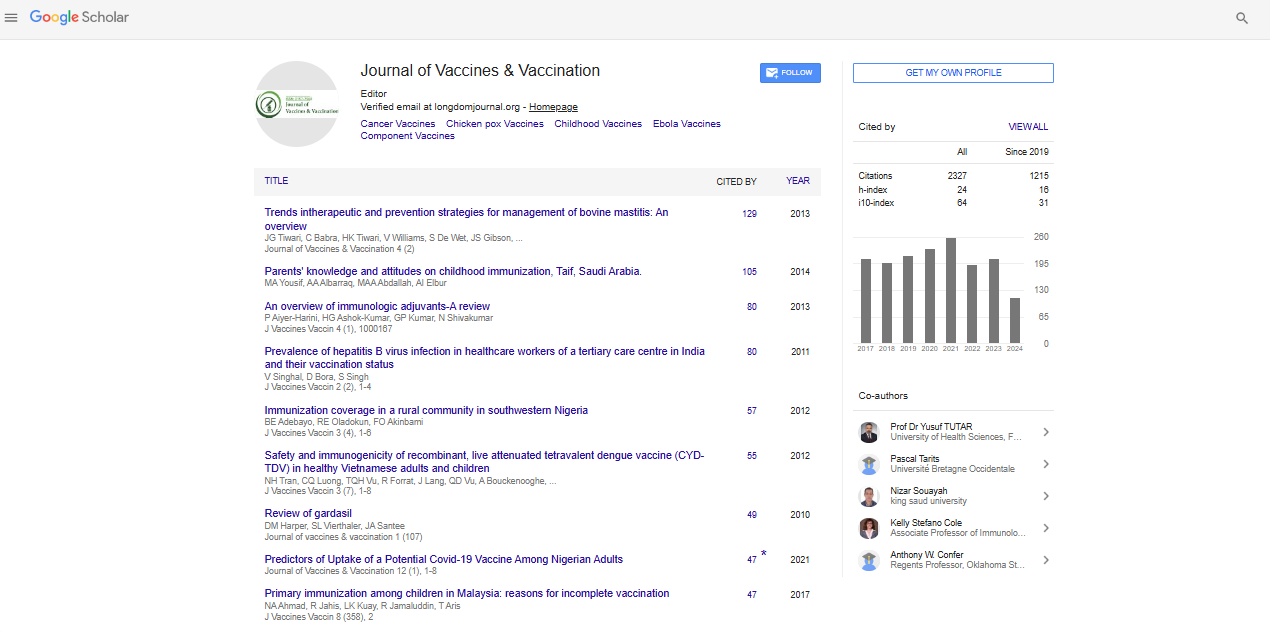
- Google Scholar
Useful Links
Share This Page
Open Access Journals
- Agri and Aquaculture
- Biochemistry
- Bioinformatics & Systems Biology
- Business & Management
- Chemistry
- Clinical Sciences
- Engineering
- Food & Nutrition
- General Science
- Genetics & Molecular Biology
- Immunology & Microbiology
- Medical Sciences
- Neuroscience & Psychology
- Nursing & Health Care
- Pharmaceutical Sciences
Short Communication - (2025) Volume 16, Issue 9
Vaccine Safety Monitoring in Contemporary Immunization Programs
Ove Frid*Received: 29-Aug-2025, Manuscript No. JVV-25-31764; Editor assigned: 01-Sep-2025, Pre QC No. JVV-25-31764 (PQ); Reviewed: 15-Sep-2025, QC No. JVV-25-31764; Revised: 22-Sep-2025, Manuscript No. JVV-25-31764 (R); Published: 29-Sep-2025, DOI: 10.35248/2157-7560.25.16.622
Description
Vaccination has transformed public health by reducing the occurrence of many infectious diseases that once caused significant illness and death. While vaccines undergo extensive evaluation before approval, continuous observation after they are introduced into the population remains an essential component of immunization programs. Vaccine safety monitoring refers to the systematic collection, analysis, and interpretation of information related to adverse events that may occur following vaccination. This ongoing process helps health professionals identify uncommon reactions, assess possible associations, and maintain confidence in immunization activities.
Before a vaccine becomes available for public use, it passes through several stages of laboratory testing and clinical studies involving volunteers. These studies provide valuable information regarding effectiveness and safety. However, even large clinical trials may not detect very rare events because the number of participants is limited compared with the millions of individuals who may eventually receive the vaccine. For this reason, observation continues after authorization so that additional information can be gathered from broader populations representing different age groups, health conditions, and demographic backgrounds.
One of the primary methods used in vaccine safety monitoring is passive reporting. In this approach, healthcare professionals, vaccine recipients, caregivers, and manufacturers can report adverse events that occur after vaccination. Reports are collected in national or regional databases where specialists review the information. These reports do not automatically indicate that a vaccine caused a particular event. Instead, they provide signals that may require further investigation. By examining patterns among numerous reports, experts can determine whether additional studies are needed.
Active surveillance provides another valuable source of information. Unlike passive systems, active surveillance seeks data through organized follow-up activities. Healthcare records, hospital databases, and immunization registries may be analyzed to identify adverse events among vaccinated individuals. This approach allows researchers to compare rates of specific medical conditions between vaccinated and unvaccinated groups, helping to determine whether observed events occur more frequently than expected.
Modern technology has significantly improved vaccine safety monitoring efforts. Electronic health records enable rapid access to large volumes of patient information while maintaining privacy protections. Advanced statistical methods assist researchers in identifying unusual patterns that may warrant examination. Digital reporting platforms have also simplified the submission of adverse event reports, increasing participation from healthcare providers and members of the public.
An important aspect of vaccine safety monitoring involves distinguishing coincidence from causation. Since millions of people receive vaccines every year, some medical events will naturally occur shortly after vaccination without being related to the vaccine itself. For example, illnesses, hospitalizations, or chronic disease diagnoses may happen during the same period that an individual receives a vaccine. Careful scientific evaluation is necessary to determine whether a genuine association exists. Researchers consider factors such as timing, biological plausibility, consistency across studies, and the frequency of events in comparison with expected background rates.
International cooperation plays a major role in vaccine safety activities. Health agencies, research institutions, regulatory authorities, and global organizations regularly exchange information regarding adverse events and emerging safety signals. Shared databases and collaborative investigations allow experts to evaluate findings from multiple countries. This broader perspective increases the ability to detect rare events that may not be apparent within a single population.
Conclusion
Vaccine safety monitoring serves as an ongoing scientific process that extends well beyond the initial approval of a vaccine. Through passive reporting systems, active surveillance programs, epidemiological studies, and international cooperation, health authorities continuously evaluate vaccine performance in realworld settings. These efforts support informed public health decisions, strengthen confidence in immunization programs, and contribute to the safe administration of vaccines across diverse populations. Continuous observation, careful analysis, and transparent communication remain essential elements in maintaining effective vaccination programs and protecting communities from infectious diseases.
References
- Sophian A, Sulanjari D, Harumanto A. Global implications of recent changes in US vaccine policy: ethical and trust challenges for immunization programs. Vaccine. 2026;77:128393.
- Chandra D, Yadav AK, Jain V. An integrated framework for managing vaccine supply chain shortages in the child immunization program of India. Comput. Ind. Eng. 2025;205:111149.
- He Q, Chen Y, Li Y, Cheng X, Li X, Wu M, et al. Single immunization of non-adjuvant recombinant TTFC-mi3 nanoparticle vaccine elicited a rapid and potent protective immunity against tetanus. Vaccine. 2024;42(20):125976.
- Ali I, Sharif A, Qamar A, Sadique S, Elbarazi I. Navigating through HPV stigma: an intersectional lens on community engagement for vaccine acceptance in Pakistan. Lancet Reg Health Southeast Asia. 2026;46.
- Savage RD, Bell CA, Righolt CH, Wilkinson K, Schwartz KL, Chen C, et al. A multisite study of pertussis vaccine effectiveness by time since last vaccine dose from three Canadian provinces: A Canadian Immunization Research Network study. Vaccine. 2021;39(20):2772-2779.
- Psihogios A, Bota AB, Mithani SS, Greyson D, Zhu DT, Fung SG, et al. A scoping review of active, participant-centred, digital adverse events following immunization (AEFI) surveillance: a Canadian immunization research network study. Vaccine. 2022;40(31):4065-4080. [Crossref]
- Habash N, Abash I. Hepatitis B Vaccine: Time to Rethink Our Correlate of Protection. In Mayo Clinic Proceedings 2026. Mayo Clin Proc.
[Crossref] [Google scholar] [Pubmed]
- Nyambayo PP, Gold MS, Mehta UC, Clarke S, Manyevere R, Chirinabe L, et al. Efficacy and feasibility of SMS m-Health for the detection of adverse events following immunisation (AEFIs) in resource-limited setting-The Zimbabwe stimulated telephone assisted rapid safety surveillance (Zm-STARSS) randomised control trial. Vaccine. 2023 Oct 26;41(45):6700-6709.
- Rositch AF, Liu T, Chao C, Moran M, Beavis AL. Levels of parental human papillomavirus vaccine hesitancy and their reasons for not intending to vaccinate: insights from the 2019 National Immunization Survey-Teen. J Adolesc Health. 2022;71(1):39-46.
- Lam JY, Yuen CK, Cheung SK, Cheung PH, Yuen KY, Kok KH. Nasal RNA-scaffold-protein vaccine protects mice from human H5N1 clade 2.3. 4.4 b virus lethal infection and safeguards against vaccine-unmatched viruses. EBioMedicine. 2026;126.
Citation: Frid O (2025) Vaccine Safety Monitoring in Contemporary Immunization Programs. J Vaccines Vaccin. 16:622.
Copyright: © 2025 Frid O. This is an open access article distributed under the terms of the Creative Commons Attribution License, which permits unrestricted use, distribution and reproduction in any medium, provided the original author and source are credited.