
Indexed In
- Academic Journals Database
- Open J Gate
- Genamics JournalSeek
- JournalTOCs
- China National Knowledge Infrastructure (CNKI)
- Scimago
- Ulrich's Periodicals Directory
- RefSeek
- Hamdard University
- EBSCO A-Z
- OCLC- WorldCat
- Publons
- MIAR
- University Grants Commission
- Geneva Foundation for Medical Education and Research
- Euro Pub
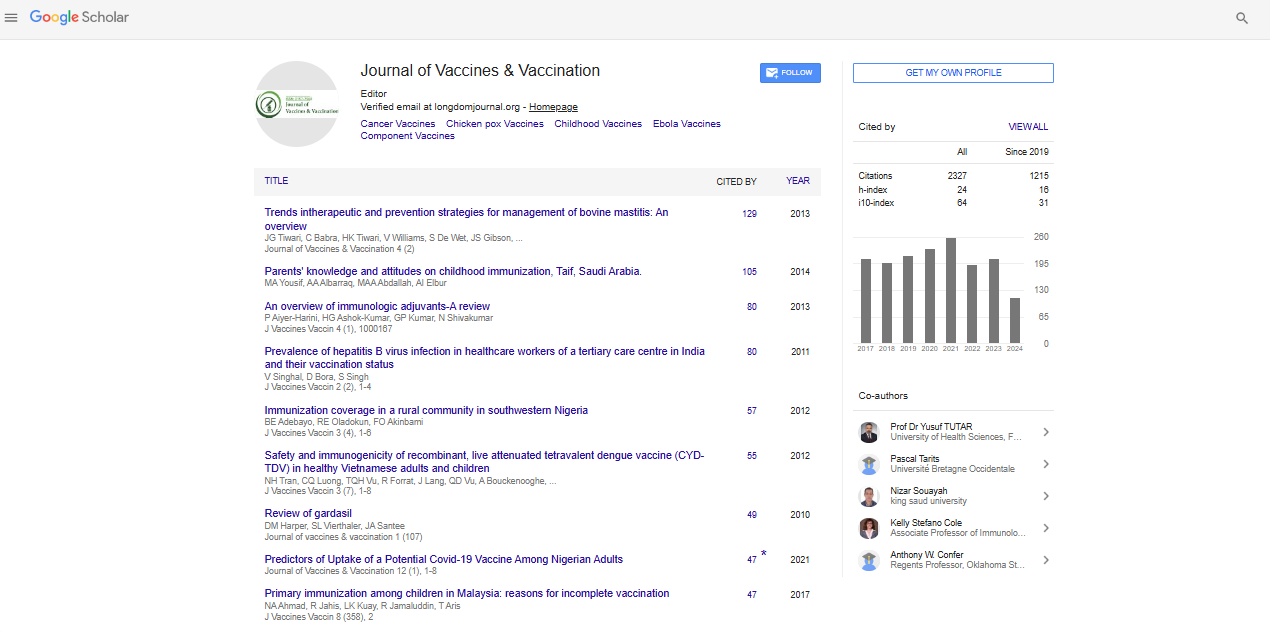
- Google Scholar
Useful Links
Share This Page
Open Access Journals
- Agri and Aquaculture
- Biochemistry
- Bioinformatics & Systems Biology
- Business & Management
- Chemistry
- Clinical Sciences
- Engineering
- Food & Nutrition
- General Science
- Genetics & Molecular Biology
- Immunology & Microbiology
- Medical Sciences
- Neuroscience & Psychology
- Nursing & Health Care
- Pharmaceutical Sciences
Short Communication - (2025) Volume 16, Issue 11
Vaccination Advances and Their Role in Strengthening Global Health Protection
Michael Anderson*Received: 29-Oct-2025, Manuscript No. JVV-26-31817; Editor assigned: 31-Oct-2025, Pre QC No. JVV-26-31817; Reviewed: 14-Nov-2025, QC No. JVV-26-31817; Revised: 21-Nov-2025, Manuscript No. JVV-26-31817; Published: 28-Nov-2025, DOI: 10.35248/2157-7560.25.16.632
Description
Vaccination has transformed the landscape of public health by reducing the burden of infectious diseases and protecting populations from preventable illnesses. It is a biological process that prepares the immune system to recognize and fight specific pathogens through the introduction of vaccine components, such as weakened, inactive, or modified forms of microorganisms or their parts. This approach allows the body to develop immune memory without causing the disease itself, enabling faster and more effective responses during future exposure. Early vaccination efforts, particularly against smallpox, demonstrated the possibility of controlling widespread infections through preventive methods. Over time, advances in immunology, molecular biology and biotechnology have contributed to the creation of vaccines against numerous viral and bacterial diseases. Immunization programs have played an important role in decreasing disease transmission, preventing complications and improving survival rates across different age groups.
Vaccines stimulate the immune system by introducing antigens that resemble disease-causing organisms. These antigens activate immune cells, leading to the production of antibodies and memory cells. When an individual encounters the actual pathogen later, the immune system can respond more rapidly and efficiently. This mechanism provides protection not only to vaccinated individuals but also contributes to community-level immunity by reducing the spread of infections. The importance of vaccination extends beyond individual health. Widespread immunization supports public health systems by lowering the number of severe infections and reducing pressure on healthcare resources. Diseases that once caused large-scale outbreaks can be controlled or eliminated through consistent vaccination coverage.
Vaccination across different stages of life helps maintain protection against various health threats. Childhood vaccines protect developing immune systems from serious infections, while adult vaccination programs help prevent diseases that may occur later in life. Booster doses are often recommended because immunity against certain infections may decrease over time. Special vaccination strategies are also designed for individuals with specific health conditions, occupational risks, or increased exposure possibilities. The safety evaluation of vaccines involves extensive research, clinical studies and continuous monitoring after approval. Regulatory authorities assess vaccine quality, effectiveness and safety before they become available for public use. Like other medical interventions, vaccines may produce temporary reactions such as mild fever, soreness, or fatigue as the immune system responds. These effects are generally short-lived and are monitored through established safety systems.
Vaccine research continues to evolve with improvements in technology and scientific understanding. New vaccine platforms, including advanced genetic and protein-based approaches, have expanded possibilities for addressing emerging infectious diseases. Researchers are also exploring methods to improve vaccine accessibility, storage, delivery systems and effectiveness for different populations around the world. These developments support faster responses during outbreaks and improve preventive healthcare approaches. Public awareness and accurate health information influence vaccination acceptance and participation. Clear communication from healthcare professionals helps individuals understand vaccine benefits, schedules and safety information. Community involvement, education programs and reliable healthcare services support successful immunization efforts.
Vaccination has also contributed to improving life expectancy by preventing illnesses that previously caused widespread mortality. Many infectious diseases that affected millions of people have become less common due to successful immunization campaigns. The protection offered by vaccines allows communities to maintain healthier environments and reduces the possibility of disease outbreaks. Continued monitoring and research help ensure that vaccination strategies remain effective as pathogens change over time. The future of vaccination includes innovative approaches aimed at creating more effective, accessible and adaptable vaccines. Scientists are investigating new technologies that may allow vaccines to be developed more quickly and delivered more efficiently. These advancements may support better responses to existing diseases as well as newly emerging health threats.
Conclusion
vaccination represents a powerful medical advancement that protects individuals and populations by strengthening immune defense against infectious diseases. Through scientific progress, organized immunization programs and public cooperation, vaccines continue to contribute to longer and healthier lives worldwide. The continued improvement of vaccine technologies provides new opportunities to control emerging infections and enhance disease prevention strategies. Expanding access to safe and effective vaccines remains an important goal for healthcare systems across the globe. Collaboration among researchers, healthcare providers and communities supports the ongoing success of immunization efforts. Vaccination will continue to serve as a foundation for maintaining public health and reducing the impact of infectious diseases in future generations.References
- Abel MK, Mann AK, Sonawane K, Kapp DS, Deshmukh AA, Chan JK. Prevalence of oral human papillomavirus infection by number of vaccine doses among US adults. JNCI Cancer Spectra 2021;5(6): pkab086.
- Ahrlund-Richter A, Cheng L, Hu YO, Svensson M, Pennhag AA, Ursu RG, et al. Changes in cervical Human Papillomavirus (HPV) prevalence at a youth clinic in Stockholm, Sweden, a decade after the introduction of the HPV vaccine. Front Cell Infect Microbiol.2019; 9:59.
- Ali H, Guy RJ, Wand H, Read TR, Regan DG, Grulich AE, et al. Decline in in-patient treatments of genital warts among young Australians following the national HPV vaccination program. BMC Infect Dis. 2013; 13:140.
- Andrews N, Stowe J, Miller E. No increased risk of Guillain-Barre syndrome after human papilloma virus vaccine: a self-controlled case-series study in England. Vaccine. 2017;35(13):1729-1732.
- Arnheim-Dahlström L, Pasternak B, Svanstrom H, Sparen P, Hviid A. Autoimmune, neurological and venous thromboembolic adverse events after immunisation of adolescent girls with quadrivalent human papillomavirus vaccine in Denmark and Sweden: cohort study. BMJ. 2013;347(7930): f5906.
- Ba DM, McCall-Hosenfeld JS, Ssentongo P, Chinchilli VM, Agbese E, Liu G, et al. Cervical cancer screening varies by HPV vaccination status among a national cohort of privately insured young women in the United States 2006-2016. Medicine. 2021;100(41): e27457.
- Baandrup L, Dehlendorff C, Kjaer SK. One-dose human papillomavirus vaccination and the risk of genital warts: a Danish nationwide population-based study. Clin Infect Dis. 2021;73(9): E3220-E3226.
- Cheong D, Song JY. Pneumococcal disease burden in high-risk older adults: exploring impact of comorbidities, long-term care facilities, antibiotic resistance and immunization policies through a narrative literature review. Hum Vaccin Immunother. 2024;20(1):2429235.
- Kruckow KL, Zhao K, Bowdish DME, Orihuela CJ. Acute organ injury and long-term sequelae of severe pneumococcal infections. Pneumonia (Nathan). 2023;15(1):5.
- Darkwah S, Kotey FCN, Ahenkorah J, Adutwum-Ofosu KK, Donkor ES. Sepsis-related lung injury and the complication of extrapulmonary pneumococcal pneumonia. Diseases. 2024;12(4):4.
Citation: Anderson M (2025). Vaccination Advances and Their Role in Strengthening Global Health Protection. J Vaccines Vaccin. 16:632.
Copyright: © 2025 Anderson M. This is an open access article distributed under the terms of the Creative Commons Attribution License, which permits unrestricted use, distribution and reproduction in any medium, provided the original author and source are credited