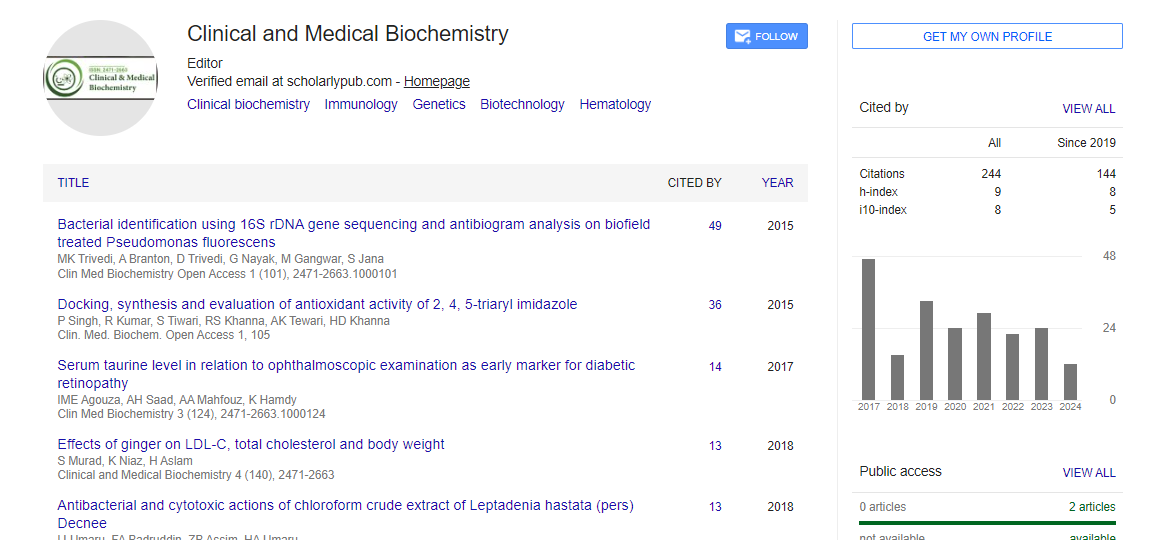

Indexed In
- RefSeek
- Directory of Research Journal Indexing (DRJI)
- Hamdard University
- EBSCO A-Z
- OCLC- WorldCat
- Scholarsteer
- Publons
- Euro Pub
- Google Scholar
Useful Links
Share This Page
Journal Flyer
Open Access Journals
- Agri and Aquaculture
- Biochemistry
- Bioinformatics & Systems Biology
- Business & Management
- Chemistry
- Clinical Sciences
- Engineering
- Food & Nutrition
- General Science
- Genetics & Molecular Biology
- Immunology & Microbiology
- Medical Sciences
- Neuroscience & Psychology
- Nursing & Health Care
- Pharmaceutical Sciences
Opinion Article - (2025) Volume 11, Issue 3
Understanding the Identification, Quantification, and Significance of Analytes in Modern Analytical Chemistry
Markus Schneider*Received: 31-Jul-2025, Manuscript No. CMBO-25-30257; Editor assigned: 04-Aug-2025, Pre QC No. CMBO-25-30257; Reviewed: 18-Aug-2025, QC No. CMBO-25-30257; Revised: 25-Aug-2025, Manuscript No. CMBO-25-30257; Published: 01-Sep-2025, DOI: 10.35841/2471-2663.25.11.265
Description
Analytes are substances or chemical components in a sample that are measured or quantified during analytical testing. In analytical chemistry, the identification and quantification of analytes are central to understanding the composition, purity and behavior of materials in various physical, chemical and biological systems. Whether in pharmaceuticals, environmental monitoring, food quality assessment, or medical diagnostics, analytes serve as the measurable indicators that reveal essential information about the sample’s properties and characteristics. The accuracy and reliability of analytical measurements depend on the ability to detect and quantify these analytes precisely, often at trace or ultra-trace levels, making their study fundamental to modern scientific investigation and technological advancement.
The process of analyzing an analyte begins with sampling, followed by sample preparation, detection and data interpretation. The nature of the analyte-whether it is organic, inorganic, biological, or complex-determines the analytical approach employed. For instance, in chemical analysis, an analyte could be a metal ion, an organic molecule, or a gas, while in biological studies, it might be a protein, enzyme, or metabolite. The analytical goal can vary from simple detection to highly precise quantification, depending on the purpose of the study. The development of methods that provide accurate, reproducible and sensitive measurements has driven much of the progress in analytical chemistry over the past century.
Quantitative analysis of analytes relies on a variety of instrumental and non-instrumental methods. Classical techniques such as titration, gravimetry and colorimetry still find use in basic laboratories, offering simple yet effective means for measuring concentrations. However, the demand for higher precision, lower detection limits and faster results has led to the widespread adoption of instrumental methods. Spectroscopic techniques-including Ultraviolet-Visible (UV-Vis) spectroscopy, atomic Absorption Spectroscopy (AAS) and Infrared (IR) spectroscopy-measure analyte interaction with electromagnetic radiation to determine concentration or structural information. Chromatographic techniques, such as Gas Chromatography (GC) and High-Performance Liquid Chromatography (HPLC), separate complex mixtures into individual components, allowing the detection of analytes even in trace amounts.
Mass Spectrometry (MS) has emerged as one of the most powerful tools for analyte identification and quantification, capable of providing molecular weight, structural information and concentration data simultaneously. When coupled with chromatographic systems, such as GC-MS or LC-MS, this technique allows unparalleled accuracy in detecting analytes in complex matrices. For example, in pharmaceutical analysis, mass spectrometry enables the detection of active ingredients, impurities and degradation products with exceptional precision. In environmental studies, it helps identify pollutants and toxins present in air, water and soil samples at parts-per-billion levels, highlighting the sensitivity and versatility of modern analytical instrumentation.
Electrochemical techniques are also widely used for analyte detection, especially for ions and biologically relevant molecules. Methods like potentiometry, voltammetry and amperometry measure electrical signals produced by redox reactions involving analytes. These methods are particularly useful in biosensing applications, where electrochemical sensors are designed to detect glucose, cholesterol, or other biomarkers in clinical diagnostics. The miniaturization and integration of electrochemical sensors into portable devices have revolutionized point-of-care testing and environmental field analysis, making analyte detection faster and more accessible.
The selection of an appropriate analytical method depends on several factors, including the chemical nature of the analyte, the complexity of the matrix, the required sensitivity and the available instrumentation. For instance, trace metal analysis in biological tissues requires techniques like Inductively Coupled Plasma Mass Spectrometry (ICP-MS), which offers extremely low detection limits and multi-element capability. On the other hand, organic pollutants in water are often analyzed using gas chromatography due to their volatility and compatibility with detector systems like flame ionization or electron capture detectors. Each method requires careful calibration using standards to ensure accuracy and reliability, with validation steps that assess linearity, precision, reproducibility and detection limits.
In biochemistry and medical diagnostics, analytes play a crucial role as biomarkers that reflect physiological or pathological states. Glucose, creatinine, hemoglobin and hormones are among the many biological analytes measured to assess health conditions. Clinical laboratories employ automated analyzers that perform high-throughput testing of blood, urine and tissue samples, providing rapid and reliable diagnostic results. Enzyme-Linked Immunosorbent Assays (ELISA), Polymerase Chain Reaction (PCR) and biosensors have become indispensable for detecting analytes related to infectious diseases, cancers and metabolic disorders. The precision of these methods directly influences medical decision-making, patient monitoring and treatment outcomes.
Environmental and agricultural sciences also rely heavily on analyte detection. Monitoring analytes such as heavy metals, pesticides and nitrates in soil and water ensures the safety of ecosystems and food supplies. Advances in portable analytical devices now allow on-site monitoring of environmental pollutants, reducing the need for complex laboratory procedures. These field-deployable instruments, equipped with miniaturized sensors and digital connectivity, contribute to real-time environmental surveillance and pollution control, offering a sustainable approach to managing natural resources.
In food science, the quantification of analytes determines the nutritional content, authenticity and safety of food products. Detection of contaminants like aflatoxins, preservatives and adulterants protects consumers from harmful substances and ensures regulatory compliance. Analytical methods such as Liquid Chromatography-Tandem Mass Spectrometry (LCMS/MS) and near-infrared spectroscopy have become standard tools for food quality assessment. Similarly, in the pharmaceutical industry, analyte analysis ensures that drugs meet rigorous standards for composition, potency and purity, safeguarding public health.
The accuracy of analyte measurement depends greatly on instrument calibration and quality control. Calibration involves using known standards to establish a relationship between instrument response and analyte concentration. Regular calibration and maintenance of instruments minimize errors and ensure data integrity. Quality assurance procedures, including method validation and proficiency testing, are essential components of analytical laboratories to guarantee reliable results that meet international standards.
The future of analyte detection and quantification lies in the integration of advanced technologies such as nanotechnology, artificial intelligence and microfluidics. Nanomaterials are enhancing sensor sensitivity, allowing detection at the molecular level, while AI algorithms assist in pattern recognition and data interpretation. Microfluidic lab-on-a-chip systems are capable of performing complex analyses on miniature platforms, reducing sample volumes and processing times. These innovations are reshaping analytical science, making analyte detection faster, more precise and more environmentally friendly.
Conclusion
In conclusion, analytes represent the core focus of analytical chemistry and related disciplines. Their detection and quantification provide critical insights into chemical, biological, environmental and industrial systems. The evolution of analytical techniques-from classical methods to cutting-edge instrumentation-has enhanced our ability to measure analytes with remarkable accuracy and efficiency. As science continues to advance, the study of analytes will remain fundamental to discovery, diagnosis and technological innovation, underscoring their vital role in understanding and improving the world around us.
Citation: Schneider M (2025). Understanding the Identification, Quantification and Significance of Analytes in Modern Analytical Chemistry. Clin Med Bio Chem. 11:265.
Copyright: © 2025 Schneider M. This is an open-access article distributed under the terms of the Creative Commons Attribution License, which permits unrestricted use, distribution and reproduction in any medium, provided the original author and source are credited.