
Indexed In
- Academic Journals Database
- Open J Gate
- Genamics JournalSeek
- JournalTOCs
- China National Knowledge Infrastructure (CNKI)
- Scimago
- Ulrich's Periodicals Directory
- RefSeek
- Hamdard University
- EBSCO A-Z
- OCLC- WorldCat
- Publons
- MIAR
- University Grants Commission
- Geneva Foundation for Medical Education and Research
- Euro Pub
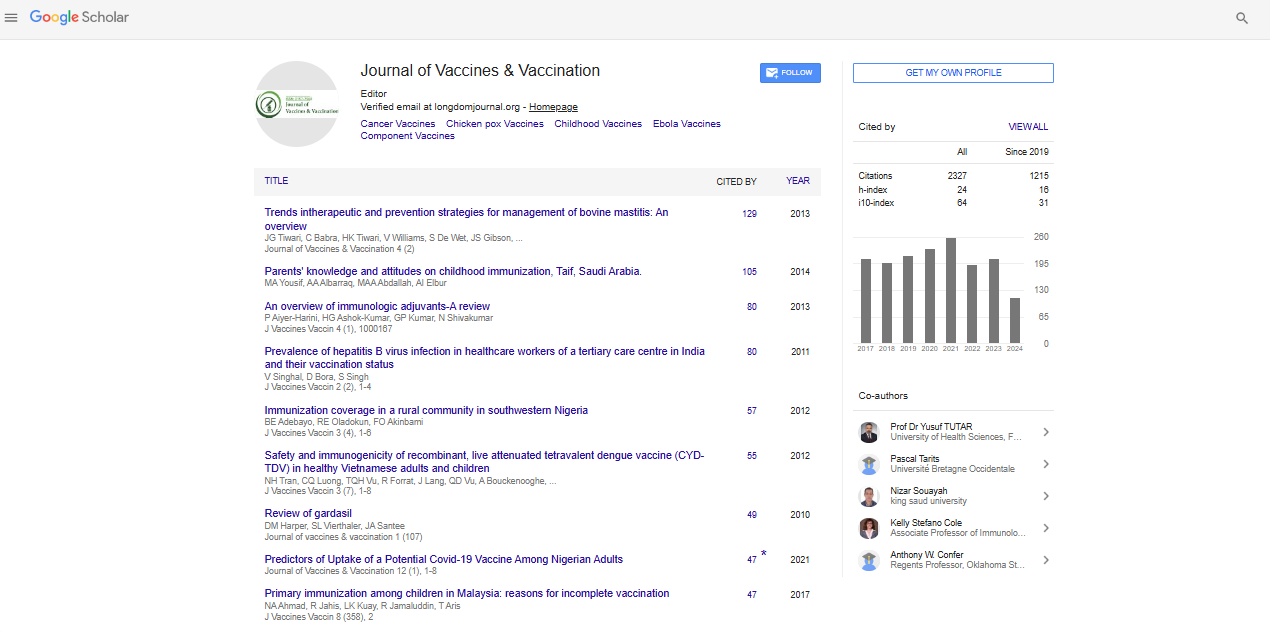
- Google Scholar
Useful Links
Share This Page
Open Access Journals
- Agri and Aquaculture
- Biochemistry
- Bioinformatics & Systems Biology
- Business & Management
- Chemistry
- Clinical Sciences
- Engineering
- Food & Nutrition
- General Science
- Genetics & Molecular Biology
- Immunology & Microbiology
- Medical Sciences
- Neuroscience & Psychology
- Nursing & Health Care
- Pharmaceutical Sciences
Commentary - (2025) Volume 16, Issue 4
Understanding the Global Landscape of Vaccines Epidemiology and Its Public Health Implications
Maria Gonzalez*Received: 01-Apr-2025, Manuscript No. JVV-25-30311; Editor assigned: 03-Apr-2025, Pre QC No. JVV-25-30311; Reviewed: 17-Apr-2025, QC No. JVV-25-30311; Revised: 24-Apr-2025, Manuscript No. JVV-25-30311; Published: 01-May-2025, DOI: 10.35248/2157-7560.25.16.598
Description
Vaccines epidemiology represents an essential branch of public health science that studies the distribution, patterns and determinants of vaccine-preventable diseases within populations. It plays a crucial role in understanding how vaccines influence the spread and control of infectious diseases and provides evidence-based insights for policymaking and health planning. Over the decades, vaccines have drastically reduced global morbidity and mortality associated with diseases such as smallpox, polio, measles and diphtheria. The systematic application of epidemiological methods to vaccine development and deployment has not only enhanced disease control strategies but also guided the evolution of immunization programs tailored to the unique needs of diverse populations.
At its core, vaccine epidemiology focuses on the interaction between the pathogen, the host and the environment. By analyzing the transmission dynamics of infectious agents, epidemiologists can predict outbreaks, evaluate vaccine effectiveness and identify vulnerable populations requiring targeted interventions. The concept of herd immunity is central to this discipline, emphasizing that when a sufficient proportion of individuals are immunized, the overall community gains protection, reducing disease transmission even among the unvaccinated. This principle has been demonstrated repeatedly, from the eradication of smallpox to the near-elimination of poliovirus in most regions of the world. The ability to model and monitor such phenomena through epidemiological data allows global health agencies to make timely and effective decisions.
The application of vaccines epidemiology extends beyond routine immunization coverage. It encompasses vaccine safety surveillance, post-marketing evaluation and assessment of longterm population-level effects. Adverse Events Following Immunization (AEFIs) are meticulously tracked through epidemiological studies to ensure public confidence and regulatory compliance. Modern epidemiological tools, such as cohort studies, case-control studies and mathematical modeling, enable researchers to quantify vaccine performance and identify potential risk factors associated with waning immunity or breakthrough infections. In recent years, the use of real-time data analytics and digital health technologies has revolutionized vaccine monitoring, allowing near-instant assessment of vaccine uptake, hesitancy trends and outbreak prediction.
Global vaccine epidemiology has faced several challenges, particularly in the context of emerging infectious diseases and pandemics. The COVID-19 crisis underscored the importance of rapid epidemiological assessment in vaccine development, distribution and monitoring. Epidemiologists played a pivotal role in designing trials, determining priority groups and assessing vaccine effectiveness against evolving viral variants. The integration of genomic surveillance with vaccine epidemiology further enhanced the understanding of viral mutation patterns and guided the updating of vaccine formulations. Similarly, influenza vaccine strategies rely on continuous epidemiological tracking to match circulating strains with vaccine components, demonstrating the indispensable nature of this scientific discipline in global health security.
Despite remarkable progress, disparities in vaccine access and coverage continue to persist. Low- and middle-income countries often face challenges such as inadequate cold chain infrastructure, limited health workforce capacity and sociocultural barriers to immunization. Vaccine epidemiology provides essential insights into these inequalities by identifying high-risk zones and populations with low immunization rates. Through data-driven interventions, global initiatives such as Gavi, the Vaccine Alliance and the World Health Organization’s (WHO) Expanded Programme on Immunization (EPI) have made substantial efforts to close immunization gaps. However, the success of such programs depends heavily on local epidemiological surveillance systems that can generate accurate and timely data. Strengthening these systems remains a top priority for achieving universal vaccine coverage.
Another critical dimension of vaccines epidemiology involves addressing vaccine hesitancy and misinformation. In many regions, public apprehension toward vaccines has been fueled by false narratives, leading to outbreaks of previously controlled diseases like measles. Epidemiologists study behavioral trends, risk perception and communication patterns to develop strategies that enhance vaccine acceptance. By correlating vaccination data with demographic and psychological variables, researchers can design culturally sensitive awareness campaigns that build trust and counter misinformation. The success of vaccination programs, therefore, depends not only on biological efficacy but also on the social and epidemiological understanding of public attitudes.
Furthermore, vaccine epidemiology extends into the realm of non-communicable diseases and therapeutic vaccines. As research advances, vaccines are being developed for conditions such as cervical cancer, which is preventable through immunization against Human Papillomavirus (HPV). Epidemiological studies track the reduction of cancer incidence and mortality following large-scale HPV vaccination programs, showcasing how vaccines can transform global disease landscapes beyond traditional infectious disease control. The ongoing monitoring of vaccine impact over time helps refine immunization schedules and optimize resource allocation in healthcare systems.
The future of vaccine epidemiology is intertwined with advances in technology, data science and global collaboration. Artificial intelligence and machine learning are being integrated into surveillance systems to predict outbreaks and evaluate vaccine performance in real time. The availability of big data from electronic health records and mobile applications has enhanced the precision of epidemiological models, enabling targeted interventions and rapid response strategies. Moreover, the establishment of global data-sharing networks promotes transparency and accelerates scientific discovery.
Conclusion
In conclusion, vaccines epidemiology stands as a cornerstone of preventive medicine and global public health. It provides the scientific framework for designing, implementing and evaluating vaccination programs that save millions of lives each year. By merging biological, social and technological insights, the discipline continues to adapt to emerging health threats and changing population dynamics. As the world moves toward a future of precision public health, vaccine epidemiology will remain at the forefront of efforts to ensure equitable access, safety and effectiveness of vaccines for all, reinforcing humanity’s collective resilience against disease.
Citation: Gonzalez M (2025) Understanding the Global Landscape of Vaccines Epidemiology and Its Public Health Implications. J Vaccines Vaccin. 16:598.
Copyright: © 2025 Gonzalez M. This is an open access article distributed under the terms of the Creative Commons Attribution License, which permits unrestricted use, distribution and reproduction in any medium, provided the original author and source are credited.