
Indexed In
- Open J Gate
- Genamics JournalSeek
- Academic Keys
- ResearchBible
- Cosmos IF
- Access to Global Online Research in Agriculture (AGORA)
- Electronic Journals Library
- RefSeek
- Directory of Research Journal Indexing (DRJI)
- Hamdard University
- EBSCO A-Z
- OCLC- WorldCat
- Scholarsteer
- SWB online catalog
- Virtual Library of Biology (vifabio)
- Publons
- Geneva Foundation for Medical Education and Research
- Euro Pub
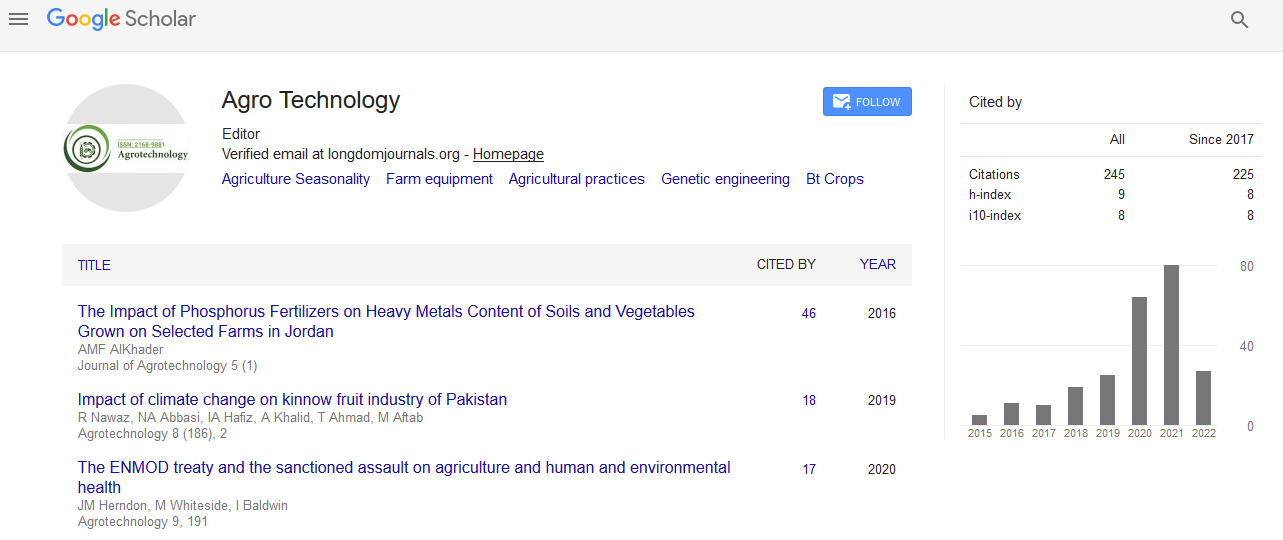
- Google Scholar
Useful Links
Share This Page
Journal Flyer
Open Access Journals
- Agri and Aquaculture
- Biochemistry
- Bioinformatics & Systems Biology
- Business & Management
- Chemistry
- Clinical Sciences
- Engineering
- Food & Nutrition
- General Science
- Genetics & Molecular Biology
- Immunology & Microbiology
- Medical Sciences
- Neuroscience & Psychology
- Nursing & Health Care
- Pharmaceutical Sciences
Perspective - (2025) Volume 14, Issue 2
Transforming Agriculture through Sustainable Resource Management
Weiye Ferre *Received: 30-May-2025 , Manuscript No. AGT-25-32422 ; Editor assigned: 02-Jun-2025 , Pre QC No. AGT-25-32422 (PQ); Reviewed: 16-Jun-2025 , QC No. AGT-25-32422; Revised: 23-Jun-2025 , Manuscript No. AGT-25-32422; Published: 30-Jun-2025 , DOI: 10.35248/2168-9891.25.14.410
Description
Agriculture has always been closely connected with natural resources, human development, and food security. As global populations continue to grow, agricultural systems face increasing pressure to produce sufficient food while protecting soil, water, and biodiversity. Sustainable resource management and responsible farming practices provide effective approaches for maintaining agricultural productivity while reducing environmental stress. These methods focus on improving farm efficiency, conserving natural resources, and supporting the wellbeing of farming communities.
Healthy soil is essential for successful crop production. Soil contains important nutrients, microorganisms, and organic matter that influence plant growth and agricultural output. Sustainable farming practices such as compost application, organic matter management, crop rotation, and conservation tillage help maintain soil structure and fertility. These approaches improve water retention, increase biological activity, and support healthier crop development. Protecting soil resources ensures that farmland remains productive for future agricultural activities.
Water conservation has become an important focus in modern agriculture due to increasing demand and changing environmental conditions. Efficient irrigation systems, including drip irrigation and precision water delivery methods, allow farmers to provide adequate moisture to crops while reducing unnecessary water consumption. Rainwater harvesting and improved water storage methods also support agricultural activities in areas affected by limited water availability. Responsible water management protects both farming operations and surrounding ecosystems.
Crop diversity plays an important role in sustainable agricultural systems. Growing different crops within farming areas helps improve soil conditions, reduces dependence on specific agricultural inputs, and supports ecological balance. Diverse cropping systems can reduce the spread of pests and diseases while providing farmers with multiple sources of income. The integration of trees, livestock, and crops through agroforestry and mixed farming systems further improves resource utilization and environmental protection.
Responsible use of fertilizers and pesticides is another important aspect of sustainable agriculture. Excessive application of chemical inputs may affect soil organisms, water quality, and surrounding habitats. Farmers are increasingly using integrated nutrient management and biological pest control methods to maintain crop health. Organic fertilizers, microbial products, and natural pest management techniques help reduce environmental impact while supporting agricultural productivity.
Modern technology is contributing to the improvement of sustainable farming practices. Digital agriculture tools, remote sensing systems, automated machinery, and data-based decisionmaking methods allow farmers to monitor field conditions more accurately. These technologies help determine appropriate amounts of water, fertilizers, and other inputs required for different areas of farmland. By improving resource efficiency, technology supports better farm management and reduces unnecessary consumption.
Renewable energy applications are also becoming more common in agricultural operations. Solar energy systems, energy-efficient equipment, and waste recycling methods help reduce reliance on traditional energy sources. Agricultural residues can be converted into useful materials such as compost, animal feed supplements, or bioenergy. These practices reduce waste and create additional benefits from materials generated during farming activities.
Sustainable agriculture also supports rural communities by promoting stable livelihoods and improving economic opportunities. Small and large-scale farmers require access to knowledge, training, financial support, and suitable markets to implement sustainable practices successfully. Agricultural education programs can provide farmers with information about resource conservation, climate adaptation, and improved production techniques. Strong connections between researchers, farmers, and agricultural organizations encourage knowledge exchange and practical solutions.
Climate-related challenges have increased the need for adaptable agricultural systems. Changes in temperature, rainfall patterns, and extreme weather events can influence crop growth and farm productivity. Sustainable farming methods help farmers prepare for these challenges through improved soil management, diversified production systems, and efficient resource utilization. These approaches allow agricultural systems to remain productive under changing environmental conditions.
Consumer choices also influence the development of sustainable food systems. Growing awareness about environmental protection and responsible food production encourages demand for products created through sustainable methods. Farmers who follow environmentally responsible practices can contribute to healthier food systems while meeting changing consumer expectations.
Conclusion
The future of farming depends on achieving a balance between agricultural development and resource conservation. Sustainable resource management provides a foundation for productive farms, healthy ecosystems, and stronger rural communities. Through continuous improvement and responsible decisionmaking, agriculture can continue to meet human needs while preserving the natural resources required for generations to come.
Citation: Ferre W (2025) Transforming Agriculture through Sustainable Resource Management and Responsible. Agrotechnology. 14:410.
Copyright: © 2025 Ferre W. This is an open access article distributed under the terms of the Creative Commons Attribution License, which permits unrestricted use, distribution, and reproduction in any medium, provided the original author and source are credited.