
Indexed In
- Academic Journals Database
- Open J Gate
- Genamics JournalSeek
- JournalTOCs
- China National Knowledge Infrastructure (CNKI)
- Scimago
- Ulrich's Periodicals Directory
- RefSeek
- Hamdard University
- EBSCO A-Z
- OCLC- WorldCat
- Publons
- MIAR
- University Grants Commission
- Geneva Foundation for Medical Education and Research
- Euro Pub
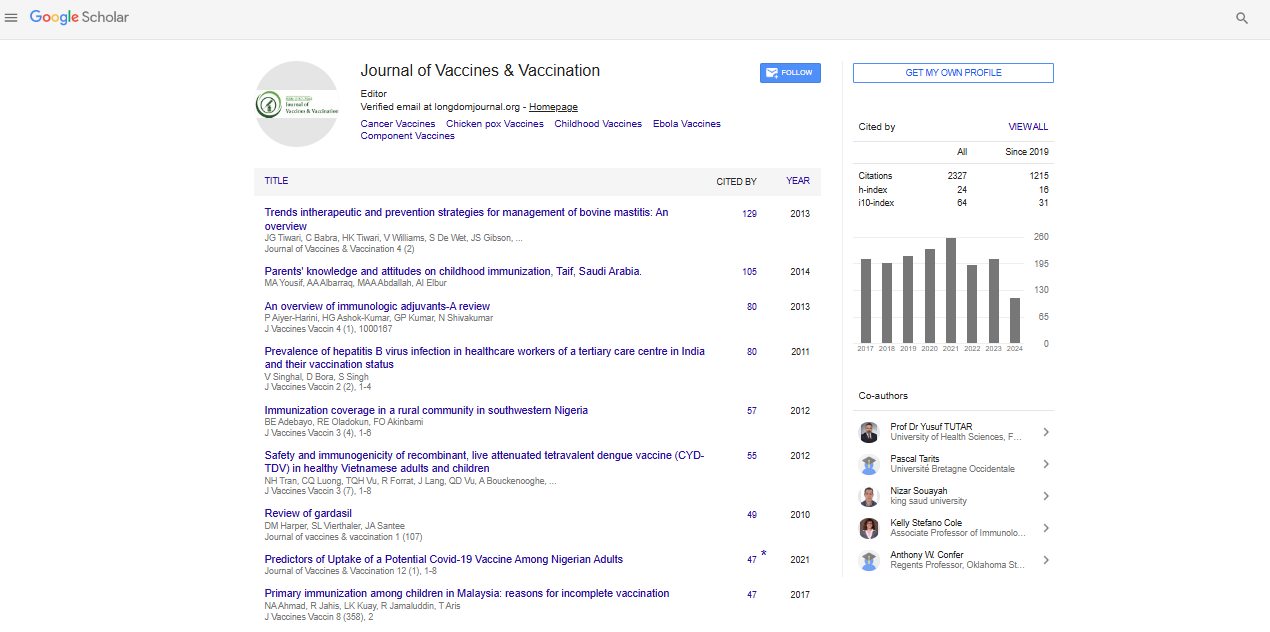
- Google Scholar
Useful Links
Share This Page
Open Access Journals
- Agri and Aquaculture
- Biochemistry
- Bioinformatics & Systems Biology
- Business & Management
- Chemistry
- Clinical Sciences
- Engineering
- Food & Nutrition
- General Science
- Genetics & Molecular Biology
- Immunology & Microbiology
- Medical Sciences
- Neuroscience & Psychology
- Nursing & Health Care
- Pharmaceutical Sciences
Opinion - (2026) Volume 17, Issue 6
Therapeutic Vaccines: Training the Immune System Against Established Disease
Lina Moretti *Received: 20-May-2026 , Manuscript No. JVV-26-32844; Editor assigned: 22-May-2026 , Pre QC No. JVV-26-32844; Reviewed: 06-Jun-2026 , QC No. JVV-26-32844; Revised: 13-Jun-2026 , Manuscript No. JVV-26-32844; Published: 20-Jun-2026 , DOI: 10.35248/2157-7560.26.17.667
Description
Therapeutic vaccines are designed to stimulate an immune response after a disease has already developed. This differs from conventional preventive vaccination, which prepares the body before exposure to a pathogen. Therapeutic vaccination is being investigated for cancer, chronic viral infections, and several other persistent disorders in which the immune system needs additional antigen-specific stimulation.
The central concept is to present selected antigens to immune cells in a form that encourages an effective response. Depending on the disease, vaccine components may include proteins, peptides, Deoxyribonucleic Acid (DNA), messenger Ribonucleic Acid (RNA), viral vectors, bacterial vectors, or modified immune cells. These approaches can activate antigen-presenting cells and promote T-cell and antibody responses. For cancer, particular attention is given to tumor-associated antigens and neoantigens produced by mutations within malignant cells.
Cancer is one of the most actively studied areas of therapeutic vaccination. Unlike preventive vaccines against cancer-associated infections such as human papillomavirus and hepatitis B virus, therapeutic cancer vaccines are intended for people who already have malignant disease. Their objective is to help immune cells recognize abnormal cells and eliminate them while generating immune memory that may help control residual disease.
Several vaccine platforms are being evaluated in clinical research. Peptide vaccines contain selected fragments of disease-associated proteins, while DNA and messenger Ribonucleic Acid (mRNA) approaches provide genetic instructions that allow cells to produce the desired antigen. Dendritic-cell vaccines use immune cells that have been prepared outside the body and returned to the patient. Viral-vector systems can deliver antigenic material efficiently and stimulate cellular immunity. Each platform has different requirements for production, administration, stability, and patient selection.
Therapeutic vaccines can also be studied for chronic infections. Persistent infections such as hepatitis B, human papillomavirus, and Human Immunodeficiency Virus (HIV) can alter immune activity and remain difficult to eliminate with conventional treatment alone. Researchers are therefore examining vaccines that stimulate cellular immunity against infected cells. Studies involving Human Papillomavirus (HPV) and Epstein-Barr virusassociated diseases emphasize the importance of measuring cellmediated immune responses when evaluating these interventions.
Combining therapeutic vaccines with other treatments has become an important research strategy. In cancer, vaccines may be administered alongside immune checkpoint inhibitors, chemotherapy, radiation, or other immunotherapies. Such combinations are intended to increase immune recognition while reducing mechanisms that limit immune activity within tumors. Research has shown that vaccination alone may not always produce substantial tumor regression, making treatment combinations an important area of investigation.
Recent clinical developments have illustrated both the potential and limitations of this field. Personalized mRNA cancer vaccines combined with immune checkpoint inhibitors have produced encouraging results in some melanoma studies, while other vaccine trials have failed to demonstrate sufficient clinical benefit. These contrasting outcomes demonstrate why therapeutic vaccine development requires careful clinical testing across different diseases and patient groups.
Personalized vaccination is another developing approach. Tumor sequencing can identify mutations that are specific to an individual's cancer, allowing researchers to select several targets for a vaccine. This strategy may generate immune responses against multiple abnormal features of a tumor rather than relying on a single antigen. However, individualized manufacturing, laboratory analysis, treatment scheduling, and quality control can make these therapies complex to produce and administer.
Conclusion
Therapeutic vaccines therefore represent a distinct approach to immunotherapy in which vaccination is used after disease has appeared. Advances in antigen identification, genetic sequencing, vaccine delivery, and immune monitoring are expanding research possibilities. Continued clinical evaluation will determine which vaccine platforms and treatment combinations can provide meaningful benefits while maintaining acceptable safety and practical manufacturing requirements. Important challenges remain. Disease-associated antigens may vary among patients, tumors can contain different cell populations, and established disease may suppress immune activity. Researchers must also determine suitable doses, administration schedules, combinations, and biomarkers for identifying patients most likely to benefit.
Citation: Moretti L (2026). Therapeutic Vaccines: Training the Immune System Against Established Disease. 17:667.
Copyright: © 2026 Moretti L. This is an open access article distributed under the terms of the Creative Commons Attribution License, which permits unrestricted use, distribution and reproduction in any medium, provided the original author and source are credited.