
Indexed In
- Academic Journals Database
- Open J Gate
- Genamics JournalSeek
- JournalTOCs
- China National Knowledge Infrastructure (CNKI)
- Scimago
- Ulrich's Periodicals Directory
- RefSeek
- Hamdard University
- EBSCO A-Z
- OCLC- WorldCat
- Publons
- MIAR
- University Grants Commission
- Geneva Foundation for Medical Education and Research
- Euro Pub
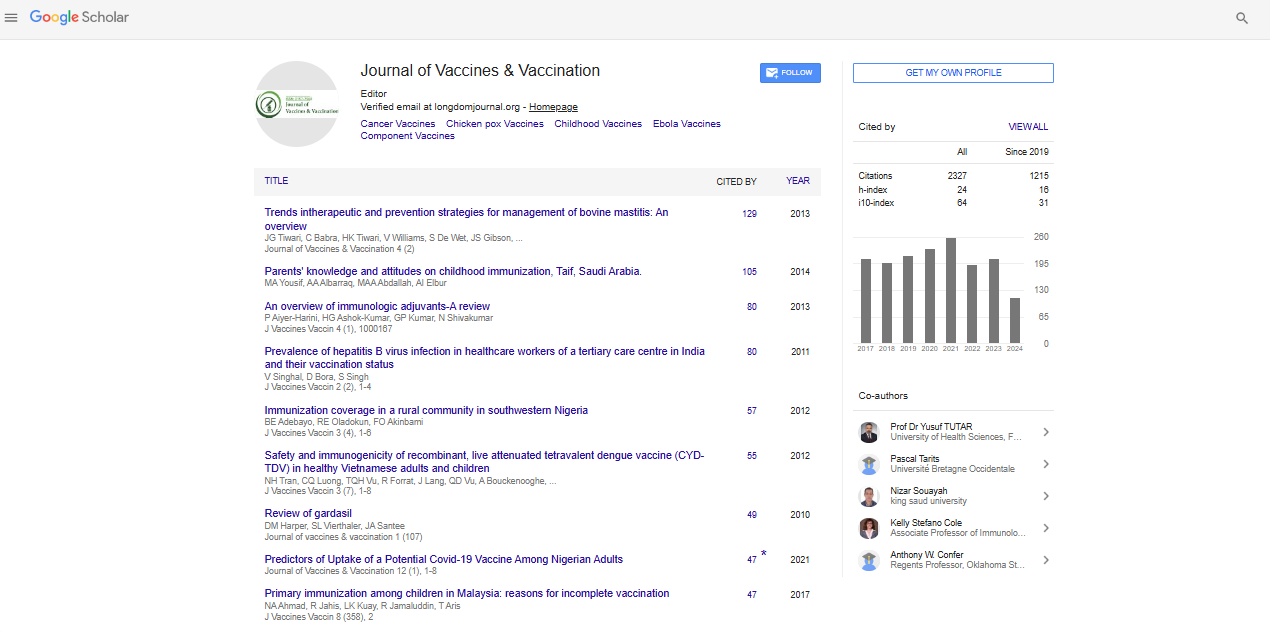
- Google Scholar
Useful Links
Share This Page
Open Access Journals
- Agri and Aquaculture
- Biochemistry
- Bioinformatics & Systems Biology
- Business & Management
- Chemistry
- Clinical Sciences
- Engineering
- Food & Nutrition
- General Science
- Genetics & Molecular Biology
- Immunology & Microbiology
- Medical Sciences
- Neuroscience & Psychology
- Nursing & Health Care
- Pharmaceutical Sciences
Short Communication - (2025) Volume 16, Issue 5
The Role of Regulatory Agencies in Safeguarding Vaccine Quality and Effectiveness
Lars Petersen*Received: 01-May-2025, Manuscript No. JVV-25-31076; Editor assigned: 05-May-2025, Pre QC No. JVV-25-31076 (PQ); Reviewed: 19-May-2025, QC No. JVV-25-31076; Revised: 26-May-2025, Manuscript No. JVV-25-31076 (R); Published: 30-May-2025, DOI: 10.35248/2157-7560.25.16.606
Description
The development and deployment of vaccines are among the most impactful achievements in public health, yet they require navigating highly complex regulatory frameworks. Regulatory oversight ensures that vaccines meet stringent standards for safety, efficacy and quality before they are administered to populations. These processes are essential for maintaining public trust, preventing adverse events and ensuring that immunization programs achieve their intended health outcomes. Understanding the landscape of vaccine regulatory issues provides insight into the scientific, ethical and legal considerations that guide global immunization efforts. Vaccine regulation begins at the preclinical stage, where laboratory and animal studies generate data on immune response, safety and potential efficacy. Regulatory authorities review these findings before granting permission to initiate clinical trials. Preclinical evaluation ensures that only candidates with a reasonable expectation of safety and biological activity proceed to testing in human volunteers. This early oversight helps protect participants and strengthens the scientific foundation for subsequent clinical evaluation. Clinical trials are divided into multiple phases, each subject to regulatory review. Phase one trials assess safety and dosage in a small group of healthy volunteers. Phase two trials evaluate immunogenicity and refine dosage, while phase three trials examine efficacy and monitor for adverse effects in large populations. Regulators require detailed protocols, ethical approvals and continuous monitoring throughout all phases. Compliance with these requirements ensures that the risks to participants are minimized and that data collected are robust and reliable.
One of the critical challenges in vaccine regulation is balancing the need for rapid development with comprehensive safety assessment. During public health emergencies, such as outbreaks of emerging infectious diseases, expedited regulatory pathways may be employed. Emergency use authorizations allow vaccines to be distributed based on preliminary data demonstrating strong immune responses and acceptable safety profiles. Even in these circumstances, regulators require continuous data collection and post authorization surveillance to identify rare or long term adverse effects. Global coordination of regulatory standards remains an ongoing issue. While organizations such as the World Health Organization (WHO) provide guidance on quality and safety, each country maintains its own regulatory agency and approval process. Variability in requirements can lead to differences in timelines, manufacturing standards and acceptable data endpoints. International collaboration and harmonization efforts aim to streamline approval processes without compromising public safety. Initiatives to share data, recognize approvals across jurisdictions and establish common safety benchmarks help accelerate vaccine accessibility worldwide. Manufacturing oversight is another essential regulatory component. Vaccine production must adhere to Good Manufacturing Practice standards, ensuring consistency, purity and potency across batches. Regulators inspect production facilities, review quality control procedures and verify that storage and transportation requirements are met. Cold chain management, sterilization and contamination prevention are all tightly monitored to protect vaccine integrity.
Post market surveillance continues once a vaccine has been approved and deployed. Regulators monitor adverse events, track effectiveness and require manufacturers to report any issues promptly. Pharmacovigilance systems collect data from healthcare providers and patients, enabling rapid identification of rare side effects. This ongoing evaluation allows timely interventions, such as updated recommendations or additional safety measures and maintains public confidence in vaccination programs. Ethical considerations permeate vaccine regulatory processes. Informed consent, equitable access and transparency are fundamental principles. Regulatory agencies ensure that clinical trials are conducted with respect for human rights and that vulnerable populations receive appropriate protections. Additionally, communication about regulatory decisions and the basis for approval is critical in countering misinformation and reinforcing public trust. Emerging technologies, such as genetic vaccines and recombinant vectors, present novel regulatory challenges. These platforms require specialized evaluation methods to assess genetic stability, immune response and long term safety. Regulators must adapt to rapidly evolving science while maintaining rigorous standards. Continuous professional training, scientific consultation and expert advisory panels support informed decision making. Public perception and trust are closely linked to regulatory performance. A transparent and scientifically rigorous regulatory process reassures communities that vaccines are safe and effective. Conversely, perceived shortcuts or inconsistent oversight can fuel hesitancy and reduce immunization coverage. Authorities must therefore engage in clear, evidence based communication, providing accessible explanations of regulatory criteria, review procedures and ongoing safety monitoring.
Conclusion
In conclusion, vaccine regulatory issues encompass a complex interplay of scientific, ethical and legal factors designed to protect public health. From preclinical evaluation through post market surveillance, regulatory frameworks ensure that vaccines meet high standards of safety, efficacy and quality. Global harmonization, emergency authorization mechanisms and ongoing monitoring contribute to the timely and reliable availability of vaccines. As new technologies emerge and infectious disease threats evolve, strong regulatory systems will remain essential to maintaining trust, safeguarding populations and advancing the success of global immunization programs.
References
- Sáfadi MA. The importance of immunization as a public health instrument. J Pediatr. 2023;99: S1-3.
[CrossRef] [Google Scholar] [PubMed]
- Modlin JF, Schaffner W, Orenstein W, Bandyopadhyay AS. Triumphs of immunization. J Infect Dis. 2021;224: S307-8.
[CrossRef] [Google Scholar] [PubMed]
- Decouttere C, De Boeck K, Vandaele N. Advancing sustainable development goals through immunization: a literature review. Global health. 2021;17(1):95.
[CrossRef] [Google Scholar] [PubMed]
- Sapienza A, Falcone R. The role of trust in COVID-19 vaccine acceptance: considerations from a systematic review. Int J Environ Res Public Health. 2022;20(1):665.
[CrossRef] [Google Scholar] [PubMed]
- Apeagyei AE, Bisignano C, Elliott H, Hay SI, Lidral-Porter B, et al. Tracking development assistance for health, 1990–2030: historical trends, recent cuts, and outlook. Lancet. 2025;406(10501):337-348.
[CrossRef] [Google Scholar] [PubMed]
- Chan MX, Khoo YK, Stona AC, Joarder T, de Alwis R,et al . Regulatory factors affecting sustainable vaccine manufacturing in Asia and the Pacific: Findings from a scoping review and semi-structured interviews. Vaccine. 2025; 63:127607.
[CrossRef] [Google Scholar] [PubMed]
- Blaschke TF, Lumpkin M, Hartman D. The World Health Organization prequalification program and clinical pharmacology in 2030. CPT.2019;107(1):68.
[CrossRef] [Google Scholar] [PubMed]
- Suphap S, Luksameesate P, Nerapusee O, Anantachoti P. A scoping review of authorisation pathway for COVID-19 vaccines among selected countries. J Pharm Policy Pract. 2025;18(1):2520861.
[CrossRef] [Google Scholar] [PubMed]
- Bujar M, McAuslane N, Liberti L. The qualitative value of facilitated regulatory pathways in Europe, USA, and Japan: benefits, barriers to utilization, and suggested solutions. Pharmaceutical medicine. 2021;35(2):113-122.
[CrossRef] [Google Scholar] [PubMed]
- Large K, Ruiz AA, Slovenski I, Vieira M, Moon S. The 30-year evolution of oral cholera vaccines: A case study of a collaborative network alternative innovation model. PLOS Glob Public Health. 2025;5(1): e0003599.
[CrossRef] [Google Scholar] [PubMed]
Citation: Petersen L (2025). The Role of Regulatory Agencies in Safeguarding Vaccine Quality and Effectiveness. J Vaccines Vaccin. 16:606.
Copyright: © 2025 Petersen L. This is an open access article distributed under the terms of the Creative Commons Attribution License, which permits unrestricted use, distribution and reproduction in any medium, provided the original author and source are credited.