
Indexed In
- Academic Journals Database
- Open J Gate
- Genamics JournalSeek
- JournalTOCs
- China National Knowledge Infrastructure (CNKI)
- Scimago
- Ulrich's Periodicals Directory
- RefSeek
- Hamdard University
- EBSCO A-Z
- OCLC- WorldCat
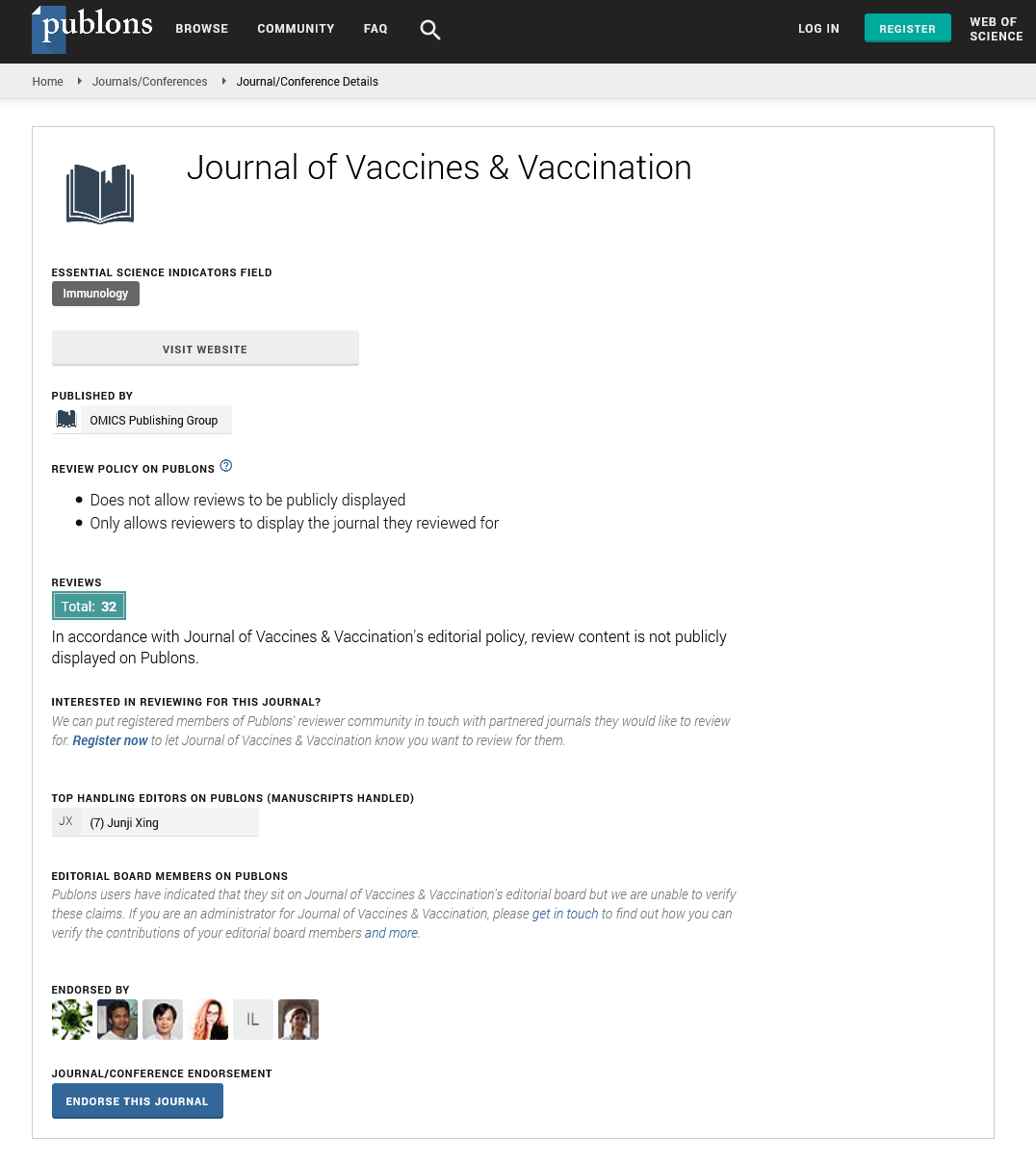
- Publons
- MIAR
- University Grants Commission
- Geneva Foundation for Medical Education and Research
- Euro Pub
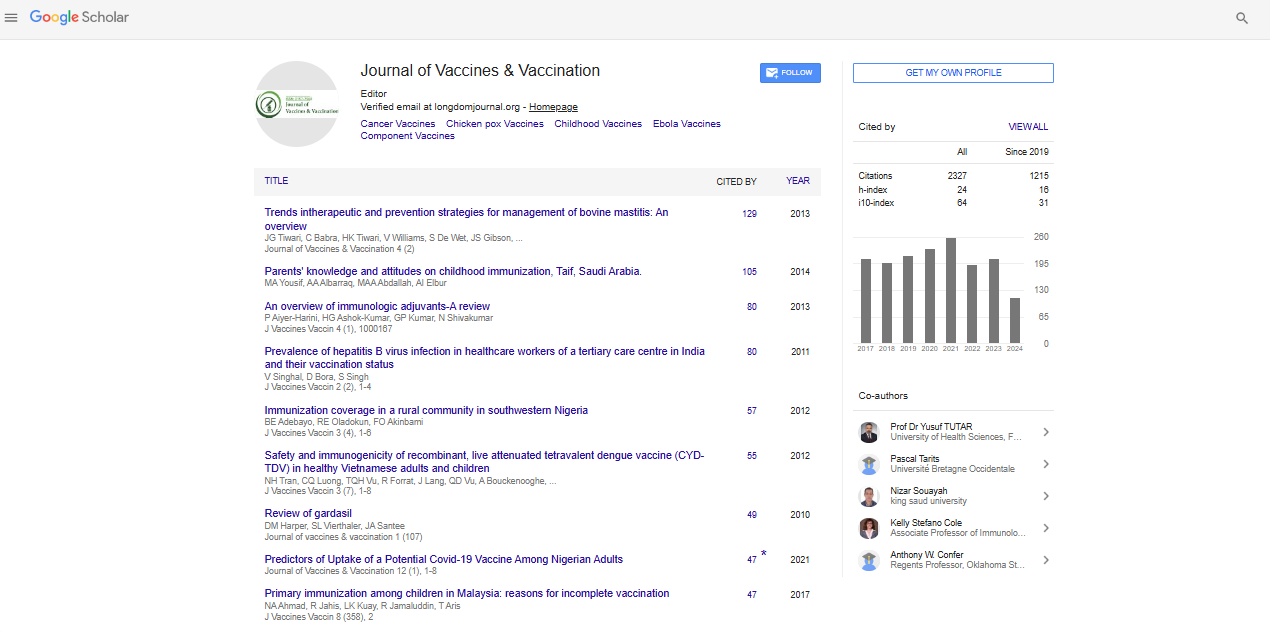
- Google Scholar
Useful Links
Share This Page
Open Access Journals
- Agri and Aquaculture
- Biochemistry
- Bioinformatics & Systems Biology
- Business & Management
- Chemistry
- Clinical Sciences
- Engineering
- Food & Nutrition
- General Science
- Genetics & Molecular Biology
- Immunology & Microbiology
- Medical Sciences
- Neuroscience & Psychology
- Nursing & Health Care
- Pharmaceutical Sciences
Opinion Article - (2025) Volume 16, Issue 4
The Global Importance and Long-Term Impact of Childhood Vaccines on Public Health
Daniel Okafor*Received: 01-Apr-2025, Manuscript No. JVV-25-30314; Editor assigned: 03-Apr-2025, Pre QC No. JVV-25-30314; Reviewed: 17-Apr-2025, QC No. JVV-25-30314; Revised: 24-Apr-2025, Manuscript No. JVV-25-30314; Published: 01-May-2025, DOI: 10.35248/2157-7560.25.16.601
Description
Childhood vaccines are among the most effective public health interventions ever developed, saving millions of lives each year and preventing the spread of infectious diseases that once caused widespread mortality and suffering. Immunization during early childhood is essential not only for the protection of individual children but also for the creation of community-wide immunity that helps protect those who cannot be vaccinated due to medical reasons. Over the decades, vaccination programs have transformed global health by drastically reducing or eliminating diseases such as smallpox, polio, diphtheria, pertussis and measles. The continuous development and implementation of safe, effective childhood vaccines represent one of humanity’s greatest achievements in medicine.
The principle of vaccination is based on training the immune system to recognize and fight pathogens without causing disease. By introducing harmless components or weakened forms of microbes, vaccines stimulate the body’s immune response, leading to the development of memory cells that provide longterm protection. In children, whose immune systems are still developing, vaccines play a particularly critical role in building this defense early in life. The first few years of childhood are a period of vulnerability, as exposure to infectious agents can lead to severe illness or death. Therefore, timely immunization following established schedules ensures optimal protection during this crucial developmental stage.
The World Health Organization (WHO) and national health authorities have established comprehensive childhood immunization programs that typically include vaccines against diseases such as tuberculosis, hepatitis B, polio, diphtheria, pertussis, tetanus, measles, mumps, rubella and Haemophilus influenzae type b. Newer vaccines targeting rotavirus, pneumococcal infections and human papillomavirus have also been incorporated in many countries, broadening protection against diseases that contribute significantly to global childhood morbidity and mortality. The introduction of combination vaccines has simplified immunization schedules by allowing protection against multiple diseases with a single injection, reducing discomfort and increasing compliance among parents and healthcare providers.
One of the most remarkable outcomes of childhood vaccination has been the near-eradication of polio, a disease that once paralyzed hundreds of thousands of children annually. Global collaboration through the global polio eradication initiative has brought the world to the brink of eliminating this crippling disease. Similarly, measles deaths have declined dramatically due to widespread vaccination campaigns, although periodic outbreaks still occur in regions with low vaccine coverage. These examples highlight both the power and the fragility of vaccine success. The persistence of diseases in unvaccinated populations demonstrates the need for continued vigilance, outreach and education to sustain progress.
Despite overwhelming scientific evidence supporting the safety and effectiveness of vaccines, vaccine hesitancy remains a significant challenge. Misinformation spread through social media, mistrust of healthcare systems and cultural beliefs contribute to declining vaccination rates in some regions. Vaccine hesitancy not only endangers unvaccinated children but also threatens herd immunity, allowing preventable diseases to resurface. Public health authorities and healthcare professionals must address this issue through transparent communication, community engagement and education. It is crucial to emphasize that the risks of vaccine-preventable diseases far outweigh the minimal risks associated with vaccination. Building public trust through evidence-based information and empathetic dialogue remains a cornerstone of successful immunization programs.
The benefits of childhood vaccination extend beyond disease prevention. By reducing the burden of illness, vaccines contribute to improved child survival rates, economic productivity and overall societal well-being. Families experience fewer hospitalizations and healthcare costs, while communities benefit from reduced disease transmission and healthier populations. Immunization also supports broader development goals, including poverty reduction and educational attainment, as healthy children are more likely to attend school and reach their full potential. Economists and global health experts recognize vaccination as one of the most cost-effective public health interventions, yielding high returns in terms of lives saved and resources conserved.
However, disparities in vaccine access persist between highincome and low-income countries. In some regions, logistical challenges such as inadequate cold chain systems, limited healthcare infrastructure and political instability hinder the delivery of vaccines to remote or underserved populations. International initiatives such as Gavi, the Vaccine Alliance, have played a crucial role in addressing these gaps by supporting immunization programs in low-resource settings. Through partnerships with governments, manufacturers and global health organizations, Gavi has helped ensure that millions of children in developing countries receive life-saving vaccines that would otherwise be unavailable. Continued investment in infrastructure, healthcare worker training and equitable distribution systems is essential to achieving universal immunization coverage.
The COVID-19 pandemic disrupted routine childhood vaccination efforts worldwide, leading to alarming declines in immunization rates and increasing the risk of disease resurgence. Lockdowns, supply chain interruptions and overwhelmed healthcare systems diverted resources away from immunization services. As the world recovers, restoring and strengthening routine vaccination programs has become a global priority. Integrating vaccination with broader healthcare services, improving digital record-keeping and expanding community outreach are key strategies to rebuild public confidence and coverage levels.
Scientific innovation continues to shape the future of childhood vaccines. Advances in biotechnology have led to the development of new vaccine platforms such as mRNA and viral vector technologies, which promise faster production and greater adaptability to emerging pathogens. Researchers are also working on needle-free delivery systems, thermostable formulations and combination vaccines that reduce the number of required doses. These innovations not only improve convenience and acceptance but also hold the potential to reach children in areas with limited healthcare access.
Conclusion
In conclusion, childhood vaccines are a cornerstone of modern public health, providing protection that lasts a lifetime and preventing the spread of dangerous infectious diseases. Their impact on global health cannot be overstated, as they have transformed childhood survival, strengthened healthcare systems and contributed to economic and social development worldwide. Continued commitment to vaccination programs, public education and equitable access is essential to sustaining these gains and achieving a healthier future for all children. As science advances and societies adapt, the promise of universal childhood immunization remains one of the most powerful testaments to human cooperation and medical progress.
Citation: Okafor D (2025) The Global Importance and Long-Term Impact of Childhood Vaccines on Public Health. J Vaccines Vaccin. 16:601.
Copyright: © 2025 Okafor D. This is an open access article distributed under the terms of the Creative Commons Attribution License, which permits unrestricted use, distribution and reproduction in any medium, provided the original author and source are credited.